



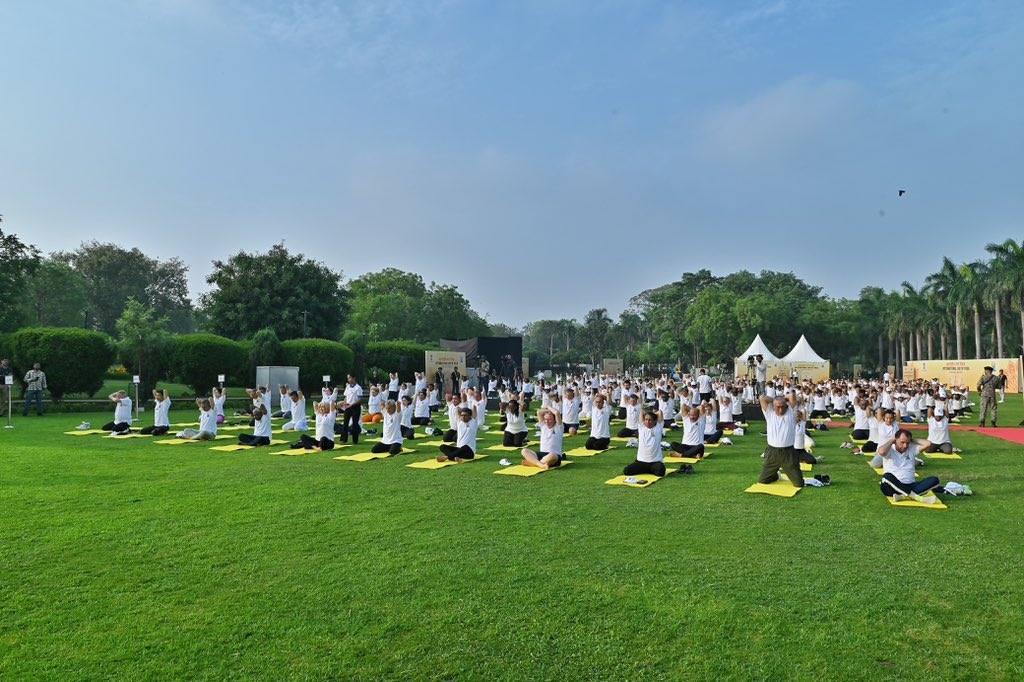
The success of yoga lies not just in how widely it is known, but in how personally it is used.
By Ravindra Garimella and Rajas Kolhatkar
Yoga has always meant different things to different people. For some, it’s a public celebration of wellness and shared culture. For others, it’s a quiet practice: physical, personal, and grounded in breath. What’s remarkable is how comfortably yoga holds both spaces at once. It exists in mass gatherings and silent rooms, in community centres and private corners of the day. Its strength lies in this duality: outward-facing, yet deeply internal. In India, that quiet adaptability has shaped how yoga has lived in the lives of its people, including those at the highest levels of public life.
Over the decades, several of India’s political leaders have quietly incorporated yoga into their lives, drawing on it as a source of steadiness and reflection. Jawaharlal Nehru wrote in The Discovery of India about the value of discipline, clarity, and self-restraint: virtues that lie at the heart of yoga’s philosophical core. A well-known photograph shows him mid-sirsasana, legs vertical, hands clasped. It wasn’t staged. It wasn’t a press event. It was a reflection of habit, not image.
Indira Gandhi’s association with yoga was more visible. She studied under Dhirendra Brahmachari, one of the most influential yoga teachers of the era. Brahmachari was not only her personal instructor but also a public figure in his own right, hosting Yogabhyas, a weekly program on Doordarshan, and promoting yoga in schools. Their relationship brought yoga into the national conversation, threading it through both private practice and public visibility.
Later, P.V. Narasimha Rao, remembered for his restraint and thoughtful decision-making, was known to practice yoga daily. Those who worked with him often remarked on his quiet composure. Atal Bihari Vajpayee, in his later years, sought therapeutic help from B.K.S. Iyengar for knee pain. Iyengar’s discipline, focused on precision and rehabilitation, matched Vajpayee’s introspective style. For these leaders, yoga was not part of a public narrative, but it held a steady place in their private routines.
My own (Ravindra’s) association with yoga began in school. At Mother’s International School in New Delhi, founded by the Sri Aurobindo Ashram, our mornings began with prayer and yogic breathing. At the time, it felt routine—just part of how the day began. But over the years, those practices revealed their weight. They helped build a rhythm that stayed with us long after we left the classroom. Friends still recall those early sessions: the silence, the slowness, the way we learned to begin not with urgency, but with awareness.
Yoga’s persistence in Indian life may lie in its elasticity. It fits itself to the individual. For some, it is spiritual. For others, therapeutic. It offers something to a schoolchild who cannot focus, to an athlete looking to recover, to a retiree seeking balance. Its power doesn’t rely on spectacle or faith—it lies in the experience of doing it: a few minutes of breathing, a posture that quiets pain, the deliberate act of slowing down in a world that demands speed.
READ: Indian embassy celebrates eighth International Yoga Day (June 20, 2022)
Its reach has grown quietly, both institutionally and informally. From school curricula and physiotherapy clinics to early morning park groups and workplace wellness sessions, yoga has found its way into structures without losing its softness. Its language has changed—sometimes medical, sometimes philosophical—but its core remains rooted in attention and breath. Television programs, local camps, and community instructors have helped it enter everyday vocabulary. “Take a deep breath” is no longer abstract advice; it’s an instruction rooted in practice.
In more recent years, the scale of its public presence has expanded. The current government has played a role in broadening yoga’s international profile, most notably through the UN-backed International Day of Yoga. These initiatives have helped bring yoga into new public settings—across schools, ministries, and cities. Yet for many, yoga still works best when returned to privately: outside the frame of celebration, in moments of stress, fatigue, or reflection. Its success lies not just in how widely it is known, but in how personally it is used.
Yoga does not ask for performance. It does not require proclamation. It offers presence: whether in a leader’s daily schedule, a student’s routine, or a patient’s recovery. Its appeal is not in ideology, but in how gently it asks people to return to themselves. That is perhaps why, across governments, cultures, and generations, it has remained steady. Unforced. Unhurried.
And maybe that’s the real endurance of yoga in India—it has never needed to declare itself. It is simply there, waiting for whoever might return to it.
(Ravindra Garimella is Secretary to the Leader of the Opposition in the Rajya Sabha, Parliament of India. Rajas Kolhatkar is a recent LAMP Fellow.)