


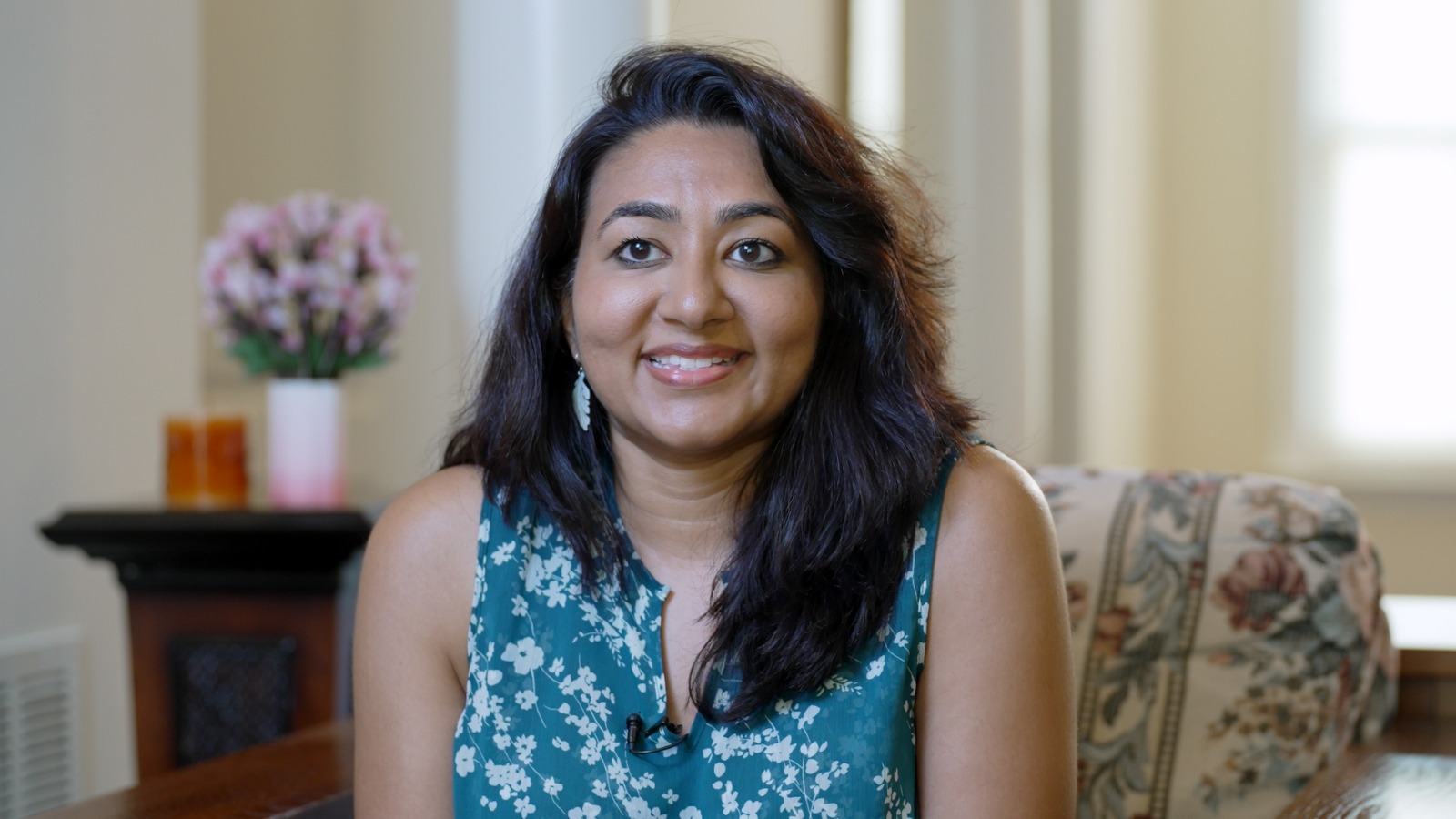
Dr. Priya Punnoose, a psychiatrist specializing in child, adolescent, and adult mental health, has announced her run for Virginia’s 11th Congressional District. She announced her candidacy for the June 28 Democratic primary, seeking to fill the seat left vacant by the death of Rep. Gerry Connolly on May 21.
A special election is set for September 9. Dr. Punnoose brings medical expertise, policy experience, and a strong record of community service to her campaign.
Punnoose began her medical journey at Virginia Commonwealth University, earning her undergraduate degree before completing medical school at the American University of Antigua. She trained in adult psychiatry at Central Michigan University and went on to complete a fellowship in child and adolescent psychiatry at Children’s National Hospital in Washington, D.C., where she later served as Associate Program Director for the fellowship program and Medical Director of Emergency Psychiatric Services.
READ: Meet Dr. Priya Punnoose, candidate for Virginia’s 11th Congressional District (June 22, 2025)
Currently, Punnoose is an Assistant Professor of Psychiatry and Behavioral Health at George Washington University, where she mentors future mental health professionals. In 2024, she was named a Congressional Fellow by the American Academy of Child and Adolescent Psychiatry, a role that took her to Capitol Hill to help shape national mental health policy.
In an exclusive interview with The American Bazaar, Punnoose shares her bid for Congress, centering on expanding healthcare access, advancing mental health reform, and promoting equitable opportunities across Virginia.
The American Bazaar: What motivated you to run in the Democratic primary for Virginia’s 11th Congressional District?
Dr. Priya Punnoose: I am definitely not a career politician, but I think that works to my advantage. I have a lot of experience with caring for kids and families for advocating for families and for navigating really complex systems. And I think that plus my experience as a child — not a lesson psychiatrist of listening to patients [but] really trying to find and diagnose what’s going on with them and then problem solving with them to come up with practical and compassionate solutions for what’s happening.
That’s what I bring to the table and I think that’s really what we need in Congress right now. Because I have the practical experience of talking to people and understanding where they’re coming from and then being able to come up with those solutions.
In your view, what are the key issues the nation as well as Virginia’s 11th Congressional District are facing in particular?
The key issues that are being faced right now [are] one, nationally what we’re facing is a huge issue of trust. People don’t trust institutions, they don’t trust the science and they don’t trust each other, which I think is the worst part of all. In District 11, some of the challenges that we have are the attacks on the federal workforce and transportation has become a real problem.
And in terms of mental health, we just don’t have the resources that we need. And so, you know, my goal is to address these issues as we move forward.
What are your thoughts on immigration? As a first-generation American and a daughter of immigrant parents, how do you see Trump’s anti-immigrant stance and his massive deportation drive?
It’s cruel and wrong and I feel it very personally because my parents are immigrants and they came here legally but they worked multiple jobs, they faced discrimination, and they made massive sacrifices for both me and my brother. And that’s not unlike the experience that many undocumented families face. And I am really concerned about what’s happening with that.
If you were in charge, how would you resolve the migration crisis and the problem of illegal immigration?
This is definitely a multi-pronged issue to solve.
First, we need to have a functional legal immigration system, one that is prioritizing clear pathways, and decreasing the backups that we have and also improving communication with the countries of origin.
Second, we need to make sure that we are handling undocumented families in a way that is both humane and secure. And right now, there seems to be a lot of fear mongering, and a lot of threats and family separations, and we need to focus more on making sure that they’re safe. For example, a lot of these families, they are working, they’re paying their taxes, and their kids are often Americans.
The third thing we need to do is really understand the businesses that are hiring undocumented workers and address that. And last of all, we really need to consider what are the issues abroad that are contributing to undocumented migrants.
The big factors that we know about are violence, poverty, and climate change. And until we can sort of address these issues abroad, working with these governments, we’re going to continue to see undocumented migrants.
You have suggested in Congress that you will be a voice for science-driven policies, how do you propose to take on President Trump and his MAGA supporters?
So the thing is, I don’t want to play their game.
Essentially, I want to talk to people who believe in facts and believe in science.
But aside from that, I do think that most people want clean air for their kids, they want their kids’ schools to be safe, and they want their kids to be able to live productive, healthy lives. It doesn’t matter if they’re coming from a red state or a blue state. I think that these are priorities that all people have. And my experience as a psychiatrist is working with people who maybe don’t necessarily approach things in the same way initially, but working together until we find that common ground and we’re able to explore it.
I will work with anyone, left, right, or center, if it helps us create policies that move us in the right direction.
As healthcare, mental health, NIH, research cuts are your key priorities, how do you propose to counter MAHA (“Make America Healthy Again”) policies?
The most important thing to do is push back with data and with people. I have worked with a lot of families who wait for months for mental health appointments, for families that have lost care, life-saving care at this point because of the cuts to the NIH research.
And my goal is to address these issues by fighting to protect NIH funding and by expanding access to mental health care and expanding access to health care in general.
And I think it’s important for all of us to recognize that health care is a basic human right.
You have also listed education, federal workforce cuts and climate change as your other priorities, how would you tackle these issues?
Education is the very fundamental piece of opportunity. And I think it’s really important that we are ensuring that our teachers are really well supported, both financially, but also in terms of the resources that they have in the classroom.
And students are able to access education equally. So right now, there’s a lot of challenges to protections for kids with disabilities, and that’s an area that’s particularly important to me. And making sure that kids have those protections and that teachers have resources is something that I plan on focusing on.
As for the federal workforce, it’s really terrible what’s happening in terms of the cuts.
For the past several years, there’s been this narrative that’s really vilifying federal workers, and that is incredibly unfair, given the fact that this is a group of people who have really chosen to dedicate their lives to public service. They had opportunities to work in the private sector, and they turned that down because they felt it was important to serve their country. I think people often sort of see them as this nameless, faceless entity. They’re federal workers. They work for the government. But they really need to remember that these are people who are your neighbors, and they are working in systems that are there to protect and serve you. And so, ensuring that their rights are being maintained is critically important.
As for climate change, it is the defining challenge of this time. I think we really need to prioritize clean energy, green jobs, and climate resilience. Those are the things that I plan on prioritizing.
How do you rate your chances in the race given that Rep. Gerald Connolly endorsed his former chief of staff, Fairfax County Supervisor James R. Walkinshaw, and Democratic leaders within state government have endorsed state Sen. Stella Pekarsky?
I really respect those endorsements but ultimately, I believe that the seat belongs to the people of District 11, and it is up to them to make that choice about what and who they’re looking for.
From the people that I’ve talked to, they seem to want somebody who has a fresh voice and who is not necessarily part of the establishment. And what I can say is that if the people of District 11 are looking for somebody who knows how to listen to them and knows how to work for the people, then I would be the person to vote for.
I am not here to climb some political ladder. I really am here to serve the people.
Could you tell us about your family?
My parents come from Kerala in India, and they came in the ‘70s and early ‘80s. I was born in Virginia Tech while my dad was going to college there. We moved up here to Herndon when I was three months old.
My dad is an engineer, and my mom was running the computer lab at the local elementary school while I was in [high] school myself. Then I have a younger brother — his name is Andrew.
He lives up in Boston with his wife and two kids. He studied aerospace engineering and currently works as an engineer. And my niece and nephew are my two favorite people. And I try to visit them at least once a month. This past year has been kind of challenging with the Congressional Fellowship, but they are asking me when the race is going to be over so that I can come visit them again.
I’ve also been very lucky with my extended family. They have all been so incredibly supportive as well. They’ve been jumping in and helping with photo shoots and with websites and canvassing, making phone calls.
I couldn’t be luckier in regards to my aunts and uncles and second cousins and third cousins and sometimes even fourth cousins.
And they’re spread all over the country. And I’ve had their support from California to Massachusetts down to South Carolina. Everyone has been so supportive and has been so helpful in this campaign. I am immensely grateful and I would also be grateful for your vote on June 28th. Thank you so much and see you out there.
—
Early voting takes place on June 24, 25, and 26 at the Fairfax County Government Center from 3:00 p.m. to 8:00 p.m.
To learn more about Dr. Punnoose’s campaign, visit https://www.punnooseforcongress.com.