



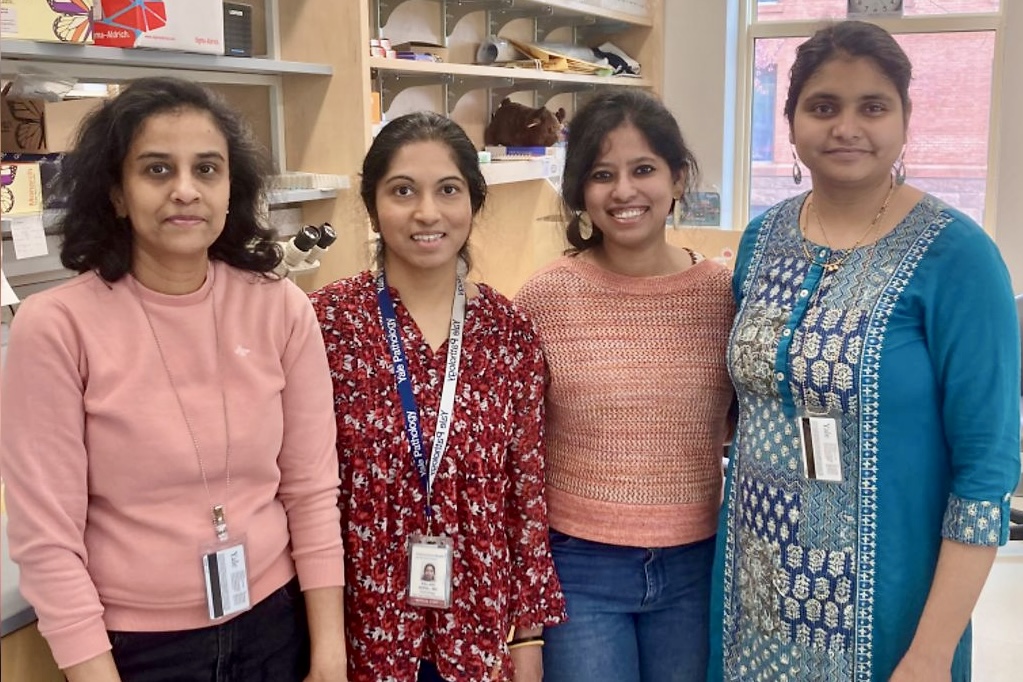
A team of Indian American scientists led by Pallavi Gopal are working to learn more about the dynamics of a protein to help patients with two major neurodegenerative diseases — ALS and FTD.
Amyotrophic lateral sclerosis (ALS), is a nervous system disease that weakens muscles and impacts physical function, while frontotemporal dementia (FTD), is a progressive brain disorder affecting the frontal and temporal lobes
In the Gopal Lab at Yale Pathology, the scientists are taking a close look at TDP-43, a protein that binds to RNA and DNA in the nucleus of cells and is involved in many essential cell functions.
READ: Meet Dr. Priya Punnoose, candidate for Virginia’s 11th Congressional District (June 22, 2025)
While TDP-43 is a crucial protein, the accumulation of TDP-43 aggregates in the central nervous system is a common feature of many neurodegenerative diseases, including ALS, FTD and Alzheimer’s disease.
Researchers have learned that mutations in TDP-43 and other genes that cause ALS, also known as Lou Gehrig’s disease, have also been linked to FTD. The Gopal Lab’s focus is on the role of TDP-43 in ALS and FTD, according to an article on Yale School of Medicine website.
“We study this RNA binding protein because there’s a lot of genetic and cell biological evidence that this is an important part of the pathogenesis of those two diseases,” says Gopal, associate professor of pathology and director, Neuropathology and Human Brain Discovery, in the Department of Pathology.
Among the things that Gopal and her team—including Sonali Vishal, PhD, associate research scientist, Smita Mathew, PhD, associate research scientist, and Aditi Naskar, PhD, postdoctoral research associate—are trying to learn are the early steps of the disease and if there is a way to intervene.
“Part of the difficulty with Alzheimer’s Disease, and all of these neurodegenerative diseases, is that the changes start to happen in the cells of the brain years before there are symptoms,” Gopal says. “So by the time we realize and get a diagnosis, it’s almost too late to intervene. We need to be able to detect people who are at risk for disease and be able to detect early on so we can do something before it’s too late and the cells are gone.”
The Gopal Lab uses a live-cell confocal microscopy to track the TDP-43 protein within a neuron and observe it in real time. Neurons communicate with muscles to move via long processes called axons that send an electrical impulse from the spinal cord out to the muscle, instructing it to move. Weakness and loss of movement are common challenges experienced by patients with ALS.
TDP-43 has many critical functions regulating RNA splicing and processing. Another one of the jobs of TDP-43 is to carry mRNA from the nucleus into the cytoplasm to get translated into a protein, and also carry it to the tips of the axon.
“In the Gopal Lab, we study how TDP-43 moves in and out of the cytoplasm but also how it shuttles its specific mRNAs from the cell body so that protein that are needed in places far from the spinal cord can still be made,” she says. “We’ve observed mutations, including mutations linked to ALS. Compared to wild-type TDP-43 in a normal cell, which moves around really well, these ALS mutations cause the TDP-43 to not move well at all.
“We’re trying to understand what controls the dynamics of TDP-43, and when you have the ALS mutations or other triggers for the disease, what is changing in the cells to make this whole process not work. What we want to come to understand is, are there ways that we can prevent the normal TDP-43 from forming these little aggregates?
“Can we intervene somewhere along the way, or are there other factors that we still don’t understand that regulate this process? If we understand that better, maybe we can intervene. The ultimate goal is to reduce TDP-43 mis-localization to the cytoplasm, restore TDP-43’s RNA regulatory functions, and prevent motor neuron degeneration.”
Gopal is a graduate of the Medical Scientist Training Program at the University of Pennsylvania, Perelman School of Medicine in Philadelphia. Her Ph.D. thesis work in Neuroscience with Dr. Jeffrey Golden focused on understanding the cellular and molecular mechanisms that guide neuronal migration during forebrain development.
Gopal is a recipient of the NINDS Clinical Scientist Research Career Development Award. She joined the Pathology Department at Yale School of Medicine in January 2018.