



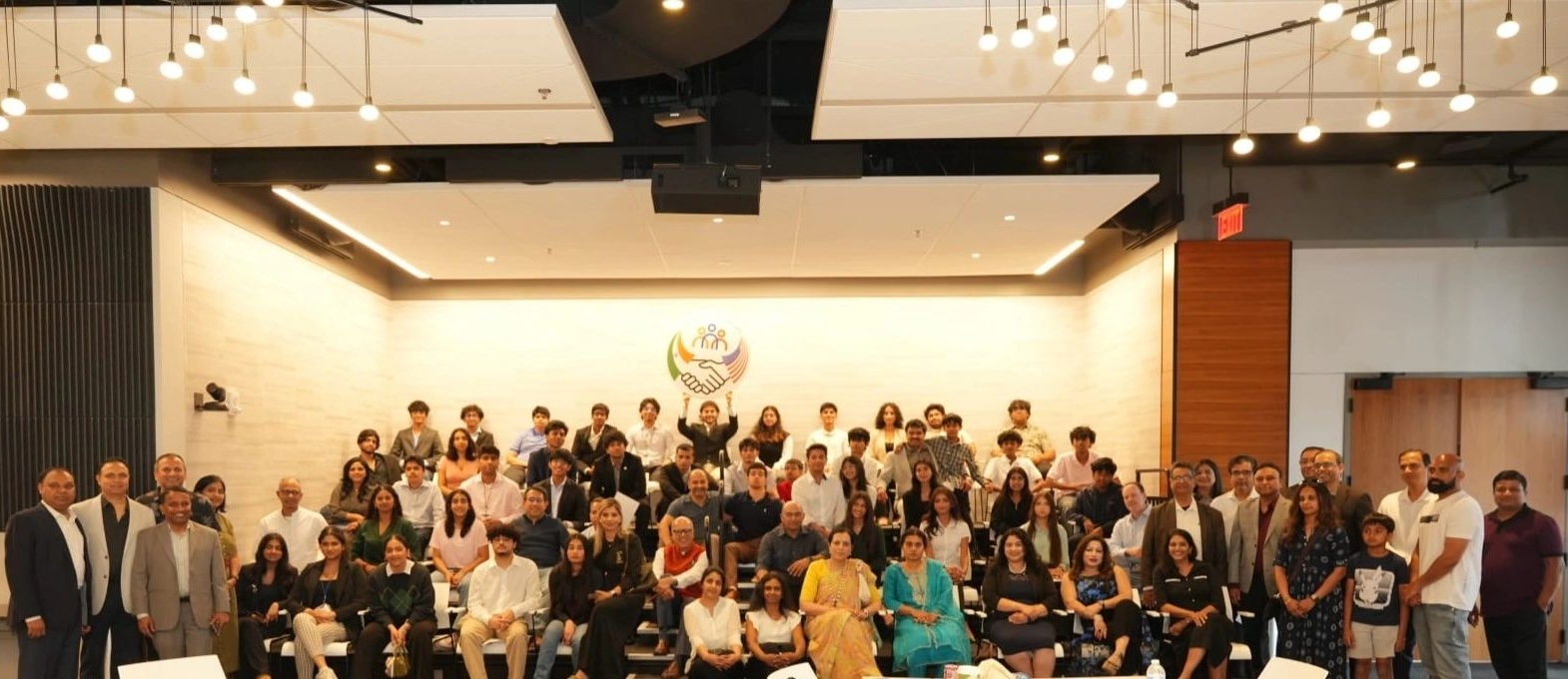
The three-day IAMBIG program brought together 70 Indian American youth from across the country to build leadership skills, foster confidence, and inspire community impact through mentorship, networking, and hands-on sessions.
The Indian American Business Impact Group (IAMBIG) held a youth leadership boot camp earlier this month, aiming to bring together young members of the Indian American community to build leadership skills, boost confidence, and inspire positive community impact.
Held from June 6 to 8, the camp featured a Friday evening networking dinner with industry leaders, followed by an immersive weekend of expert-led sessions focused on team building and leadership development.
The program drew approximately 70 attendees, primarily from the greater Washington, D.C., area, with a few participants traveling from Dallas, Atlanta, Austin, and Philadelphia.
IAMBIG is a platform for Indian American business leaders to exchange ideas, explore opportunities, and build professional networks. Its mission includes creating, growing, and preserving wealth through tax and investment strategies; promoting emerging businesses through investment, partnership, and mentorship; facilitating collaboration between small and large enterprises; developing leadership in the next generation of Indian Americans; and making a meaningful impact in the United States.
“We want to teach them skills and give them confidence,” said Ravi Puli, co-founder of IAMBIG, in an interview with The American Bazaar. He explained that the organization’s mission is to empower the next generation of leaders — not just by offering guidance, but by standing with them every step of the way.
READ: Seattle’s Kymavi wins top prize at TiE Young Entrepreneurs Global finals (June 20, 2025)
Puli said that while he initially envisioned an intensive, week-long program, he decided to begin with a shorter, trial-format inaugural edition. “We kicked it off with a networking dinner and two sessions,” he said.
The IAMBIG co-founder said second-generation Indian Americans shared their personal journeys in person to inspire and motivate attendees. “We brought in a neurosurgeon, an entrepreneur, and someone from private equity. We also had someone who studied law at Columbia University,” he said. “Almost all of them are children of our members or their classmates. That way, the attendees could see that success is within reach. When they see someone like Elon Musk, they might think — he looks different, he’s from South Africa, he has a unique background. But when they see someone who could be their neighbor, someone from their own community, they think, ‘Why not? We can do it too.’”
“If one of them wants to start a business,” he said, “we are willing to share our knowledge and experience. We’re prepared to invest in their startup, serve as advisors, become their first customers, and even act as brand ambassadors. This support isn’t limited to entrepreneurship; it also extends to public service and social ventures. If someone wants to start a nonprofit or enter public service and needs to raise funds, we will stand up, write a check, and connect them with our network to help them succeed.”
Anil Sharma, another IAMBIG co-founder and CEO of 22nd Century Technologies, echoed that message during his remarks at the boot camp. “Leadership doesn’t stop here; it starts here,” he said. “It’s about taking action, adapting, and lifting others. As we always say — don’t wait for the perfect moment, create it. Take the lessons from this program and turn them into action in your schools, communities, and beyond.”
In his interview with The American Bazaar, Puli also reflected on how quickly second-generation Indian Americans have integrated into American culture. “It takes one generation to fully adapt,” he noted. “Our kids speak English, they speak American, they act American, and they are American. That’s why we need to focus on them: to help them step up and carry forward our mission and vision. That’s what led me to start this youth leadership program.”
Puli also spoke about the growing opportunities in India and highlighted the Overseas Citizenship of India (OCI) program, which allows Indian Americans to live, work, and do business in India. “That’s another goal — connecting with and promoting India,” he said. “It supports our broader mission and vision.”
Summing up the purpose of the youth leadership boot camp, Puli said, “The idea is simple. We want to ignite the spark of leadership in their minds. And for those who already have that mindset, we aim to equip them with additional tools to take the next step.”
When asked whether the program was limited to American citizens or open to other individuals — such as Indian students or professionals living in the U.S. — Puli clarified that there were no restrictions based on citizenship. However, all of the applicants for this session happened to be Indian American.
He also recalled his message during the opening session of the camp: “First, you need to start by leading yourself. Then you lead your family, your community, your state, and your country. Eventually, you can go on to lead the world.” The program concluded with an awards ceremony where participants were presented with certificates of completion.
Puli also reflected on his personal journey and how his background inspired him to start IAMBIG. He recalled growing up in a small village in Telangana, India, and being a first-generation graduate and immigrant. He shared how he was largely self-taught, learning English, computers, and the fundamentals of business on his own. “I had to struggle to connect, to network, and to move forward,” he said. “I had to search for an organization where I could go, network, learn, and contribute.”
After serving on the boards of several nonprofits, he realized something was missin: a dedicated, broad-based Indian American business group. That gap, especially in the D.C. area, inspired him to establish IAMBIG.