


By Sreedhar Potarazu, MD, MBA
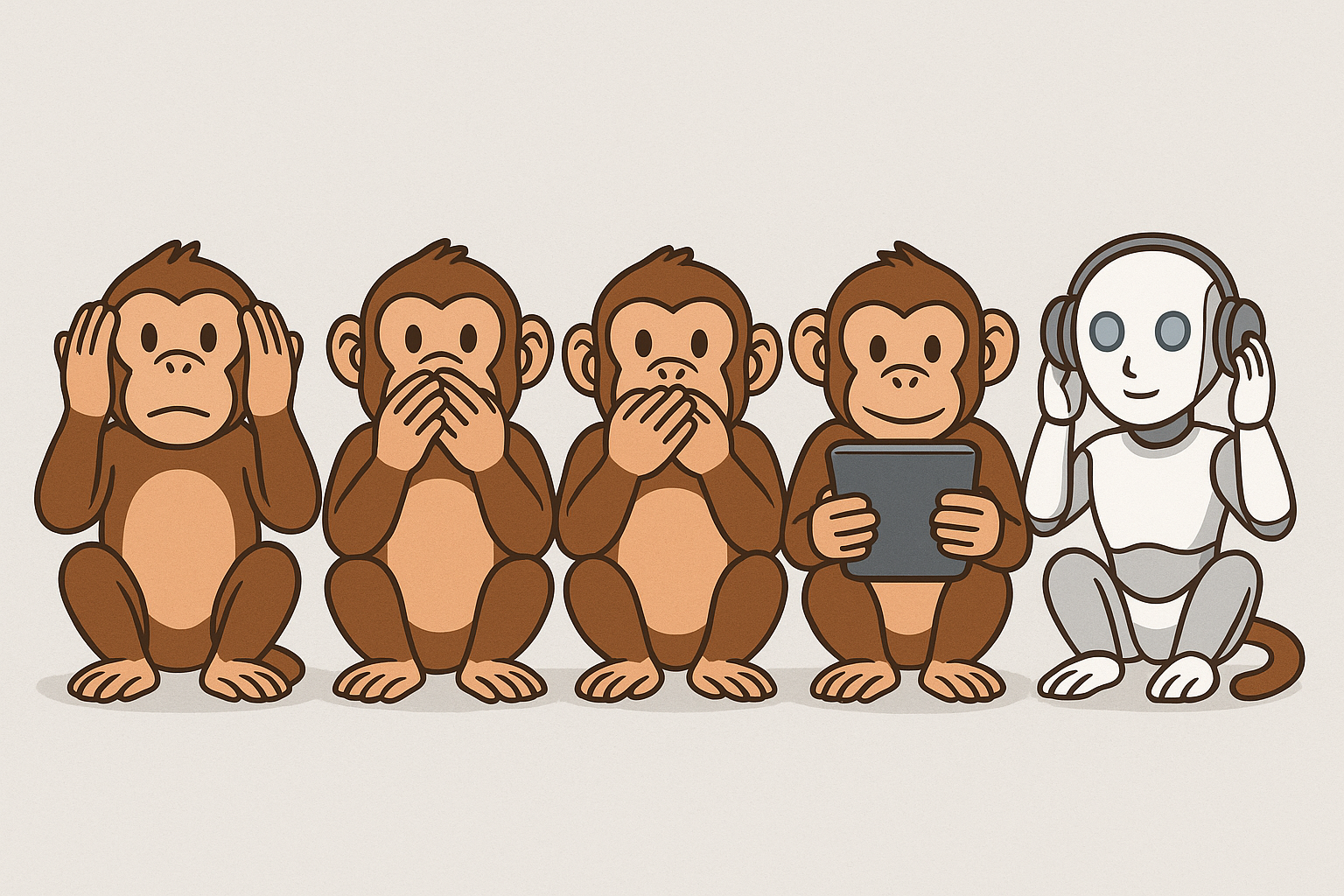
The ancient proverb of the “Three Wise Monkeys” see no evil, hear no evil, speak no evil has long served as a moral compass in Eastern philosophy, particularly in Confucian and Buddhist teachings. The image of the three monkeys known as Mizaru (who covers his eyes), Kikazaru (who covers his ears), and Iwazaru (who covers his mouth) originated from 17th-century carvings over the door of the Tōshō-gū shrine in Nikkō, Japan. The three monkeys were not advocating ignorance; rather, they pointed to the virtues of restraint, awareness, and thoughtful silence in a world full of distraction and distortion. With the advance of technology, these species too have evolved into the fourth and fifth monkeys which are a symbol of where society is headed in our ability to communicate by advances in technology and artificial intelligence.
How we look at each other has changed. We now find ourselves face to face with a different reality that lacks even the visual connection the first monkey warned us to preserve. Human beings are biologically wired for visual engagement. From the moment we are born, we seek eye contact as a primal form of bonding. Eye contact regulates conversation, builds trust, and fosters empathy. Yet, we have increasingly lost the art of truly seeing one another eye to eye both literally and figuratively.
Instead of connecting through intentional gaze, we fixate on screens. In meetings, at dinner tables, even during personal conversations, our eyes drift to our phones. The world around us becomes blurred background noise as we dive deeper into our devices. This visual detachment has implications beyond rudeness. Importantly it erodes our capacity for empathy and diminishes the neural feedback loops that are the very core of our social and emotional intelligence. It’s what makes humans special.
READ: What’s the point? Lessons from Scottie Scheffler and Carlos Alcaraz on what really matters (July 23, 2025)
Just as we no longer see each other, we have also lost the capacity to truly hear. Not in the auditory sense, but in the act of active listening which is the kind that requires presence, attention and empathy. Listening is not a passive act but is a powerful force for connection and understanding, especially in relationships, workplaces, and communities. Active listening involves more than waiting for your turn to speak. It means setting aside distractions, withholding judgment, and allowing the speaker to feel heard and validated. But in a world of constant interruption by phones and background noise, active listening is rare. We skim over messages, skip voice messages, and multitask through Zoom calls. We hear only what confirms our beliefs and tune out the rest.
Language is the very vehicle of human communication and how we express our identity, emotions, nuance, and truth. And yet, in this age of social media, abbreviations, emojis, and recommendations, that depth of human connection is shallower. We speak more but say less, we text instead of talk and we react instead of respond. What once required meaningful interaction is now reduced to short prompts like “LMK,” “TBH,” “ICYMI.” Entire relationships are negotiated via these acronyms and language has taken on an entirely new vocabulary. By doing this we lose the complexity of our internal world and worse still, we lose the courage to be vulnerable as well as the clarity to be understood.
Now, with the rise of Generative AI and Chat GPT, communication is entering a phase where people are outsourcing even the crafting of their messages. While there is great promise in these technologies, the risk is that we become further distanced from our authentic voices. We become curators of prompts rather than communicating what we really mean to say.
If Mizaru sees no evil, Kikazaru hears no evil, and Iwazaru speaks no evil, then the Fourth Monkey neither sees, hears, nor speaks to anyone because he is always on the phone. Head down, neck bent over, fingers scrolling. The Fourth Monkey is the archetype of our new distracted age of devices. This monkey does not look into the eyes of others, nor listen with intent, nor communicate with clarity. Instead, the Fourth Monkey is perpetually engaged with a screen, filtering human interaction through apps, notifications, and algorithms. They miss the world unfolding in front of them and lose the richness of real life.
Psychologists are increasingly concerned about the mental health consequences of this behavior. Studies link excessive phone use with increased rates of anxiety, depression, and loneliness particularly among younger generations. The constant availability of stimuli shortens attention spans, diminishes self-regulation, and weakens real-world social skills. The Fourth Monkey is not simply distracted but is emotionally depleted.
And now, we introduce the Fifth Monkey who is the AI twin of the Fourth. This monkey doesn’t see, hear, or speak independently. Instead, it learns entirely by observing the Fourth Monkey. It scrapes digital breadcrumbs, mimics conversational tone, predicts what we want to say next, and can even simulate real connection. The Fifth Monkey is GenAI, artificial intelligence trained on the vast behavioral patterns of a society that itself is disengaged. It reflects back to us a more flattened version of ourselves, created from echoes of distraction and disconnection. While powerful, GenAI is fundamentally a mirror with memory that is sometimes incomplete. The fifth monkey has learned either by observing the other monkeys or being prompted by the fourth monkey but it has even less emotion than the fourth monkey. It does not know how to respond to its environment unless prompted. It is perhaps more isolated in from its natural habitat then its twin or other cousins.
READ: How ideology contributed to flood devastation in the Texas Hill Country (July 18, 2025)
This reliance of the fifth monkey on AI for everyday communication with emails, texts, creative writing, even expressions of emotion raises serious questions about our own identity and authenticity. Are we enhancing our voices, or delegating them? Are we collaborating with tools, or replacing ourselves with an avatar? These debates are surfacing as to whether the fifth monkey will be smarter and wiser than all the other four as AI matures and learns more about the world or whether it will be more isolated and less able to connect?
If the original Three Monkeys taught us about restraint, then maybe the Fourth and Fifth teach us how to evolve with technology and artificial intelligence without losing our core ability to communicate. We can reclaim the ancient intimacy of the human gaze. We can practice active listening by putting away the phone sometimes. We can speak and write in our own voice and let AI be a tool and not a crutch.
The Fourth and Fifth Monkeys don’t have to remain symbols of decline. They can become forces of a new kind of wisdom that blends the best of technology with the power of our presence. After all, no matter the culture, we are forever grateful to monkeys. They are our ancestors. And in the case of the divine monkey Hanuman, a symbol of strength, loyalty, and wisdom as he reminds us that with discipline and grace, we can become wiser.