



By Soumoshree Mukherjee
Editor’s note: This article is based on insights from a podcast series. The views expressed in the podcast reflect the speakers’ perspectives and do not necessarily represent those of this publication. Readers are encouraged to explore the full podcast for additional context.
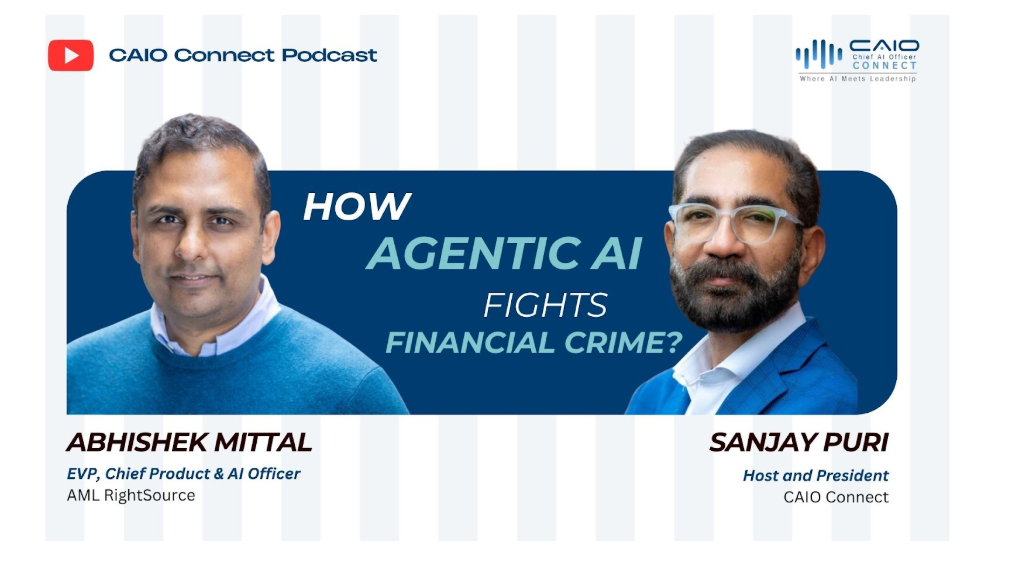
In the “CAIO Connect” podcast’s latest episode, host Sanjay Puri sits down with Abhishek Mittal, EVP and Chief Product & AI Officer at AML RightSource, to explore how enterprises can turn imperfect data into actionable AI systems and why the next frontier lies in agentic AI and digital FTEs. Mittal, who previously led innovation at Wolters Kluwer, brings a rare blend of domain, product, and AI expertise, now focused on fighting financial crime through technology.
At AML RightSource, Mittal leads a mission with a moral edge: to use AI to combat money laundering and financial fraud. He notes that if financial crime were a country, it would rank as the seventh-largest GDP in the world — a staggering reality that demands innovation. His approach combines domain expertise, AI-driven analytics, and human oversight to detect complex patterns of illicit activity hidden in massive data flows.
“The intersection of finance and technology isn’t just about efficiency,” Mittal explains. “It’s about protecting trust in the system.”
READ: Yearick’s Karin Stephan on leveraging AI to better mental health (
When it comes to building AI systems, many organizations say, “We’ll start once our data is perfect.” Mittal disagrees. His message is simple: start anyway.
He advocates a “run in laps” approach—beginning with high-value use cases, improving data iteratively, and learning through execution. “You can’t wait for perfect data because the real world is never perfect,” he says. “Each use case you deploy improves the data that follows.”
This mindset shift—from perfection to pragmatism—turns AI from a theoretical initiative into a measurable business driver.
Mittal admits he was once a synthetic data skeptic, but experience changed his mind. With enterprises struggling to access high-quality, labeled data, synthetic data became a powerful tool to train, stress-test, and simulate AI models safely.
He recalls using synthetic datasets to prepare for rare financial crime scenarios or recession-like events—conditions that real data might not yet reflect. “Synthetic data lets us test resilience,” he explains. “But it must always be validated with real data and human oversight.”
READ: Regulating AI before it regulates us: Lessons from Camille Carlton (
As AI models become commoditized, Mittal argues that experience—not algorithms—becomes the differentiator. The real advantage lies in teams trained to use AI effectively, integrating machine intelligence with human expertise.
Enterprises that blend workflow wisdom with modern AI systems can outperform even the most agile startups. “It’s not about who builds the best model,” he says. “It’s about who knows how to apply it best.”
Looking ahead, Mittal sees the rise of agentic AI—systems that don’t just predict or recommend but act autonomously. He describes this as the age of the “digital FTE” — AI agents functioning as part of human teams.
But agentic AI success requires three enablers:
- Process reimagination, not automation of old workflows.
- Empowered domain experts who guide and evaluate outcomes.
- Engineering excellence to connect AI seamlessly across legacy systems.
As the conversation wraps up, Puri highlights Mittal’s defining philosophy—pragmatism over perfection. AI, Mittal insists, is most powerful when it’s embedded into real workflows, improving both efficiency and accountability.
“Start small. Scale fast. Stay accountable,” he advises. “That’s how you turn AI from a lab experiment into enterprise transformation.”