


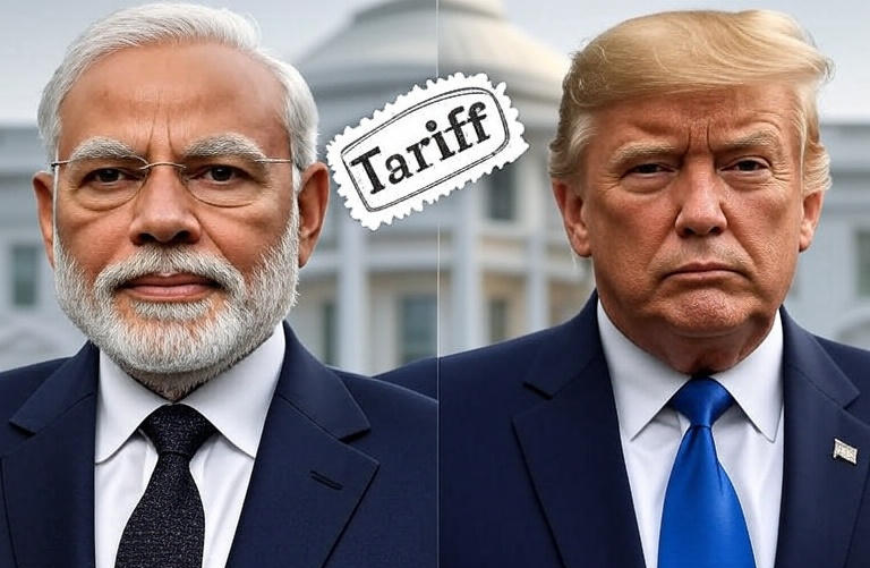
India is not buckling under the weight of escalating tariff threats by President Donald Trump.
India’s stock market showed little sign of panic a day after the U.S. announced a 50% tariff on goods from the country and threatened secondary sanctions over its continued oil trade with Russia.
And now it looks like Trump’s threats have inadvertently done something no one was expecting. His tariff threats have united the country’s leadership by bringing the opposition on board with Indian Prime Minister Narendra Modi’s stance.
Rahul Gandhi, the leader of India’s largest opposition party, the Indian National Congress, described the penalty for Russian oil purchases as “economic blackmail” by Trump, further reducing the political room for Modi to concede to American demands.
“India will never compromise on the interests of the country’s farmers, fishermen, and livestock breeders. I know it will cost me personally, but I am ready,” Modi said on Thursday morning, hours after the U.S. increased tariffs.
READ: India circumvents Trump’s tariffs with exemptions (July 31, 2025)
Trump and his administration have long cited the Ukraine-Russia war as their reason for punishing India with penalties, and now that India is not budging, it looks like Trump is feeling slighted and he is retaliating with his escalating tariffs.
Citing India’s continued imports of Russian oil and defense equipment, the U.S. imposed a 25% tariff on a broad range of Indian exports starting August 1. These tariffs targeted key Indian sectors like textiles, pharmaceuticals, gems and jewellery, and electronics, industries that together form a significant portion of India’s $87 billion in annual exports to the U.S. Analysts warn that this move could reduce India’s GDP growth by 0.3–0.8 percentage points, particularly if retaliatory measures follow or if no trade resolution is reached by year-end.
India has responded cautiously, seeking to preserve trade ties while protecting domestic interests. New Delhi is proposing limited tariff concessions on select U.S. agricultural products, such as almonds, lentils, and bourbon, to reopen talks on a potential bilateral trade agreement.
Simultaneously, India is strengthening economic ties within BRICS and other regional blocs as a hedge against growing U.S. unpredictability. While short-term export disruptions and investor outflows have impacted markets, some experts see the crisis as an opportunity for India to diversify exports, reduce dependency on the U.S., and attract global manufacturers reconfiguring supply chains away from China.
READ: India hit with fresh tariff hike; Trump doubles down with 50% (August 6, 2025)
Indian exports to the U.S.
| Sector | Exports to the U.S. in 2024 | Share of India’s exports to the U.S. |
| Electronics | $11.1 billion | 14.30% |
| Gems and jewelry | $9.9 billion | 12.80% |
| Pharmaceuticals | $8.1 billion | 10.40% |
| Nuclear reactors, parts, machinery | $6.2 billion | 8% |
| Refined petroleum products | $5.8 billion | 7.50% |
Source: India’s Ministry of Commerce
The escalating tariff conflict between India and the U.S. marks a significant turning point in their bilateral relationship, with long-term implications for both economies. For India, the standoff has reinforced its resolve to protect strategic autonomy and domestic interests, even under intense external pressure.
Modi’s firm stance, now backed by opposition leaders, signals a rare moment of national unity and suggests that India is unlikely to concede on critical issues like energy security or agricultural protection.
For the United States, the aggressive tariff strategy may achieve limited near-term leverage, but it risks alienating a key democratic partner in the Indo-Pacific. By penalizing India’s oil purchases from Russia without offering meaningful alternatives, the U.S. is pushing New Delhi to look eastward rather than westward for economic and strategic alignment. If tensions persist, the trade war could erode U.S. influence in South Asia and hinder the broader goal of building coalitions against authoritarian regimes. In effect, both countries face a test of economic self-interest versus geopolitical partnership.