



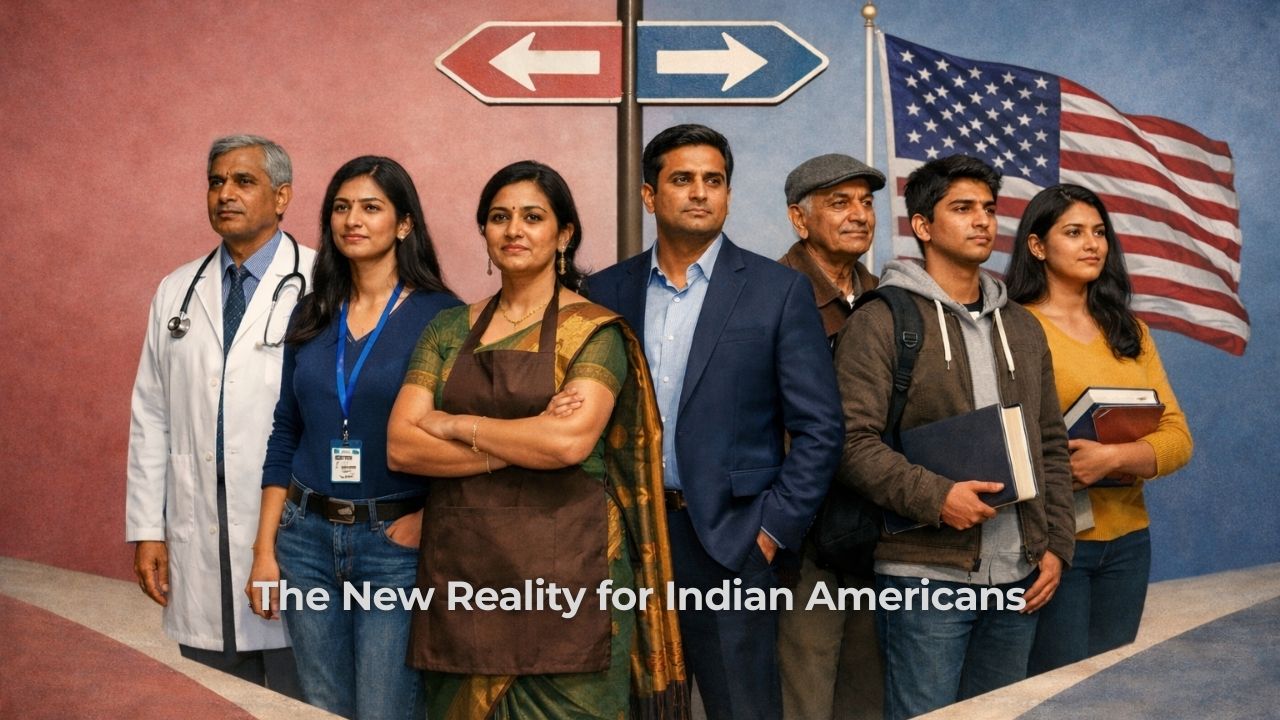
Over the past three decades, Indian Americans have traveled an extraordinary distance in American economic, social, and political life. The community currently occupies a place of influence in sectors as varied as healthcare, hospitality, finance, academia, and, most prominently, information technology.
 Indian Americans are the most educated ethnic group in the United States, with over 75% holding a bachelor’s degree or higher, with a median household income that is nearly twice the national average. From CEOs of Fortune 500 companies to founders of Silicon Valley unicorn start-ups valued at more than $1 billion, from physicians to professors to public servants, the community’s accomplishments are so well documented that they are often taken for granted.
Something changed when Donald Trump returned to the White House and the second wave of MAGA politics emerged as the defining ideology of his administration. In the year since Trump’s second term began, the nationalist fervor animating his base has not only targeted undocumented immigrants. It has also aggressively turned its attention toward high-skilled immigration.
This shift impacts Indian Americans more than any other group.
For decades, the H-1B visa program has been the primary gateway for Indian immigration. Indians have consistently received over 70% of all H-1B visas. This skilled migration has fueled American innovation and dramatically reshaped the Indian American demographic. In 1990, there were just 815,000 Indian Americans in the country. Today, that number exceeds 5 million, making the community one of the fastest-growing immigrant groups.
READ: Frank F. Islam | Layoffs in a boom: Why America’s tech giants are cutting jobs amid growth (November 30, 2025)
This success has now become ammunition for political backlash.
MAGA influencers, joined by a subset of the populist left, argue that the H-1B system “steals American jobs,” that Indian consulting firms “game the system,” and that many workers are “substandard,” a claim contradicted by nearly every major study, including those by the National Foundation for American Policy and the Brookings Institution.
In politics, perception often matters more than reality or evidence.
Once celebrated as the poster child of the “model minority” narrative, the Indian American professional is being reframed as an economic threat and cultural outsider.
In the past year, the nativist argument has widened into a larger cultural critique. Right-wing media and social media spaces now blame Indian Americans for everything from housing price increases in tech corridors to inadequate “assimilation.”
READ: Frank Islam | Mamdani’s victory in New York a political earthquake (November 5, 2025)
Viral memes mock everything from Indian grocery stores to Hindu festivals. Even harmless consumer habits, like shopping at Costco, have been satirized as evidence of “tribalism” or “in-group economic behavior.”
Remittances to India, long a symbol of immigrant success and transnational family ties, are being questioned as “capital flight.” Indian call centers are lumped into broader anti-outsourcing rhetoric and, worse, tools for scamming elderly Americans. And, temples, dance schools, and community gatherings, once seen as multicultural enrichment, are now framed by some as enclaves of foreign influence.
Almost overnight, a community that embodied the American Dream has found itself reclassified as a problem.
This reversal has left many Indian Americans, particularly those who have avoided political conflict, on unfamiliar defensive ground.
So, the real question becomes: How can a community that once felt unstoppable regain its footing?
First and foremost, Indian Americans should recognize that this is a difficult political climate — and that it will pass.
Anti-immigrant sentiment is not unique to the United States. Across Europe, South America, and parts of Asia, nationalist movements have surged, fueled by fears of economic displacement, demographic change, and cultural anxiety. Such cycles are not permanent; they eventually crest and recede.
READ: Frank F. Islam | Trump’s H-1B crackdown puts tech and U.S.-India ties at risk (September 27, 2025)
Indian Americans should not internalize the hostility of this moment. Nor should they assume it reflects the long-term trajectory of American society, which remains fundamentally pluralistic and pro-immigration.
Secondly, the community should tell its story, loudly and factually.
The Indian American success story is not propaganda; it is measurable. For example, Indian Americans:
- Constitute roughly 8% of all doctors in America i
- Found startups at rates among the highest of any immigrant group.
- Contribute tens of billions of dollars annually in taxes, entrepreneurship, research, and innovation.
Stating this is not boasting; it is reputational survival.
Narratives fill vacuums. When the community does not define itself, others — often hostile — will define it for them. For this reason, Indian American individuals and organizations should be intentional in highlighting contributions, civic participation, and positive economic impact.
Thirdly, Indian Americans should deepen political engagement, keeping in mind that voting is not optional and has consequences.
One of the paradoxes of 2024 was that over one-third of Indian Americans voted for Trump, despite his openly anti-immigrant rhetoric. Many believed, mistakenly, that wealth would inoculate them from xenophobia.
Read more columns by Frank F. Islam
As noted, political winds can shift quickly. Today’s entrepreneurs and homeowners can still become tomorrow’s scapegoats.
The lesson is clear: Vote with the community’s long-term interests in mind.
Indian Americans now have a record number of elected officials, from members of Congress to state legislators, city councilmembers, and school board leaders. This representation must continue to grow. Political neutrality is no longer a sustainable strategy.
Lastly, we must reinvest in civic life, not just professional life.
Indian Americans excel in economic spaces but lag in civic ones.
The community participates in lower-than-necessary rates of local organizing, school board involvement, community service, and cross-cultural coalition-building.
This must change.
Civic engagement is how trust is built, narratives are shaped, and stereotypes are dismantled. It is also the arena in which immigrant groups historically consolidate their place in the American fabric.
Silence, no matter how affluent or successful the community becomes, will not protect it.
Indian Americans are confronting something they have not faced in the modern era: cultural suspicion amplified by political power.
The instinct may be to retreat, to wait for calmer times, or to hope this moment will blow over. The opposite is what is needed. This is precisely the time to stand taller, speak up, and become more engaged.