


By Soumoshree Mukherjee
Editor’s note: This article is based on insights from a podcast series. The views expressed in the podcast reflect the speakers’ perspectives and do not necessarily represent those of this publication. Readers are encouraged to explore the full podcast for additional context.
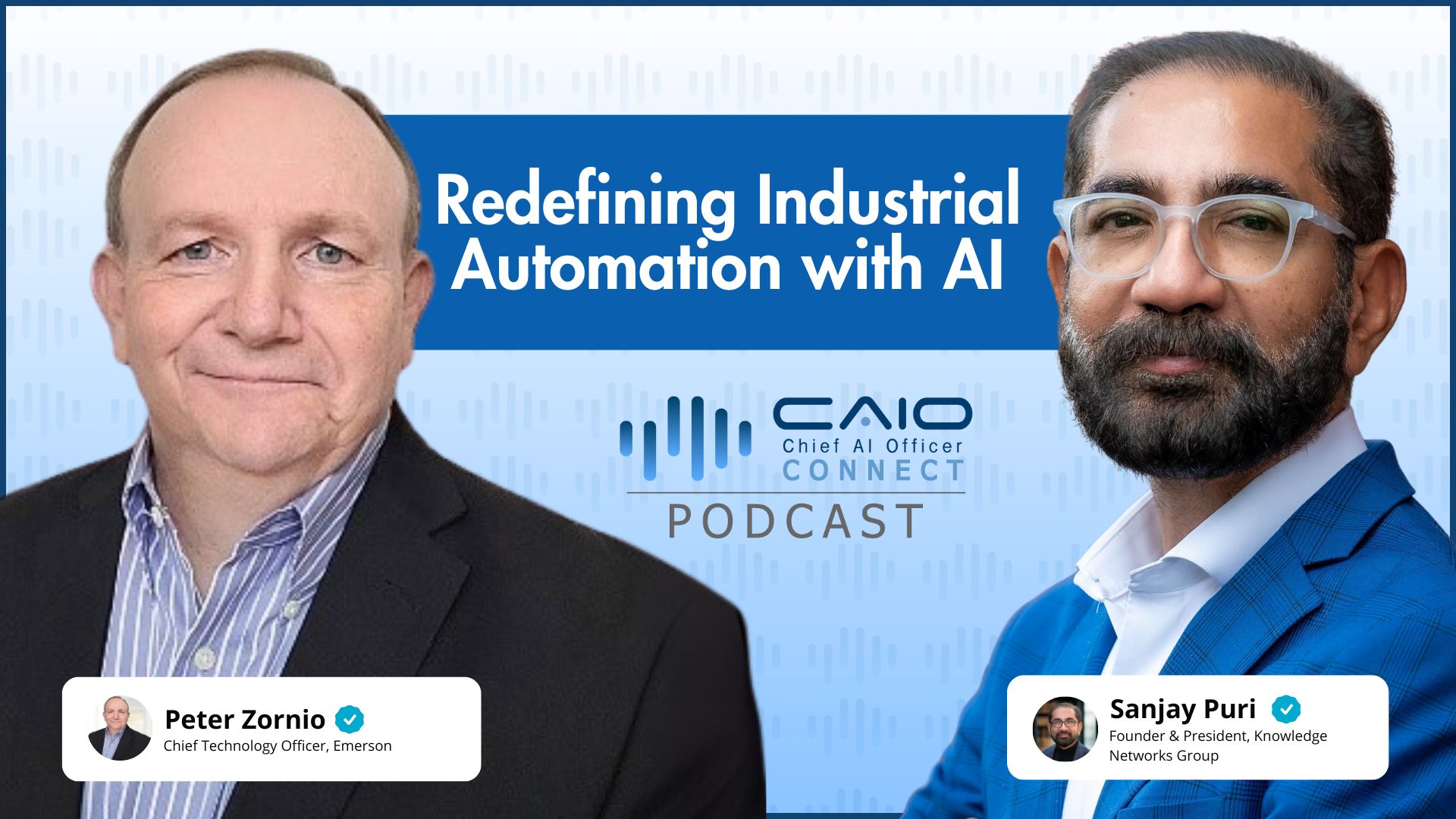
In a recent episode of the “CAIO Podcast,” hosted by Sanjay Puri, Emerson’s Chief Technology Officer Peter Zornio shared his four-decade journey through chemical engineering, industrial automation, and the integration of artificial intelligence into manufacturing. With 19 years at Emerson and 21 years at Honeywell, Zornio has witnessed and shaped the evolution of automation from analog controls to AI-driven optimization.
Emerson, a 130-year-old technology and software company, has in recent years transformed into a focused automation leader, offering complete solutions “from sensors to optimization.”
“With automation, we’re pretty much applying computer science and automation and software technologies to the control of industrial chemical processes,” Zornio explained, recalling how digitization began in the 1970s and by the mid-1980s had matured into model-based process optimization.
“I always like to say in automation, we were AI before AI was cool,” he quipped, noting that manufacturing had long used numerical models and machine learning for tasks like advanced process control and predictive maintenance.
READ: Abdullah Althawad discusses Saudi Arabia’s vision for data and AI transformation (
Today, Emerson’s “Boundless Automation” vision centers on building architectures designed for AI from the ground up. The goal is to make industrial data from production metrics to sustainability figures easily accessible and integrated, enabling optimization, predictive maintenance, and improved safety. As Zornio notes, “There is no AI strategy in manufacturing without a data strategy.”
He pointed, “the single most tangible set of benefits… that have been delivered over the last couple of decades, all revolve around advanced process control and optimization,” while highlighting multimillion-dollar productivity gains, predictive analytics preventing costly equipment failures, and emerging generative AI tools supporting “digital twins” to guide plant operators in real time.
Future advancements aim to leverage large language models and generative AI to enhance digital twins and operator guidance systems, “…that will use a lot of the latest LLMs and generative technology will be on providing more of a comprehensive digital twin to provide operator guidance as operators are operating the facility.”
However, industrial AI comes with unique challenges. Manufacturers demand explainable models they can trust to make autonomous adjustments especially in high-risk environments. Data security is another priority, with many clients preferring edge deployments over cloud to maintain control of sensitive operational data.
“In our world, AI has always been about closing the loop and taking action on whatever was coming out of the AI,” Zornio said. Emerson’s approach often involves deploying AI at the edge to balance performance, security, and latency.
READ: Leading AI transformation at H&R Block: In conversation with Aditya Thadani (
Sustainability is another focus area. AI-driven optimization now includes energy efficiency and decarbonization as core performance variables, enabling clients to meet environmental goals without sacrificing output or reliability. Zornio also sees AI as a driver for IT-OT (Information Technology-Operational Technology) convergence, pushing manufacturing and enterprise systems closer together to unlock new efficiencies.
As head of Emerson Ventures, Zornio keeps an eye on applied AI startups, particularly in sensor innovation and automated data integration. He’s optimistic but pragmatic about new technologies: “Don’t get excited just about the technology. Make sure that you’re starting with what the business problem is and where the value is going to be.”
From venture investments in sensor innovations to AI-powered data integration startups, Emerson’s eyes are firmly on the future. Yet Zornio remains grounded in a philosophy of trust, security, and measurable value. As he puts it, “The value is going to be for companies like ourselves that take that technology and apply it to delivering results.”
This blend of history, innovation, and pragmatism is why, under Zornio’s leadership, Emerson continues to shape the evolution of intelligent industrial systems quietly proving that in automation, the AI revolution began long before the hype.