



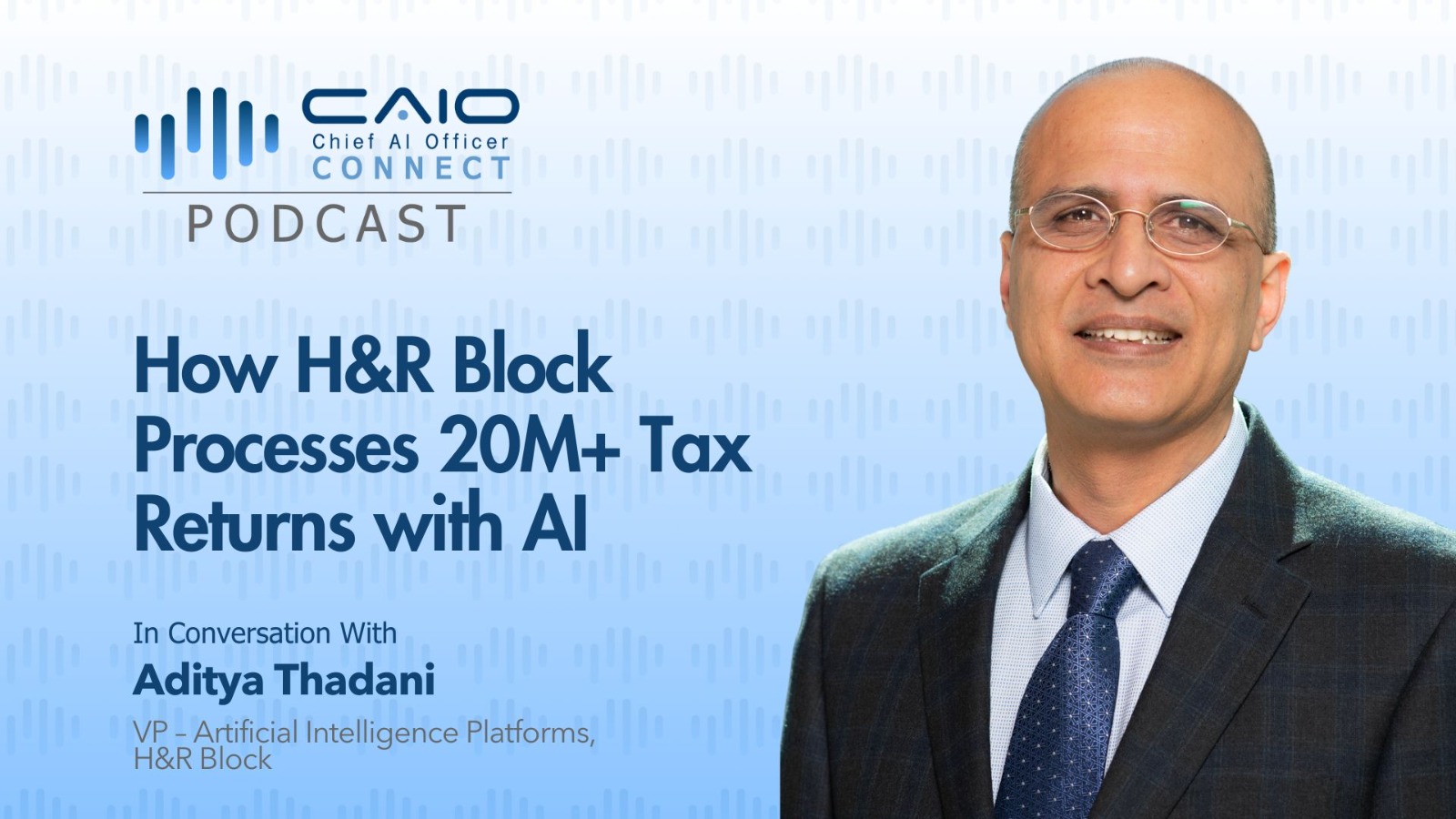
Aditya Thadani, vice president of Artificial Intelligence Platforms at H&R Block, recently joined the CAIO Podcast to discuss his role in the company’s digital transformation and AI strategy. With over 60 years of experience, H&R Block, traditionally known for tax preparation services, has expanded into mobile banking and small business solutions. Under Thadani’s leadership, the company has leveraged AI to enhance customer experience, improve operational efficiency, and modernize its legacy systems.
“AI is helping, with data analysis, especially the document submission and also customer interaction,” Thadani explained, reflecting on how H&R Block has adopted AI to stay competitive in the financial services industry.
READ: ‘The future is now’: Congressman Gabe Amo on AI policy, equity and education (April 2, 2025)
As one of the largest tax preparers in the U.S., H&R Block processes over 20 million tax returns annually. Thadani highlighted how AI has played a pivotal role in managing this massive scale. “We ingest [over 30 million] documents every year from clients, and our AI models can classify these documents in less than 100 milliseconds,” he said. This rapid document classification, powered by AI, reduces friction for customers and ensures that H&R Block’s systems perform reliably at scale.
AI also plays a role in customer interactions, particularly in H&R Block’s DIY tax preparation solution. Thadani pointed to the introduction of AI Tax Assist, which provides users with expert guidance during the tax filing process.
The company’s focus on improving customer experience has been central to its AI strategy. Thadani shared that H&R Block tracks key performance indicators like client satisfaction scores, Net Promoter Scores (NPS), and conversion rates to measure the impact of its AI implementations. “We measure our NPS scores, we look at conversion rates, (…) clients were starting, are they getting stuck at certain stages, Are they spending too much time in one phase over the other?” he said, “We look at all those measures those necessarily are still good reliable indicators of the service we are delivering to our clients. And we use the same measures to to really assess whether the tools and the technology we are adding to this mix are really additive and are creating an incremental gain in terms of client experience and client outcomes.”
Thadani also discussed the importance of cloud infrastructure in H&R Block’s AI strategy. The company migrated 75% of its compute capacity to Microsoft Azure in just 36 months, with over 90% of its computing now in the cloud. “I would say migrating to the public cloud was absolutely one of those foundational shifts that we made that that has been a big enabler and an accelerator for us in this journey.”
As a financial services provider, H&R Block deals with sensitive customer data, making ethical AI development a top priority. Thadani emphasized the importance of incorporating data privacy, transparency, and security into AI systems. “When we launched AI accesses last year, we put in control so that none of the client’s personal information ever goes to the large language model,” he noted, talking about the company’s commitment to ethical AI practices.
Thadani’s approach to AI adoption has been methodical and focused on learning. He noted that H&R Block initially started testing AI internally before rolling out customer-facing solutions. “We wanted to learn about consumer interaction model, consumer willingness to engage with this technology,” he said.
READ: Google’s AI chatbot Gemini faces accuracy concerns (December 20, 2024)
When asked about convincing the C-suite to support AI initiatives, Thadani credited the visionary leadership of H&R Block’s CEO. “We needed (…) to invest in exploring and better understanding this technology before we can say how do we productize it,” he explained. This strategic support enabled the company to prioritize AI learning and innovation, ultimately resulting in the successful deployment of AI-driven services.
For organizations looking to start or scale their AI initiatives, Thadani’s advice was clear: “Just start. Don’t wait.” He stressed that AI implementation is an ongoing journey of learning, testing, and refining. “I would say start because I think that true learning isn’t doing right. I think that’s that’s where we grow, that’s where we stretch, that’s where we challenge ourselves and that’s where we learn. And there is a lot to learn.”