



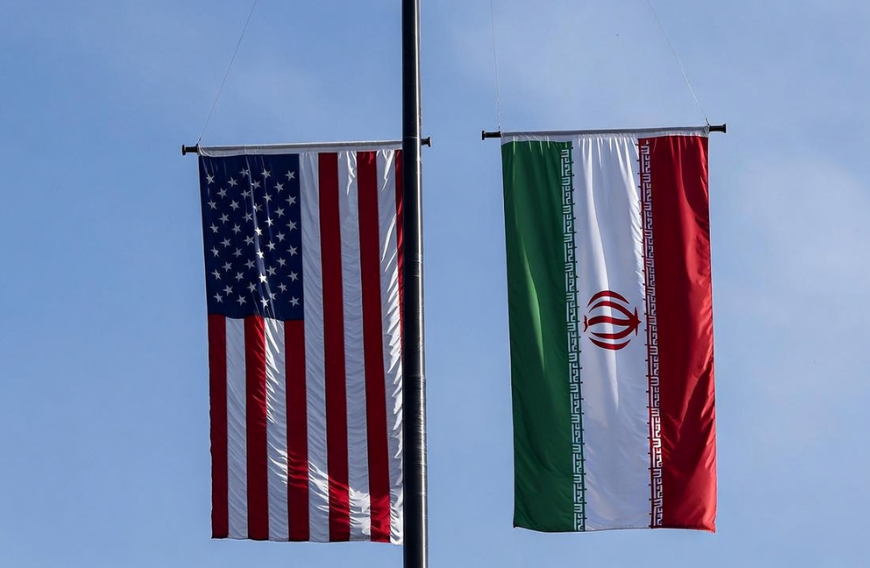
President Donald Trump claimed on Friday that he would “make a final determination” on ending the Iran war. The announcement on Truth Social was the second such signal in less than a week, suggesting that, after weeks of negotiations, the United States and Iran may be moving closer to an agreement that could bring an end to the conflict—the latest in a series of destabilizing wars in the Middle East.
 Whether it ultimately becomes a durable settlement or merely another temporary pause in this conflict-ridden region remains uncertain.
On Saturday, May 23, Trump announced on his social media platform that an agreement between the United States and Iran was “largely negotiated,” pending finalization. Iran’s foreign ministry indicated that an initial memorandum of understanding could serve as a first phase before broader negotiations begin.
READ: Frank Islam | Mamdani’s victory in New York a political earthquake (November 5, 2025)
While Trump subsequently appeared to temper expectations by saying he would not rush into an agreement—and the two sides even briefly exchanged fire—the developments of the past week represented perhaps the closest the two sides have come to a formal understanding.
Even the prospect of a deal represents a notable shift from the rhetoric and military escalation that have dominated relations between Washington and Tehran for nearly three months.
The war that began on February 28 dramatically altered the political and economic landscape of the Middle East. Beyond the immediate human toll, the conflict disrupted energy markets, rattled financial systems, and injected uncertainty into global supply chains.
Oil prices surged repeatedly as fears mounted over the status of the Strait of Hormuz — one of the world’s most strategically important waterways, through which approximately 20% of global energy supplies pass. Markets and governments alike learned once again that instability in the Persian Gulf rarely remains confined to the region itself.
India and Europe emerged as unintended casualties of the conflict, absorbing economic shocks despite being far removed from the battlefield itself. Wars in the Middle East rarely remain regional events; they ripple through energy markets, trade routes, and financial systems, affecting economies thousands of miles away.
India, which imports a significant portion of its crude oil requirements, felt the pressure almost immediately as fuel prices, cooking gas costs, and fertilizer prices climbed. Rising energy prices will eventually feed into transportation costs and manufacturing expenses, pushing up inflation and affecting households and businesses alike.
The impact extends beyond energy markets. India and most of its South Asian neighbors have millions of citizens employed across the Gulf region and receive tens of billions of dollars annually in remittances from workers there. Any prolonged conflict that slows economic activity in Gulf economies has direct consequences for the families dependent on those earnings.
Europe faces equally serious challenges. Already struggling with energy security concerns and fragile economic growth, the continent confronted renewed pressure on fuel markets, supply chains, and inflation.
READ: Frank F. Islam | Trump’s H-1B crackdown puts tech and U.S.-India ties at risk (September 27, 2025)
For both India and Europe, the war served as another reminder that instability in the Middle East carries consequences far beyond the region’s borders.
If diplomacy succeeds where military escalation did not, Washington will inevitably confront uncomfortable questions. What exactly was achieved through months of warfare?
Supporters of military action, who initially hoped for regime change in Tehran, argued that the objective was to degrade Iran’s strategic and nuclear program capabilities and to force a recalibration of Iran’s ambitions.
Wars in the Middle East have historically produced unintended consequences, strengthening forces they were designed to weaken.
History offers reasons for caution. The Iraq war reshaped regional power balances in ways few predicted. It strengthened Tehran’s regional influence, particularly through political and religious ties with significant segments of Iraq’s population.
The interventions in Afghanistan and Libya similarly produced outcomes that often diverged sharply from their stated goals. The Middle East has repeatedly demonstrated that military campaigns can create consequences extending far beyond battlefield calculations.
READ: Frank F. Islam | Layoffs in a boom: Why America’s tech giants are cutting jobs amid growth (November 30, 2025)
If an agreement leaves Iran with restored economic access through sanctions relief and a reopening of trade routes, Tehran could emerge with renewed economic leverage and greater regional influence than many anticipated at the beginning of the war between Iran and the U.S.
Gulf states such as Saudi Arabia, the United Arab Emirates, and Qatar have reportedly supported de-escalation efforts, recognizing that prolonged conflict threatens economic growth and regional stability. Their support has also given Trump political room to pursue diplomacy without appearing isolated.
Domestically in the U.S., the impact could also be significant. Wars rarely remain foreign-policy questions for long. Eventually, they become economic questions and political questions. Rising energy prices affect household budgets. Economic disruptions shape voter sentiment. Public fatigue with prolonged overseas conflict can alter political coalitions.
Within Trump’s own political base, divisions have become increasingly visible. Some traditional foreign-policy hawks have criticized any agreement perceived as too accommodating toward Tehran, while parts of the populist and anti-interventionist wing question the wisdom of extended military engagement. Those tensions may prove somewhat consequential for Trump’s support in the longer term.
None of this means an agreement is inevitable. Trump himself has repeatedly shifted positions, and negotiations involving Iran have historically moved in cycles of optimism and collapse. Even now, key questions involving sanctions, nuclear activities, regional security arrangements, and implementation appear to remain unresolved.
But if the ceasefire and negotiations hold, the United States may be closing its involvement in another difficult chapter in a long history of Middle Eastern conflicts. A chapter which will have reframed relationships in the Middle East.
The Middle East has repeatedly reminded the world that ending a war is often easier than predicting what it will ultimately change.
(Frank F. Islam is an entrepreneur, and civic and thought leader based in the Washington, D.C., area. The views expressed here are solely his own.)