



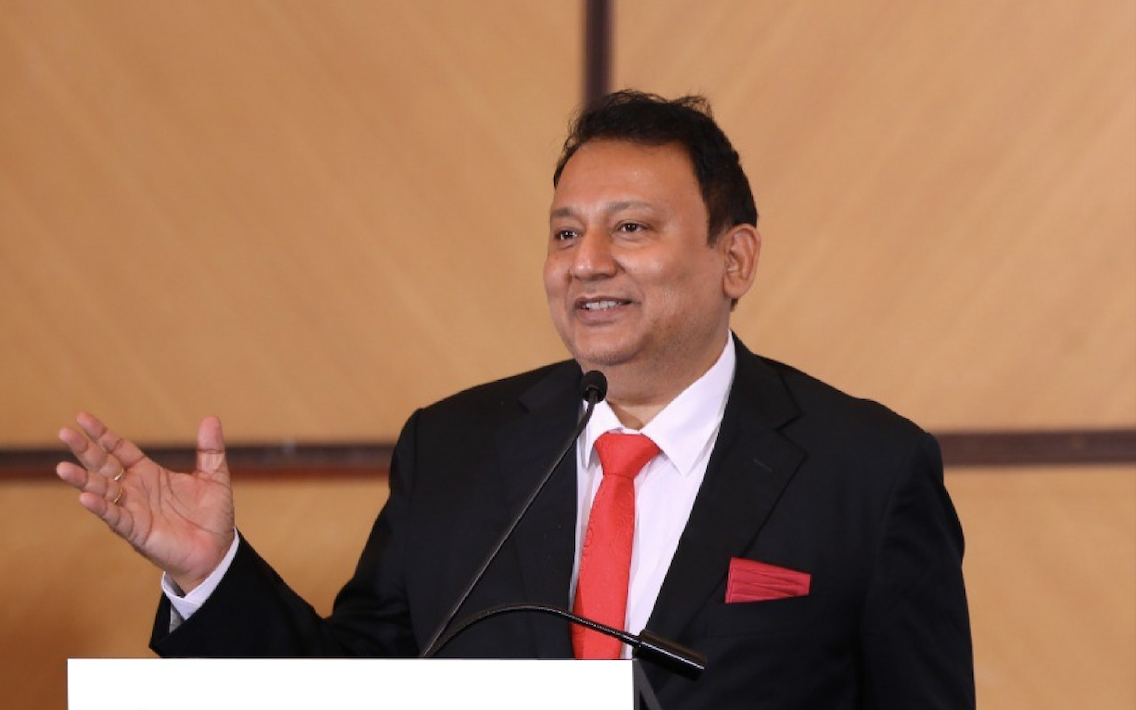
From pioneering India’s first incubator to investing in 500 startups and 11 unicorns, TiE Mumbai’s new president shares his playbook for spotting adaptive founders, scaling impact, and driving innovation from metros to Tier 3 cities.
By Kesav Dama
Apoorva Ranjan Sharma, a Ph.D. in incubation, pioneered India’s startup incubation ecosystem. Born in Kanpur, he began his career in the IT industry in Europe before returning to India in 2002 to prove the country’s first business incubator. He became an early leader in the Government of India’s incubation movement under the Department of Science and Technology, helping lay the groundwork for what has since grown into a network of 1,200 incubators and accelerators nationwide.
Sharma also plays a key role in the Startup India Seed Fund Scheme (SISF), backed by the Ministry of Commerce. This scheme allocates capital to incubators for investment in early-stage startups. He serves on the SISF advisory board, continuing his mission to strengthen India’s innovation and entrepreneurship ecosystem.
As the new President of the Mumbai chapter of The Indus Entrepreneurs (TiE), Sharma is preparing to lead from the front. Known for backing bold founders and building some of the country’s most iconic accelerators, his appointment signals a decisive push toward deeper impact, sharper founder support, and stronger ties across the startup–investor ecosystem.
With decades spent championing entrepreneurs from Tier 1 cities to India’s untapped heartlands, Sharma brings more than just experience. He is not one for buzzwords or theatrics; what sets him apart is his hands-on approach, sharp founder instincts, and deep-rooted belief that innovation is built on grit—not just pitch decks.
In an exclusive interview with Kesav Dama, Sharma shares his journey, vision, and plans. The interview has been edited for clarity.
Kesav Dama: For our audience, tell us what is the difference between an incubator and an accelerator?
Apoorva Ranjan Sharma: There is a stark difference between the two. Incubators are mostly physical spaces, while accelerators do not usually have a physical setup; they often function like micro-VCs. Accelerators are venture capital firms that develop startups through mentorship.
On the other hand, incubators typically do not invest or take equity — at least not traditionally. That changed slightly after the Startup India Seed Fund (SISF) scheme, where some began offering grants or small equity investments. But most incubators are still academy driven.
They usually offer subsidized infrastructure, co-working spaces, and support services like mentorship and networking. For instance, IIT Chennai hosts around 300 startups, and Somaiya in Mumbai has about 200. I spent 7 to 8 years setting up incubators across India, so I have seen that model up close.
How do corporate accelerators work, and how do they differ from traditional accelerators?
Corporate accelerators are designed to acquire the companies they accelerate. For example, they may build startups for Reliance, integrate them, and use them globally as reference cases. They are open to all kinds of startups, including international ones, but they usually do not invest directly. Since corporates back them, their motive is strategic alignment rather than financial return.
Accelerators, in general, can be of diverse types. Global models like Y Combinator and Tech-stars invest a fixed amount, take equity, and mentor companies to scale. Our fund, 9Unicorns, also works as an accelerator. We invest at the pre-seed stage, often when a startup is still on paper. We help build the company, offer mentorship, and once they grow, we move out. That is the core focus.
I come from an incubation background. I set up incubators for 7–8 years and launched my first accelerator in 2012. Then, 10 years ago, we started Venture Catalysts. Today, we have over 500 portfolio companies, 11 unicorns, and more than 70 soonicorns.
My first unicorn was Oyo, followed by Wow! Momo, GoMechanic, Shiprocket, and more recently, InsuranceDekho. They are digitizing insurance distribution across India—a space that is paper-based even today.
READ:How Murat Aktihanoglu turns 1,500 startup applications into 15 investments (August 3, 2025)
At the group level, we run five funds: Elevate, Beams, 9Unicorns, and two angel funds—VC Grid and Venture Address. The unicorns and soonicorns I mentioned came through these vehicles.
What are traits of a founder or business that made you want to invest in that company?
This is an individual perspective. However, because we invest early, companies are still shaping their business models and operations. What does not change is the founder; for the next five or ten years, they are still the core.
Now, the founder also changes in capability over time. That change is inevitable. If someone runs a $10 million company today and wants to run a $100 million or a billion-dollar company tomorrow, they must grow. If the founder cannot change or grow, the company will not either.
Change is constant. A founder must be adaptive. How adaptive they are—that is what we measure.
So, how do you measure that?
You must talk. You cannot use GPT or AI, and nothing works. So, what do I do? I meet at least 500 entrepreneurs every year. Over the last 20 years, that is about 10,000 face-to-face.
How do they get to that process?
Thousands of companies are emailing. There is a team that helps me out. Out of 70,000 to 40,000 startups we have looked at over the last 10 years, I would have personally evaluated around 6,000 to 7,000. The team filters it out.
How do startups typically reach you? Do they email you directly submit a deck somewhere, or is there a formal process?
Today, one can reach out via every medium, whether a website or social media tools like WhatsApp, Instagram, or LinkedIn. Many people reach out through LinkedIn or via references from our 100+ partners across India.
We operate in 54 cities and over 600 districts and receive many emails. A dedicated sourcing team actively works on this. We also visit campuses and have partnerships with various incubators.
Many VCs also refer deals to us. Once you start delivering consistently and building a solid portfolio, startups begin to come automatically, or even many are referred.
How do you identify which sectors and companies to invest in?
I do sector studies. Right now, I am focusing on defence, advanced manufacturing, and strategic autonomy because that is what any country needs. We are looking at companies making kamikaze drones or working on satellite refueling.
Many ideas come in at this stage, we evaluate based on a thesis—what will work and what will not. Each sector has 20–30 sub-categories, and 20–30 companies are in each sub-category. For example, defense has 1,200 startups in India. I am meeting 250 of them on 15th September—those who have received over ₹1 crore ($1.14 million) in grants.
Through TiE Mumbai, I am committed. If it is a good company, I will invest $1 million. We do many such outreach activities. After filtering, the Investment Committee decides yes or no. At the idea stage, access is everything.
Do you ever find yourself suggesting a business idea to a founder or someone who’s thinking about starting up?
In America, they say one of the best ways to find a VC is through a founder in their portfolio. Or if they recommend it, that is a good sign. It works if you know a partner or a founder who recommends.
Many startups recommend us. We also run a Scout program—27 unicorn and soonicorn founders help us get deals. They invest in these deals and then recommend them to us.
READ: Capital crunch, IPO backlogs, and the AI gold rush: What’s driving today’s market uncertainty (July 21, 2025)
Many VCs also refer deals to us. We have made our mark in the early stage. We have invested at the idea stage, and many of those companies have become successful. Our success ratio is good.
What sectors are you personally excited about right now, beyond consumer?
India is a consumer market, so D2C will always be in demand. New startups are born daily in D2C, consumer internet, and product companies. FinTech is also huge, especially after the UPI transformation. India now has over 30 FinTech unicorns and 10+ in D2C. It is a large domestic market with a strong banking system.
Sustainability has become a significant topic in the last four to five years. Many of our portfolio companies, such as Zypp Electric, ChargeZone, and Zingbus, are in this space.
We also found strong potential in advanced manufacturing. India is becoming a central manufacturing hub. One of our portfolio companies, Zetwerk, is in this space. For example, we invested in Ether Machine, which does precision manufacturing. They have set up CNC machines next to the Foxconn factory.
Another company I am investing in uses AI to improve the entire process flow by increasing productivity.
There’s a growing trend of companies shifting manufacturing from China to India. Are you seeing that play out?
Yes, that is happening. When Trump imposed high tariffs on China, around $100 million worth of business shifted to one of our portfolio companies, Network. So yes, manufacturing is coming to India. But globally, the situation is still unpredictable. One day it is 35%, then 500%, then back to 5% as the narrative changes. So, while the trend is real, it is hard to say how stable or long-term it is.
You’ve mentioned FinTech and Sustainability are your strongest personal interest areas. What’s happening in those spaces?
In FinTech, we are working on replicating India’s UPI in countries like Guyana. However, one major issue is that UPI does not allow you to make money directly from payments. For example, BharatPe became profitable by solving merchant problems; they built systems around payments, not just the payments themselves.
We also invest in companies like Neo (Forex cards), SKH Finance, and PropCap (inventory financing). These are not payments-focused but fall under the broader FinTech category. Only a few are in pure payments because making money in that segment is tough — the services are free for now, though that might change soon.
In Guyana, we pitched a system called GuyPay — a 2% fee model where 1% goes to the bank, 1% to GuyPay. That way, there’s revenue, and we can invest in educating the public on digital payments.
What’s your view on UPI innovation?
There is not much innovation in UPI anymore. But it is the fastest system globally for small-ticket payments — just one message, and it is done. Platforms like PhonePe and Google Pay run on it. It is simple, seamless, and supports billions of transactions.
You’ve been actively investing in sustainability. Could you explain your focus areas?
Yes. A few months ago, the Consulate General of India said, ” I know you’re investing a lot in sustainability, especially in waste-to-energy and municipal solid waste.” That includes cow dung and agricultural waste, which usually goes to methane. There is now a process converting biomass into butane, and the government is supporting it through offtake agreements. That conversation pushed me to go deeper into this space.
Plastic is a huge global problem, especially single-use plastic. The solution is biodegradable plastic. We invested in a company making biodegradable plastic using cellulose extracted from hemp molecules and some weeds. It is now one of the biggest plants in India. UK and US companies are doing it too, but India is in growing demand. These are plastic pellets that can be used to make any product. It is lighter, cost-effective, and stronger than regular plastic. Big players like Haldiram are already using it. The order book is around ₹400 crore ($46 million). Even with bottles like Coke, it can stay on shelves for up to six months before degrading.
I have also invested in five recycling plants—for plastic, aluminum, lithium, and solar panels. Recycling is booming, and every 15 days someone pitches a new plant.
Cement is another space. India’s limestone reserves may last only 10 more years. Burning 1kg of limestone releases 1kg of CO₂, and 25% of India’s pollution comes from cement. So, I have invested in a company developing a stronger, more flexible cement alternative made from plant-based materials. Cement companies are already blending it and setting up plants next to cement factories.
Another company I looked at replaces steel rebars with thermoplastics. These materials are already used in spacecraft, and the company has tweaked the formula to fit automotive use. They have even built a truck entirely out of this silica-based material.
Do you ever suggest a business idea to a founder or would-be founder?
No, that’s foolishness. Had I been that great, I would have started my own business. I am a VC entrepreneur: I invest and help companies grow. That is my role. I am not the best; 20 others are better than I am. I enjoy doing what I do.
I do get a heads-up on trends. Like sustainability, many companies are jumping into energy. What makes it hugely profitable is carbon credits. If you have a company that can expedite the creation of carbon credits, it’ll be worth a fortune.
One of my portfolio companies, G Electric, has 25,000 scooters on the ground. They are earning carbon credits daily. That falls under the voluntary regime. I have started tracking that; they earn every year.
There is another model in solid waste. Usually, waste goes to a landfill, leaving residual ash. Now, companies are converting solid waste into synthetic gas and earning carbon credits in the process.
There is a project in New Jersey—a $20 million investment that will generate $6.5 million in carbon credits per year, plus $1 million in synthetic gas. This company is expanding into India.
So, if someone becomes a carbon credit expediter, they will make a fortune. Most financials in sustainability now revolve around carbon credits.
What has TiE achieved in the last 35 years, and what still needs to be done?
TiE started 35 years ago to help entrepreneurs and businesspeople connect and do business through a strong network. It must work. India has 1.5 lakh startups, and TiE should have at least 60% of them under its umbrella, given its legacy. It has produced immense potential in India for over 25 years.
TiE is doing great in mentorship, connecting partners to entrepreneurs, and bringing like-minded ecosystem players together through events. What needs more focus is encouraging entrepreneurship further and creating subsystems to improve the environment around it. India has 120 unicorns—but we need more Indian investors and more accessible content for entrepreneurs.
Do your VC funds invest only in Indian startups?
Mostly, yes. Investing outside India has become difficult. Getting permissions from the RBI takes six to ten months, so we have stopped for now.
Are you launching any new programs for young entrepreneurs?
Yes. For entrepreneurs under 23, there will be a fellowship. They will come to places like this as observers. We will train them for months. That is one program. Another will be attached to that, and we will see how it goes in the first year.
Any pushback from other TiE chapters about your plans?
No, never. Mumbai has only three chapters; there’s space to start ten more. Whatever we do here benefits all. TiE Global approves programming: “I proposed it in Chandigarh and presented it there.”
Are there plans to expand accelerators and mentorship to Tier 2 and 3 cities?
Yes, that is already in progress. We are coordinating with column accelerators to do it.
By the end of your two-year term, what milestones are you targeting?
Three things. One—Does your solution solve a real problem? Two—is someone willing to pay for it? Three—I use a sector-specific thesis when evaluating startups. I do not apply the same model to every sector. If a company in D2C shows it can grow in three years, I will invest. And when it reaches $5 million in revenue, I will invest. For example, when they came to me, a healthcare company called Backpack, it was just an idea. I funded them. In two years, they made it work. I gave them a bit more. In another year, they had a human trial machine. Then a VC came in with $1 million. If they succeed in trials, they will enter the market. Healthcare takes five years—it is normal.
In a year, you know whether it is working or not. If it is, other investors line up. If not, it is obvious.
I meet founders every 3–4 months. We check progress. You get the next round only if you are performing. You can give 20 excuses, but unless you are in a pandemic, there is no reason not to be raising.
Does TiE Mumbai have its angel fund like some US chapters do?
They have a tie-in, but we do not have an angel fund structure. Many chapters in the US started it, and many in India also tried to close an angel fund. One hundred people screened here, and 50 are looking for angel funds. It is not an easy job. It is better to calibrate and elevate the angel fund and save the bandwidth. TiE is meant to develop companies, create a fertile environment, and connect them with VCs and angel investors. That is what I am going to do next year.
Enough angel funds are already available. If you also want to become an angel investor, that is a different business. I am not saying what others are doing is right or wrong—different people have different mindsets. For us, let us scale. One data point—if Maharashtra has 25,000 startups, TiE Mumbai should also have 25,000 with us. If they are with us, we are doing well.
If Mumbai has 5,000 to 10,000 startups, 2,000 should vouch for you. Are you doing a good job for them? Other associations—I do not know. Frankly, TiE is the oldest one, and remarkably good.
If an American angel fund wants to invest in Indian startups, what’s the best way?
Use the GIFT City license. It is like Singapore in India—a separate zone like the Cayman Islands, but in Gujarat. NRIs use these licenses to invest without worrying about tax exposure or authorities. It is a clean structure for getting money here.
If you want to invest in India’s best assets, use AI to identify them or collaborate with a local partner. We can recommend angel funds with licenses for that. They will guide you. Better than investing directly and worrying about taxation.
What about writing a direct check to a company?
Use the license—it helps. Otherwise, international transactions get complicated. We have done that before—we take FDI money through GIFT City.