



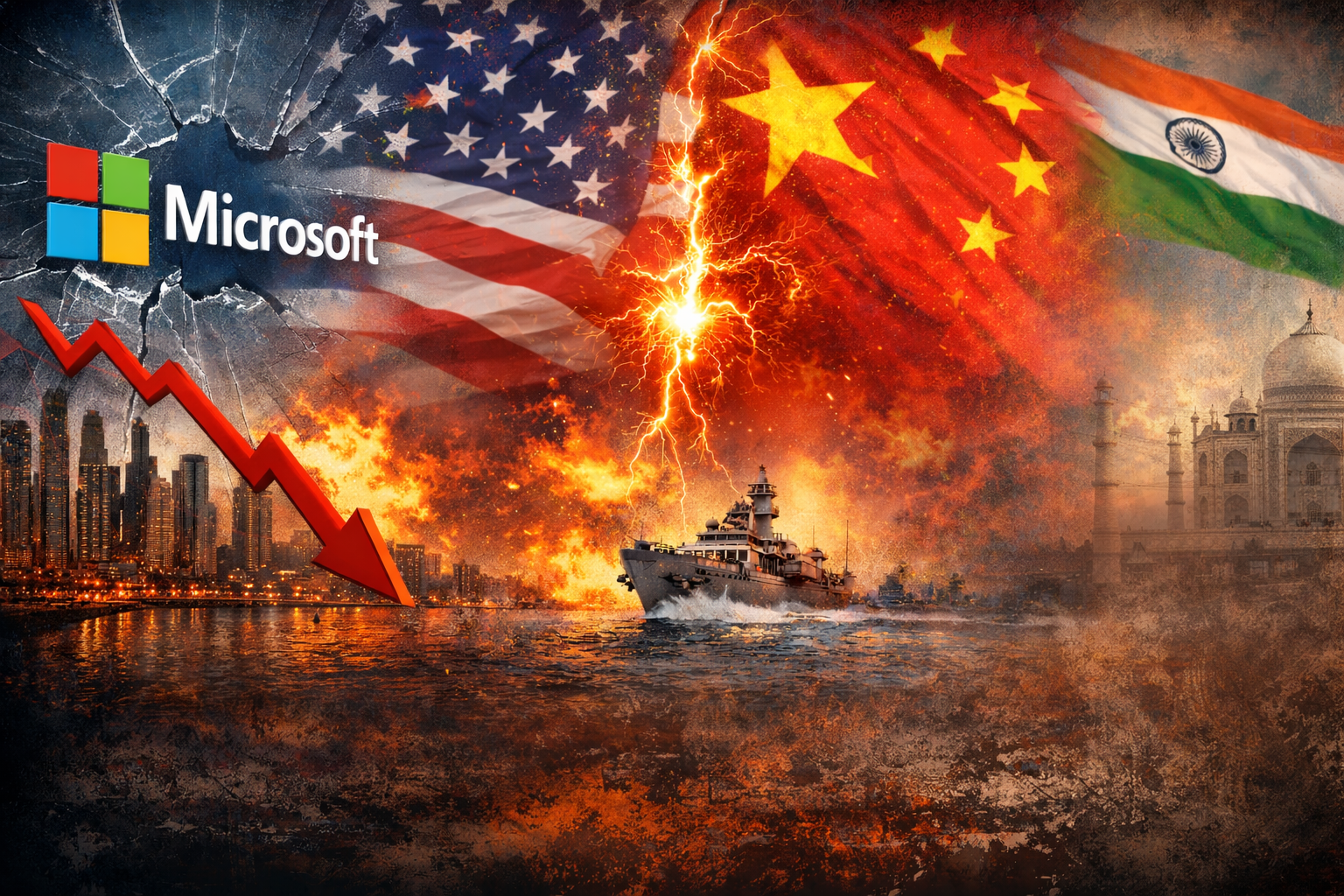
The word sovereign comes from political theory and it traditionally refers to the supreme authority within a territory and the power to govern without external dependence or interference. A sovereign state controls its laws, defenses, currency, and destiny.
In the age of artificial intelligence, sovereignty is being redefined. It now includes the capacity to independently build, scale, and control advanced AI systems which includes the models, the chips that run them, the data centers that house them, the scientists who design them, and the capital that sustains them.
The idea of complete AI sovereignty — that any one country could independently own and operate every part of the AI stack, from chips and data centers to models, talent, and access to data — is probably unrealistic. As the Sovereignty in the Age of AI report points out, building and sustaining frontier AI at scale requires enormous resources across multiple dimensions: energy to run hyperscale compute, semiconductor fabrication, global data-center networks, top-tier scientists and engineers, and access to the massive, diverse datasets needed to train models (institute.global).
No country today can fully internalize all of these capabilities on its own. The system is deeply interdependent: even the United States and China, the two centers of AI power, rely on foreign inputs, global markets, and international talent. That means AI sovereignty isn’t about total control so much as about having enough agency and leverage within a connected global ecosystem to protect interests and influence the direction of the technology.
For India, the challenge is clear: it cannot yet deliver the full stack required for scalable, independent AI. But by focusing on its strengths, a large digital market, a deep talent pool, and strategic partnerships —India could still play a meaningful role, even without full self-sufficiency.
Sreedhar Potarazu: Healthcare cracking, lawmakers scrambling, consumers falling: The demise of US healthcare as we know it (January 30, 2026)
This interdependence at the national level mirrors the corporate dynamics driving AI today. Microsoft, Meta, Google, and Amazon are not just competing for market share; they are building the underlying infrastructure that enables national sovereignty.
Microsoft’s massive investments in compute and data centers highlight the cost of sustaining frontier AI and the implications for its stock collapse . Meta’s integration of AI into advertising demonstrates how revenue generation can support long-term capability building. Google, through Gemini, quietly embeds advanced models into search, cloud, and productivity platforms, reinforcing structural influence rather than chasing headlines. Amazon, with its potential investment in OpenAI, signals how infrastructure control can translate into strategic leverage.
In this new race who will lead ? US , China or India? Meta, Microsoft, Google or Amazon? Open AI or Anthropic?
AI sovereignty, then, is not merely about technological leadership. It is about autonomy and who can train models without relying on foreign chips, deploy systems without renting compute from rivals, and shape global standards. By that definition, the AI race is no longer just a competition among companies like Microsoft, Meta, Google, and Amazon. But it is a contest among the US and China( and India in the shadows) with corporations serving as proxies. But some of those companies are losing their footing.
Microsoft shares tumble
The drop in Microsoft share price this week makes this tension an immediate reality . Microsoft’s massive investment in AI infrastructure—data centers, GPUs, power contracts, and its deep entanglement with OpenAI—has positioned it as one of the central pillars of the U.S. But scale comes at a cost and investors recoiled when those costs became visible, wiping hundreds of billions of dollars off Microsoft’s market capitalization in a matter of days. The reaction was not about whether AI matters but is about whether the financial burden of achieving AI supremacy is compatible with public-market patience.
Meta sticks to its core
Meta offers a different, and instructive, contrast. While it is spending at a comparable scale on AI infrastructure, Meta has tethered its AI ambitions tightly to its advertising engine. AI, for Meta, is not only a future capability but a revenue amplifier by improving targeting, automating creative generation, and reinforcing the cash flows that fund further expansion. This has bought Meta credibility with investors that Microsoft, at least for the moment, has struggled to maintain. Yet advertising is not an endgame but is a short term financing mechanism. The deeper question is whether a company whose core data advantage is social behavior—and whose revenue depends on attention can ultimately define the rules of an AI-driven world, or whether it is simply monetizing one layer of it.
Google and Amazon, meanwhile, occupy a quieter but no less consequential position. Google’s long investment in foundational research, custom chips, and vertically integrated AI systems gives it a form of latent sovereignty less visible in quarterly earnings but deeply embedded in the architecture of the internet itself. Recent versions of ChatGPT have faced headwinds as Gemini has eroded ChatGPT’s global traffic share and triggered a declared “code red” at OpenAI,
Amazon, through AWS, has become something even more fundamental as the infrastructure landlord of the digital economy. In many ways, AWS is closer to being “AI sovereign” than any single model builder, because sovereignty in practice often belongs to whoever owns the foundation on which everything else runs.
Amazon is reportedly in early-stage talks to invest up to $50 billion in OpenAI, a move that would make it one of the largest backers of the company behind ChatGPT and signal how infrastructure players are now trying to secure strategic positions in the AI ecosystem. Such an investment would deepen Amazon’s ties to the foundational models driving the industry and potentially shift the balance of influence away from Microsoft’s early exclusivity in cloud and compute support for OpenAI.
The New World Order- US or China
The most important AI contest is not Meta versus Microsoft or Google versus Amazon. It is the United States versus China. The world is drifting toward an AI order, in which only two countries possess the full stack required for true AI sovereignty: capital at scale, advanced semiconductor ecosystems, massive energy and data-center capacity, and a deep bench of scientific talent.
The United States benefits from an extraordinary alignment of private capital, research universities, and technology companies capable of deploying tens of billions of dollars almost overnight. China, by contrast, operates through state coordination by directing resources, shaping markets, and tolerating inefficiencies in the service of long-term strategic control. These are two very different paths to the same goal and independence in the most consequential technology of the century.
Sreedhar Potarazu: What it will take for doctors to transform US healthcare in a widening gap (
Where does this leave India?
India’s position is paradoxical. It has no shortage of talent. Indian engineers and scientists are everywhere, often at the core of AI teams in the very companies and countries competing for sovereignty and of course as CEO’s of the tech giants . But sovereignty is not about talent alone. It is about the three C’s of scale: capital, chips, and centers.
India lacks the depth of capital required to finance compute. It lacks a mature, domestic semiconductor manufacturing ecosystem. And it lacks hyperscale data-center infrastructure capable of competing with U.S. and Chinese deployments. Talent without these foundations will look elsewhere .. By the strict definition of AI sovereignty, India is not yet a contender—not because it missed the moment intellectually but because sovereignty is not just about code but what runs it .
The uncomfortable conclusion is that AI sovereignty may not be widely distributed. It may concentrate first in corporations, then in states, and ultimately in the narrow overlap between the two. The companies that appear dominant today may not be sovereign tomorrow if they cannot sustain the economic weight of scale. And nations that outsource too much of their AI capability to private actors may find that control is an illusion.
Sovereignty, in the end, is not about who invents AI first or even who uses it best. It is about who can afford to keep going when the costs compound, the returns lag, and the strategic stakes rise. In the age of artificial intelligence, sovereignty belongs to those who can endure.