


By Soumoshree Mukherjee
Editor’s note: This article is based on insights from a podcast series. The views expressed in the podcast reflect the speakers’ perspectives and do not necessarily represent those of this publication. Readers are encouraged to explore the full podcast for additional context.
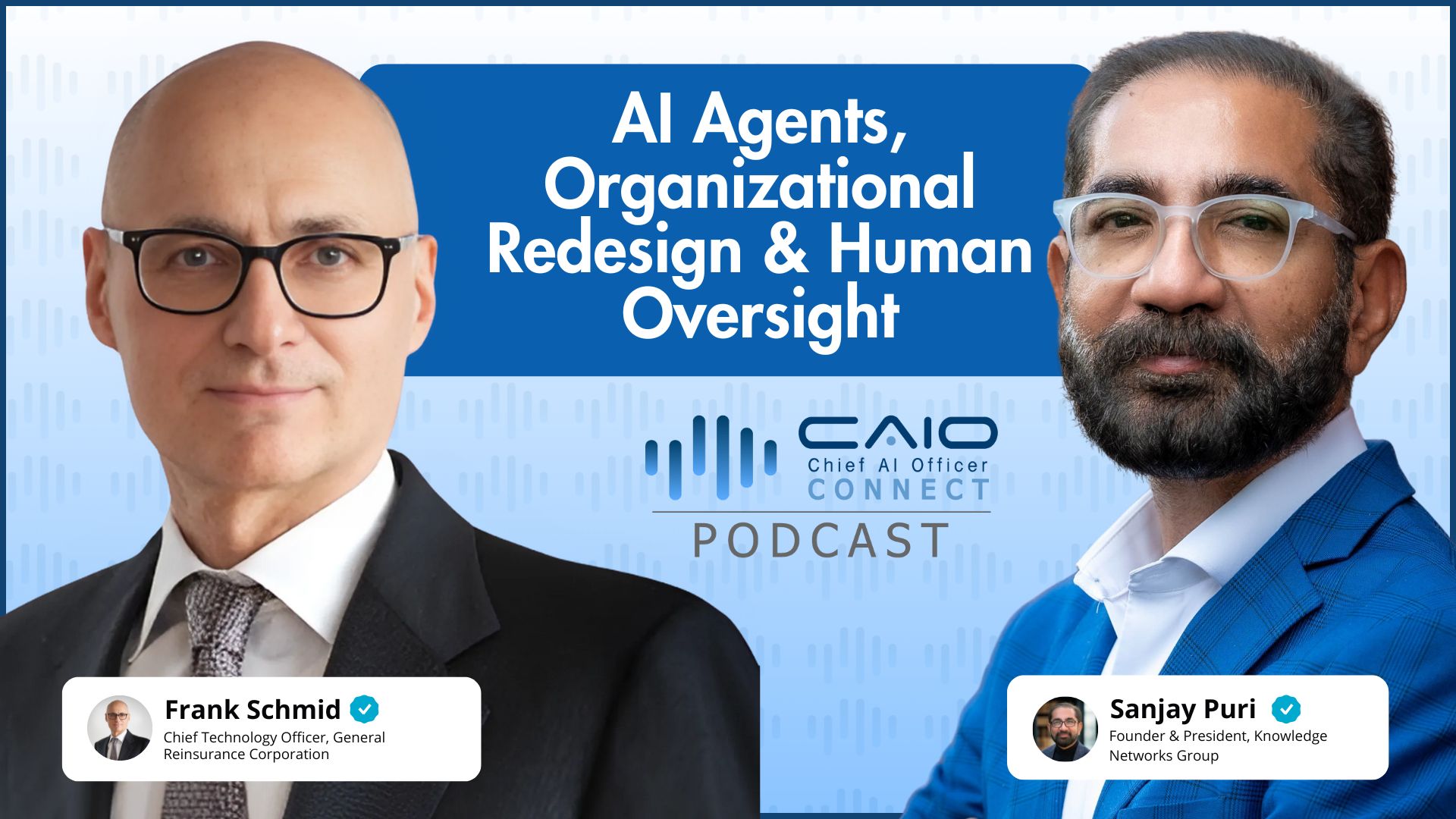
On the latest episode of “The CAIO Podcast,” host Sanjay Puri sat down with Frank A. Schmid, Chief Technology Officer at General Reinsurance Corporation (Gen Re), to explore how one of the world’s most established reinsurance companies is embracing generative AI.
Schmid, whose career spans academia, economics, and insurance, brings an unconventional lens to technology leadership. With a doctorate in economics and years as a research economist at the Federal Reserve Bank of St. Louis, he is no ordinary CTO.
“What I value about my current position that I can unite my background in econometrics, so quantification and my interest in technology,” Schmid told Puri. “So, we are seeing quantification and technology really coming together in generative AI.”
Schmid places AI in the lineage of transformative technologies alongside steam engines, electricity, semiconductors, and personal computers. He describes generative AI as a “general purpose technology” that will reshape not just tasks, but entire organizational models.
READ: ‘Bring Your Own Agents’: Claudionor Coelho Jr. on adopting AI securely (
Schmid noted, “think of how electricity changed the factory design when you transition from the steam engine to a decentralized source of power. And we may see a similar change in organizational design at across many industries including insurance, as we keep adopting generative AI, especially when it comes to AI agents.”
For a company with over a century of history, adopting AI requires more than plugging in new tools. Schmid emphasized change management as central to Gen Re’s journey. His team includes not only engineers but also a PhD social psychologist to manage organizational adoption.
“…we have gone through waves of technological development and the adoption of new technology,” he said, “it’s important as a technology leader to provide a framework for senior management.”
One of Schmid’s storytelling techniques to overcome scepticism involves simple access. Gen Re introduced co-pilots and secure productivity tools, letting employees discover value through use rather than mandate.
Currently, the company has 13 AI systems in production, moving from foundational data work to workflow redesign. Schmid outlined three stages of adoption: task-level improvements, workflow redesign, and eventually, organizational redesign powered by AI agents. While Gen Re has not deployed agents yet, it has developed the data models to be “agent ready.”
READ: ‘Everybody is responsible’: Prudential Financial’s Gaia Bellone on AI integration in finance (
Yet Schmid insists on human oversight. “We insist on human agency,” he stressed, drawing parallels with robotic process automation but acknowledging the added discretion and judgment AI agents bring.
Talent remains another challenge. In a market where AI engineers are lured by Silicon Valley giants, Schmid highlighted Gen Re’s academic freedom, autonomy, and meaningful impact as key draws.
“I think compensation is one aspect in people’s preferences, but to have an academically interesting environment with a great deal of autonomy and validation actually seems to work,” Schmid explained, “We actually have highly gifted AI engineers who have left others to join us at this point, I hope, of course, and I feel they are actually happy in this environment.”
Ultimately, Schmid remains optimistic about AI’s role in boosting defences in cybersecurity, about the productivity gains that will emerge despite the initial “J-curve” dip, and about the profound transformation underway.
“For the first time in history… the human has a competitor and that’s an AI system, an AI agent,” he said. “That will be more transformative potentially than previous general-purpose technologies.”