



By Soumoshree Mukherjee
Editor’s note: This article is based on insights from a podcast series. The views expressed in the podcast reflect the speakers’ perspectives and do not necessarily represent those of this publication. Readers are encouraged to explore the full podcast for additional context.
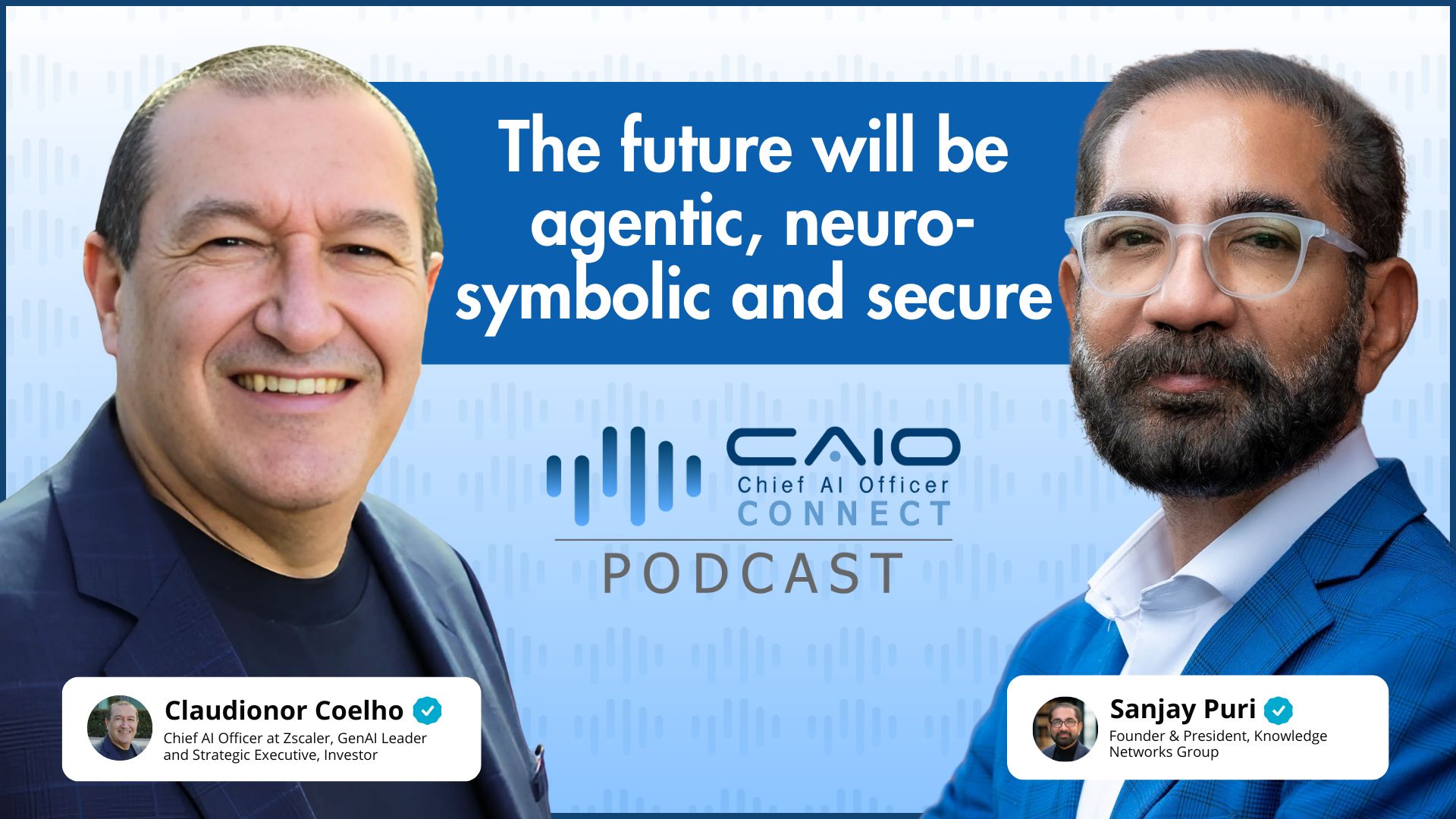
On a recent episode of the “CAIO Podcast,” host Sanjay Puri sat down with Claudionor Coelho Jr., Chief AI Officer at cybersecurity leader Zscaler, to unpack three decades of experience bridging mathematics, machine learning, and enterprise-scale AI.
Coelho’s journey began with a PhD from Stanford, specializing in formal verification a discipline that checks systems against rigorous rules. Two decades in academia and industry followed, including leadership roles at Google, Palo Alto Networks, and Advantest, before pivoting toward AI around 2010 as the technology matured.
Today, he leads AI strategy at Zscaler, operates the largest cloud-based cybersecurity platform in the world, processing over half a trillion transactions daily. “…to process that amount of data, we need from ground up to build an infrastructure that has AI in mind,” he said.
READ: ‘Everybody is responsible’: Prudential Financial’s Gaia Bellone on AI integration in finance (
A recurring theme in the conversation was the tension between discrete and probabilistic reasoning. Coelho explained that while large language models (LLMs) excel at probabilistic language interpretation, they stumble on rule-based, NP-complete problems like finding software bugs. “…LLMs can fix bugs but they can’t find them,” he noted, describing his “Unit 10x” project, which pairs formal methods to locate bugs with LLMs to generate fixes.
But recent advances in large language models (LLMs) have transformed the landscape, “… instead of being a human, [making you] a superhuman to be able to look into several scenarios and analyze several conditions at the same time. And that’s what generative AI is bringing to us at this stage in human society,” he said.
At Zscaler, Coelho’s approach to AI is grounded in security from the outset. He has been vocal about the risks in the emerging agentic ecosystem, where autonomous agents exchange data with other agents. His coined concept, “Bring Your Own Agent” (BYOA), envisions enterprises integrating third-party AI agents but warns of dangers when sensitive information leaves the corporate perimeter without traceability.
His advice: “One of the safest bets is to put everything under your virtual private cloud, so that at least you control where the data is going.”
Coelho also champions neuro-symbolic AI, blending neural networks with rule-based systems to counter LLM ambiguity. He predicts enterprises will increasingly use AI to help humans write rules, speeding up processes where instant decisions are critical.
READ: How CIOs are shaping the future of business: Insights from Ganesh Ramakrishnan (
When asked how enterprises should choose AI use cases, Coelho emphasized problem-driven design. “LLMs are extremely good at drawing business scenarios for you,” he sees immense opportunity in combining LLMs with internal structured and unstructured data to optimize workflows provided guardrails are in place to prevent hallucinations and leaks, “as you guide them, it helps you understand what really the business and the opportunity want to do.”
The pace of change, he warns, is unprecedented. From the World Economic Forum to Silicon Valley boardrooms, the conversation has shifted from ChatGPT to agents in under a year. For talent, Coelho seeks people who “think outside the box” and understand both AI tools and the business processes they’ll transform.
Asked how this wave compares to past tech revolutions like mobile or cloud, Coelho was clear: AI’s adoption is faster, riskier, and more transformative than anything before. “If you have UI/UX, as we put LLMs to be the forefront of the interaction with the user, people will not do UI/UX as they do it right now,” he said.
Coehlo makes it clear that from UI/UX to corporate governance, “[AI] will definitely change the way we do things.”
For him, the key to thriving in this transformation is simple—pair innovation with security, or risk losing both.