



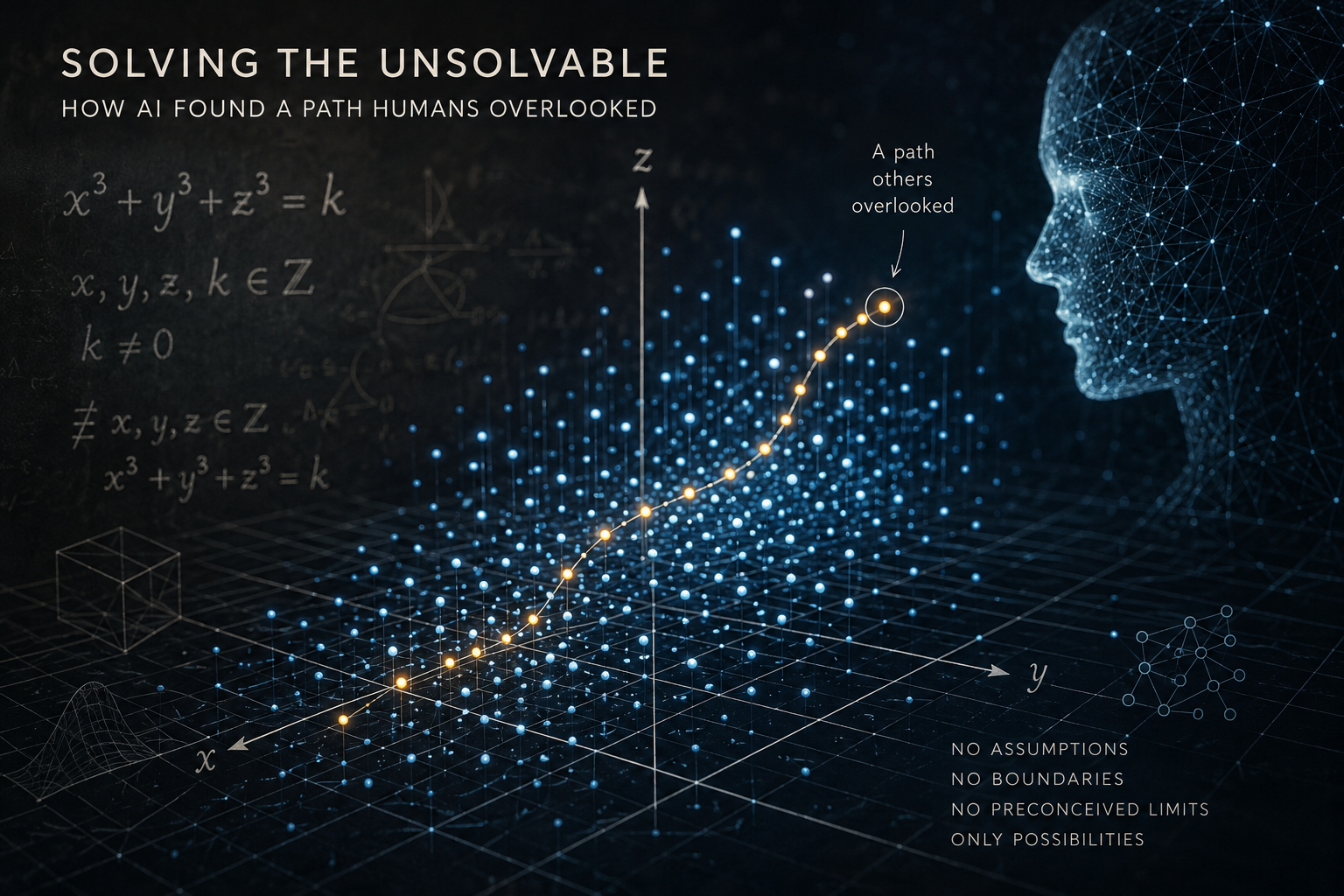
A recent announcement that an artificial intelligence model succeeded in solving a decades-old mathematical problem that had eluded generations of accomplished mathematicians was widely portrayed as another benchmark in the accelerating capabilities of AI. Much of the attention focused on the technical achievement itself, yet the mathematics may ultimately prove to be the least interesting aspect of the story.
What deserves a closer look though is why the model succeeded when highly trained human experts working over many years did not, because the answer reveals something far more significant than a breakthrough in mathematics. It exposes several characteristics of human cognition that have been narrowing over time and suggests that some of the very traits that once made human intelligence extraordinarily effective may now be limiting our ability to solve complex problems.
In very simple terms:
Imagine you have a sheet of paper and place dots on it. Now look at every possible pair of dots and count how many pairs are exactly the same distance apart.
For example, if four dots form a square, the four sides are all the same length, creating several equal-distance pairs.
Paul Erdős believed that if you wanted to maximize the number of equal-distance pairs, arranging the dots in a grid-like pattern was essentially the best you could do. For almost eighty years, mathematicians tried to prove that he was right.
The AI found something unexpected. It discovered a completely different arrangement of dots that created even more equal-distance pairs than the grid arrangement. That meant Erdős’s conjecture was not always true.
A simple analogy would be this: imagine everyone believes the best way to seat guests at a wedding is at round tables because that arrangement allows the most conversations between people. Researchers spend decades trying to prove that round tables are optimal. Then someone comes along with a completely different seating arrangement and shows that even more conversations can occur. The discovery is not that the original arrangement was bad—it was very good. The surprise is that there was a better arrangement that nobody had found.
READ: Sreedhar Potarazu | Vance vs Rubio round 3: Medicaid fraud, India, and the battle for the GOP’s future (May 29, 2026)
That is essentially what happened. Erdős thought the mathematical “seating arrangement” he identified was about as good as possible. Then AI found a better one. There are three reasons why:
The first reason is about how people approached the problem. Most mathematicians assumed that Erdős’s idea was probably correct, so they focused their efforts on trying to prove it. Once that belief became widely shared, it quietly shaped the direction of the work and made other possibilities, like the idea that the conjecture might be wrong, less likely to be explored. This was not a lack of intelligence. It is what often happens when experts spend a long time studying the same problem, because strong ideas begin to guide what they look at and what they ignore, even without anyone consciously deciding to narrow the search.
The AI model was not shaped by decades of agreement among mathematicians. It did not inherit the habits or assumptions that come from working inside a field for a long time, and it had no reason to favor one outcome over another. It simply explored different possibilities without preference for what experts expected to be true, and in doing so it followed a path that led to a disproof rather than a proof. The important point is not just that the conjecture turned out to be wrong, but that the answer came from exploring a direction that most researchers had gradually stopped considering.
This pattern is not limited to mathematics. Human thinking evolved to recognize patterns quickly, rely on past experience, and avoid wasting effort on ideas that seem unlikely to work. These traits were useful in environments where fast decisions mattered for survival. In the modern world, however, many of the most important breakthroughs come from questioning assumptions rather than following them. Real innovation often requires exploring ideas that initially look wrong, strange, or disconnected from what we already know. The difficulty is that the more expertise someone has, the more likely they are to trust established ideas and overlook alternatives.
The second reason is about how knowledge is organized. Human beings are forced to specialize because there is too much information for anyone to master across all fields. Over time, this has led to smaller and smaller areas of expertise, which has produced major progress but also separated knowledge into isolated domains. AI is different because it can move across many fields at once and combine ideas in ways that are difficult for any single person to do, which makes it easier to see connections between areas that humans rarely bring together.
The model’s solution used ideas from algebraic number theory and discrete geometry, two areas of mathematics that are usually studied separately and rarely connected in everyday research. Most mathematicians spend their careers focused on one of these areas or closely related topics. AI, however, is not limited by academic boundaries or professional labels, so it can combine ideas from different fields more freely. It treats knowledge as one connected space rather than separate subjects that do not often interact.
This difference may turn out to be one of the most important lessons from artificial intelligence. Many of the biggest advances in human history have happened when ideas moved from one field into another. Modern neuroscience came from the blending of biology, chemistry, psychology, and physics. Medical imaging developed through progress in engineering, mathematics, and computer science. Artificial intelligence itself was built from the coming together of several fields that were once separate. In general, major breakthroughs often happen where different areas of knowledge meet, even though education and professional training today tend to focus more on deep expertise in a single field rather than movement across fields.
The third reason is more difficult to accept because it goes beyond mathematics or science. The solution required long periods of sustained effort, patience, and a willingness to keep trying approaches that did not appear to be working. Humans are capable of very high levels of thinking, but they are limited by time, attention, and competing responsibilities. Researchers constantly have to choose what to pursue, when to stop, and where to focus their effort, because neither time nor attention is unlimited, and every decision involves trade-offs.
Artificial intelligence does not have the same limits. It does not get frustrated when repeated attempts fail, it is not pulled away by other responsibilities, and it does not lose momentum when progress is slow. Because of this, it can continue testing possibilities far longer than a human researcher realistically can, including paths that would normally be abandoned early.
READ: Sreedhar Potarazu | What would the great Hindu sages say about AI? (May 26, 2026)
The technologies around us are constantly competing for attention, breaking concentration into smaller pieces, and rewarding quick reactions over longer thought. At the same time, the problems we face are becoming more connected, more complex, and harder to solve with simple answers. The ability to focus deeply, connect ideas across different areas, and think independently is becoming more important, even as modern life seems to make those abilities harder to maintain.
Seen in this way, the breakthrough is not really about artificial intelligence being better than human intelligence. It is more about how human thinking has become narrower over time. The ability to question assumptions, connect ideas across different areas, and stay focused on difficult problems for long periods has always driven major human progress. AI did not create these abilities, but it showed what they can achieve when they are not limited by many of the constraints that have built up through evolution, specialization, and modern life.
The main lesson may not be about machines at all. It may be about whether we can regain and strengthen these ways of thinking in ourselves. If the future depends on the ability to think across fields, resist automatic agreement, and maintain deep focus despite constant distraction, then the real significance of this result is not that AI solved a problem humans could not. It is that it highlighted forms of thinking that humans may now need to consciously rebuild.