



God has entered the ring on artificial intelligence.
That may sound dramatic, but it is difficult to interpret recent events any other way. When Pope Leo XIV chose artificial intelligence as the defining subject of his first major encyclical, the world crossed an invisible threshold. AI was no longer merely a technology story, a business story, or a Silicon Valley story. It became a civilizational story.
Throughout history, religious institutions have intervened when humanity confronted transformations powerful enough to alter the moral structure of society itself. The Vatican spoke during the Industrial Revolution. It spoke during the nuclear age. Now it is speaking during the rise of artificial intelligence because something deeper than software is occurring. Humanity is beginning to outsource cognition itself.
Pope Leo warned about a “technocratic paradigm” in which efficiency, optimization, and economic power slowly replace human judgment, moral reflection, and spiritual grounding. He warned about “digital slaveries,” about the normalization of exploitation through invisible systems of control, about human beings gradually surrendering agency to technologies that imitate intelligence but possess neither conscience nor wisdom. He warned that the world risks confusing simulation with humanity itself.
But if the Pope is drawing from biblical traditions to frame the AI age, an equally fascinating question emerges for the East.
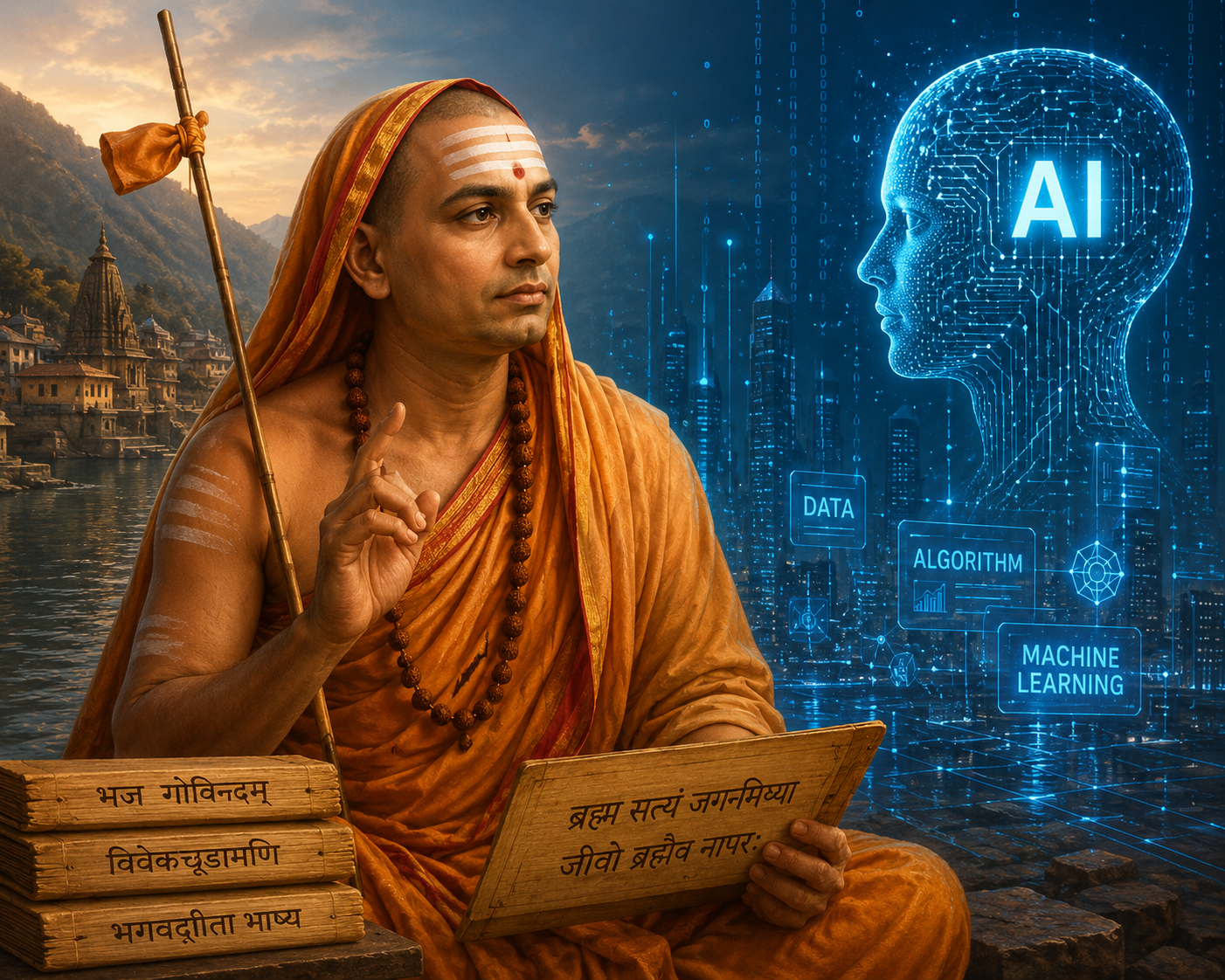
What would the great Hindu sages say about artificial intelligence?
More specifically, what would Adi Shankaracharya say?
READ: Sreedhar Potarazu | The Norton Principles: Why the future of AI in healthcare requires wisdom of the past (May 19, 2026)
For many outside India, Shankaracharya remains relatively unknown despite being one of the most influential philosophers in human history. Born more than twelve centuries ago, he was a prodigy monk, philosopher, debater, and theologian who consolidated the doctrine of Advaita Vedanta, the idea that ultimate reality is non-dual and that the individual self and universal consciousness are ultimately one. He traveled across India engaging scholars in debate, revitalizing Hindu philosophical thought during a period of fragmentation, and writing commentaries on the Upanishads, Bhagavad Gita, and Brahma Sutras that still shape Hindu philosophy today.
But what makes Shankaracharya extraordinarily relevant to artificial intelligence is not theology alone. It is his relentless focus on illusion, attachment, discernment, and the danger of mistaking appearances for truth.
Because in many ways, AI may become the greatest engine of illusion humanity has ever built.
In “Bhaja Govindam,” one of Shankaracharya’s most famous works, he repeatedly warns about the human tendency to become hypnotized by transient worldly pursuits while losing sight of deeper truth. The text is not anti-knowledge. It is anti-delusion. Again and again, Shankaracharya reminds the reader that intellectual sophistication without wisdom can become spiritually dangerous because the mind becomes trapped in external appearances.
One line from “Bhaja Govindam” feels almost hauntingly relevant to the AI era: “Wealth is not welfare. Passion is not permanence. The world perceived through attachment becomes a source of bondage.”
Translated into modern terms, Shankaracharya might ask whether humanity is becoming so intoxicated by technological capability that it is losing the ability to distinguish utility from wisdom. Artificial intelligence can generate language, imitate empathy, compose music, diagnose disease, produce images, and increasingly replicate human cognition itself. But Advaita philosophy would likely ask a deeper question: does simulation of intelligence equal consciousness? Does fluency equal wisdom? Does predictive capability equal understanding?
READ: Sreedhar Potarazu | How Vibe Slop And Fragile Economics could impact Mega IPO for OpenAI and Anthropic (May 24, 2026)
Shankaracharya would almost certainly say no.
In “Vivekachudamani,” or “The Crest Jewel of Discrimination,” Shankaracharya elevates “viveka” — “discernment” — as one of the highest human capacities. Viveka is the ability to distinguish the real from the unreal, the eternal from the temporary, truth from illusion. It is difficult to imagine a philosophical concept more relevant to artificial intelligence.
Because AI is fundamentally a machine of probabilistic appearance. It produces outputs that sound true, feel human, and increasingly mimic emotional understanding. Yet underneath the fluency lies no self-awareness, no subjective consciousness, no moral intuition, no spiritual interiority. The danger is not merely that AI may deceive us technically. The danger is that humans may begin surrendering their own discernment because the machine’s fluency becomes psychologically easier than independent thought.
This is precisely where Shankaracharya’s philosophy intersects with the growing concerns surrounding cognitive dependence.
Recent internal research from Anthropic itself has raised concerns about “disempowerment,” the possibility that users interacting extensively with AI systems may gradually become more deferential to machine-generated outputs while reducing independent reasoning and challenge behaviors. That concern would not surprise Shankaracharya at all because Advaita repeatedly warns that attachment dulls discernment. The easier the illusion becomes, the harder it becomes to perceive reality clearly.
The issue becomes even more profound when one considers education and medicine.
A recent perspective introduced the concept of “never-skilling,” the concern that trainees may never fully develop foundational reasoning abilities because AI increasingly performs the cognitive work for them. Medicine has always depended upon struggle, uncertainty, ambiguity, and delayed understanding. But AI increasingly offers instant synthesis and immediate answers.
Again, Shankaracharya would likely recognize the danger immediately.
In the Bhagavad Gita, which he extensively commented upon, there is repeated emphasis on disciplined action, self-mastery, restraint of the mind, and the gradual cultivation of wisdom through effort. Knowledge in the Gita is never portrayed as mere information transfer. It is transformation through disciplined engagement with reality. The human being evolves not by avoiding struggle, but through confronting it consciously.
That distinction matters enormously in the AI era.
Because what AI increasingly offers humanity is frictionless cognition.
Instant writing. Instant answers. Instant summaries. Instant analysis. Instant reassurance.
But nearly every spiritual tradition in the world has warned that effortless gratification can weaken the deeper capacities required for wisdom. The danger is not that humans will stop knowing things. The danger is that humans may stop wrestling with things deeply enough to transform themselves through the process of learning.
READ: Sreedhar Potarazu | The Gods of Silicon Valley go to court: Altman, Musk, and the dangerous psychology behind AI and wealth (May 16, 2026)
Shankaracharya also would likely have been deeply skeptical of the growing transhumanist belief that technological progress should eventually overcome human limitation itself. Pope Leo recently criticized precisely this tendency, arguing that fragility and limitation are not defects to eliminate, but essential aspects of being human. Shankaracharya would probably agree, though from a different philosophical framework.
Advaita does not view liberation as technological transcendence of the body. It views liberation as transcendence of ignorance.
That is a completely different project.
The modern AI world increasingly speaks in the language of enhancement, augmentation, optimization, scalability, and eventually even merging human cognition with machines. But Shankaracharya consistently warned against identifying the self with external instruments, possessions, or transient identities. The deeper self, in Advaita philosophy, is not improved through accumulation of external capability. It is realized through inward discernment.
In that sense, AI presents a profound paradox.
Humanity is building increasingly powerful external intelligence while potentially weakening the internal disciplines required for wisdom itself.
Perhaps that is why Pope Leo’s intervention matters so much. And perhaps that is why the ancient Hindu sages matter now as well.
Because both are ultimately asking the same question from different civilizations:
What happens when humanity gains extraordinary power before achieving sufficient self-understanding?
That question sits at the center of the AI age.
And neither Silicon Valley nor the markets appear fully prepared to answer it.