



By Soumoshree Mukherjee
Editor’s note: This article is based on insights from a podcast series. The views expressed in the podcast reflect the speakers’ perspectives and do not necessarily represent those of this publication. Readers are encouraged to explore the full podcast for additional context.
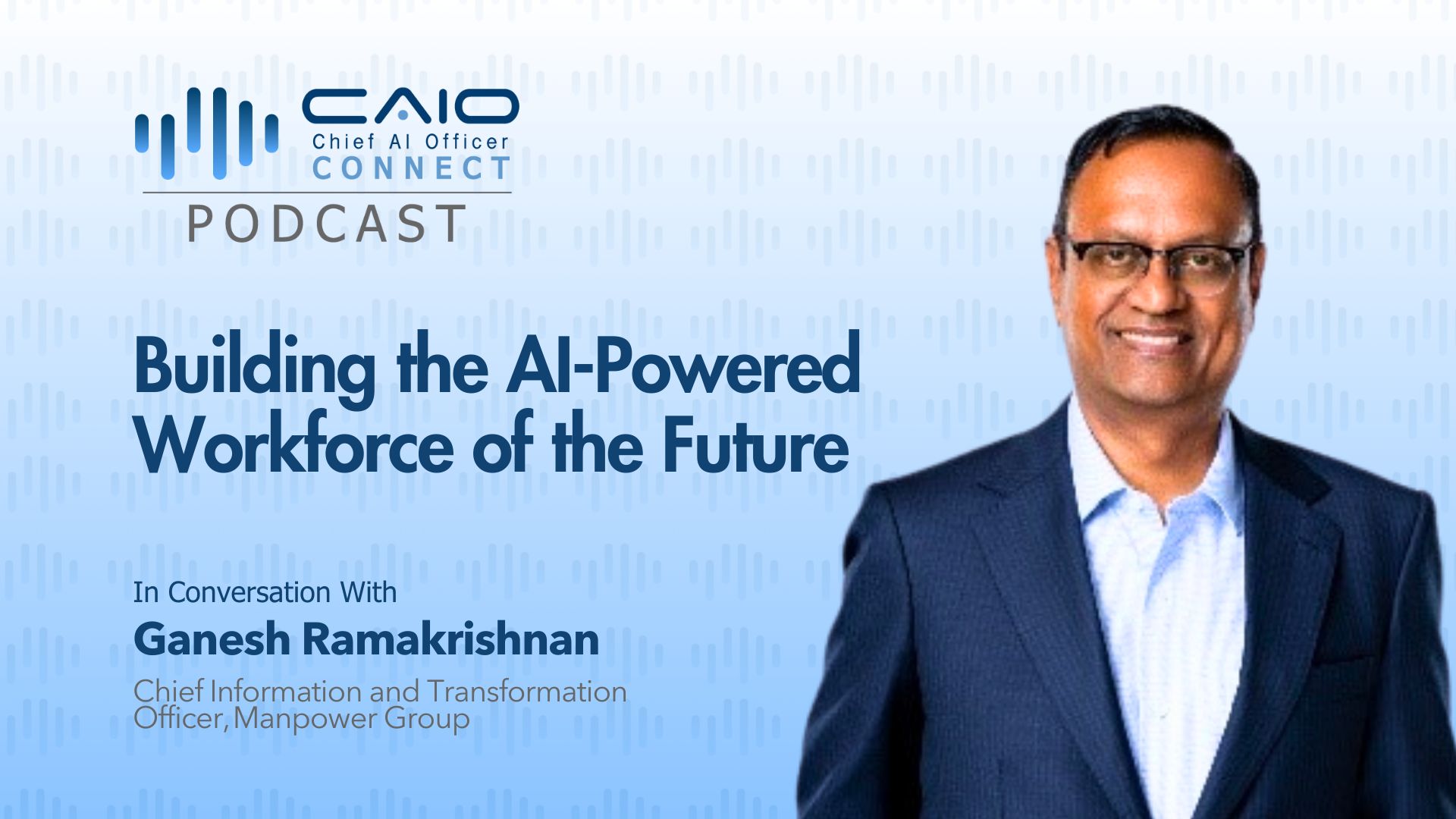
In a rapidly evolving business landscape, artificial intelligence (AI) is no longer a futuristic concept but a transformative force reshaping industry. Ganesh Ramakrishnan, a seasoned technology leader, emphasizing the pivotal role of Chief Information Officers (CIOs) in harnessing AI to drive innovation, foster resilience, and redefine business models.
Speaking on a recent episode of the CAIO podcast, the industry thought leader laid out a blueprint for how Chief Information Officers (CIOs) must step up as the architects of AI-driven transformation.
Ramakrishnan firms that AI offers businesses an unprecedented opportunity to innovate and grow. He said, “it was a wide variety of experience which shaped me and gave me a sense of how operations and technology can enable businesses.” But this potential comes wrapped in a web of confusing market signals and hype.
READ: From temp worker to CEO of a government contracting powerhouse: Anil Sharma’s C-Suite journey (July 1, 2025)
To cut through the noise, leaders must develop not just a technical understanding of AI’s mechanics, but also the strategic foresight to align it with clear business outcomes.
The role of the CIO, he argues, is evolving from that of a technology custodian to a critical bridge between complex tech stacks and real-world business strategy. Ramakrishnan underscores that understanding AI’s capabilities is essential for translating its potential into actionable strategies. Over the next decade, this shift could spell the difference between legacy companies that collapse under the weight of disruption and nimble players that thrive on it.
“It’s much more important for the CIO to understand strategically what does the cloud offer businesses… The CIO needs to know the true significance of what these new technologies can do to their organization,” he stressed. CIOs must integrate people, processes, and technology: this holistic approach, Ramakrishnan believes, will allow organizations to build a robust digital core powered by cloud capabilities and clean data on which AI and analytics can truly flourish.
Yet technology alone won’t guarantee success. “What you need is critical thinking skills and a good appreciation of what is a possibility of what AI has to offer,” he said. Ramakrishnan underlines the importance of talent, describing AI not only as a tool for innovation but as a personalized talent agent that can revolutionize recruitment and career growth.
Imagine virtual AI assistants guiding job seekers with tailored advice, easing anxieties, and opening pathways they hadn’t considered. It’s an empowering vision of the future of work, one where AI augments human potential rather than replacing it.
But to unlock this vision, companies must rethink how they deploy AI. Rather than scattering resources across countless experiments, Ramakrishnan advises focusing on four or five big, industry-relevant initiatives with strong business alignment and CEO support. “Data is your competitive advantage…,” he said, especially for established firms navigating a landscape brimming with ambitious startups.
At the heart of successful AI adoption, though, lies a cultural transformation. Critical thinking, diversity, and continuous learning are the new cornerstones of resilient technology teams. It’s not just about coding smarter algorithms but about questioning assumptions, mitigating bias, and making ethical choices. Ramakrishnan calls for a proactive risk framework for AI development, an essential step in an age where trust can be easily eroded.
He likens the commitment to continuous learning to a daily workout routine. “… develop learning as a lifelong activity,” he said, reminding leaders that adaptability is no longer optional in a world of rapid technological churn.
Ganesh Ramakrishnan’s message is clear: for organizations aiming to turn AI’s promise into tangible results, the human factor is what will set them apart. As businesses navigate this AI revolution, CIOs stand at the forefront, translating technology into strategic advantages.
By fostering critical thinking, embracing diversity, and championing ethical AI, they are not just adapting to change—they are shaping the future of work.