


Key findings:
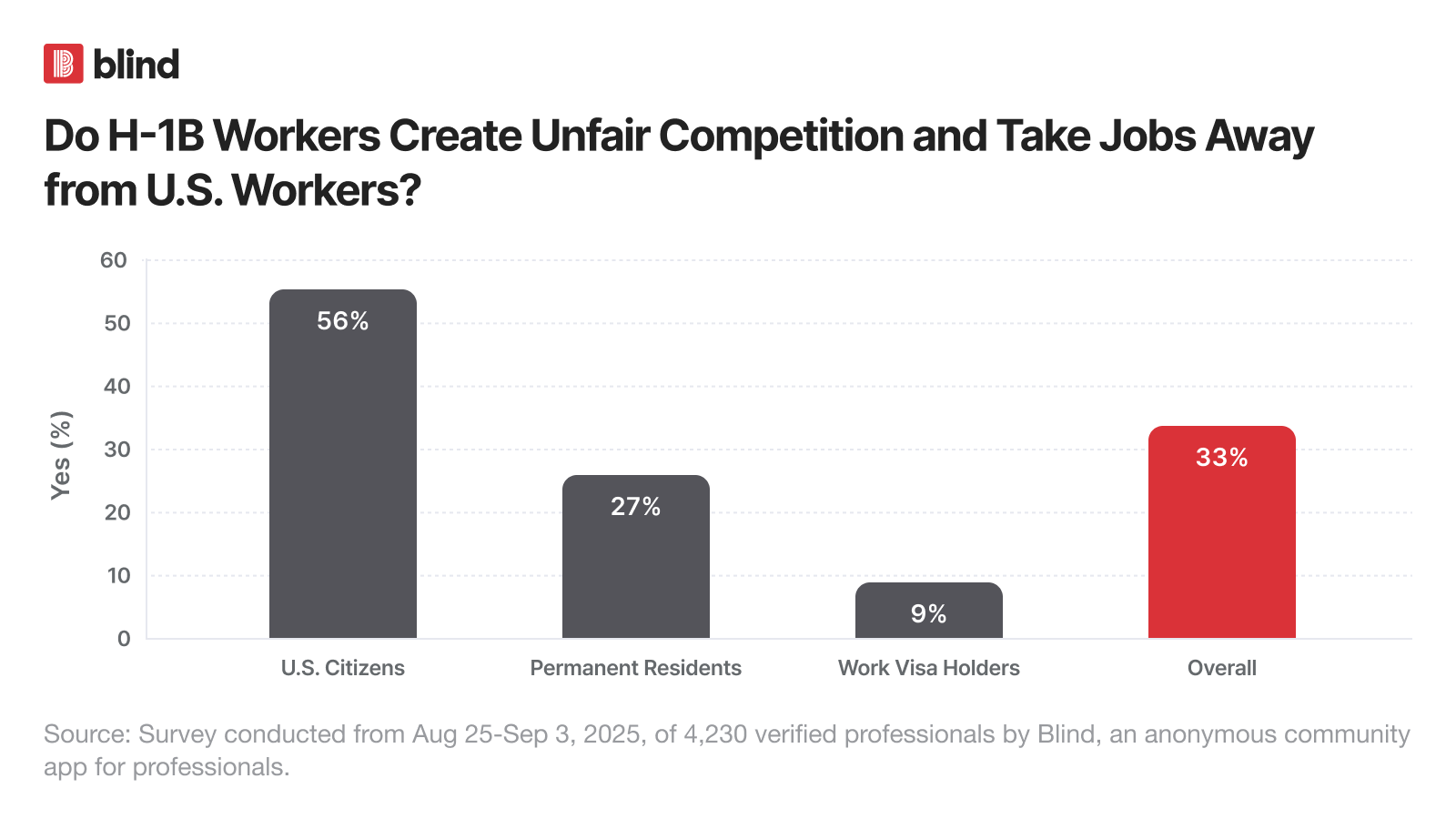
· More than half of American citizens (56%) believe H-1Bs are taking jobs away from locals.
· 60% of citizens wanted preference given should be to Americans and green card holders when it came to job hiring.
· 33% overall said H-1B visa holders create unfair competition and viewed them as direct competitors for jobs.
Editor’s note: Names of sources have been changed in the story on request.
On a recent Friday, Ankit Sharma, a 29-year-old software engineer from Hyderabad, India, sat staring at his laptop in a Bay Area café. Laid off from a mid-sized fintech firm just weeks earlier, he wasn’t only worried about finding his next job. He was racing against the 60-day H-1B grace period that could send him back to India if he failed.
In today’s climate, Sharma says, the odds of landing a job feel slimmer than ever. What worries him most is not just the competition, but the growing prejudice he senses against workers on H-1B visas. Once hailed as the backbone of America’s tech boom—hard-working professionals who poured billions into the U.S. economy—H-1B workers are now increasingly cast as villains in the job market. “The atmosphere feels hostile,” he admitted.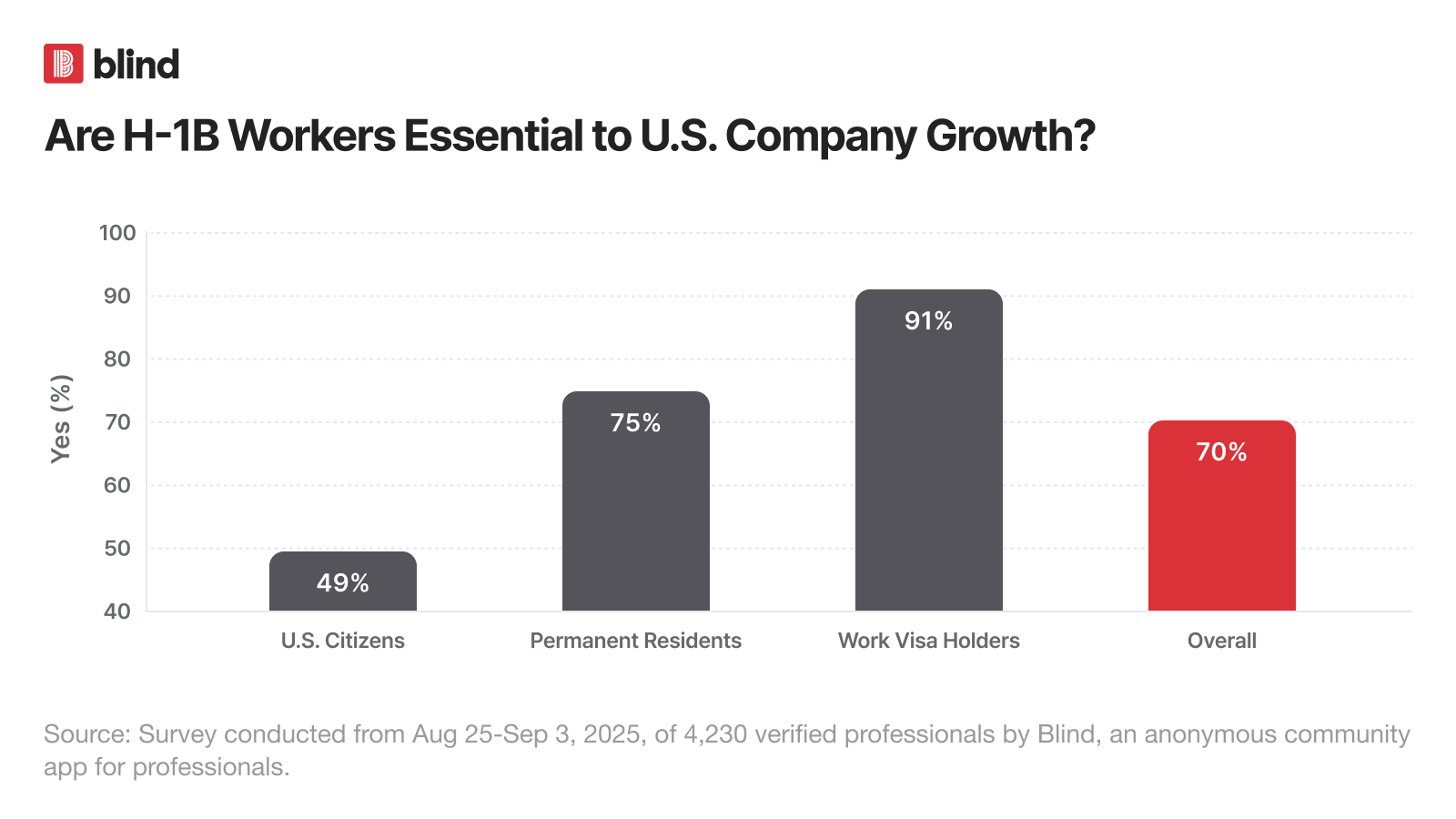
Sharma’s fears may not be unfounded. A new survey released today suggests a deep divide in how Americans view foreign workers. More than half of U.S. citizens believe professionals like him are taking jobs away.
READ: Who lost India? Trump’s tariff approach puts a generation of U.S.-India progress at risk (August 19, 2025)
The survey, conducted by Blind, a San Francisco-based anonymous community app for verified professionals, examined perceptions of H-1B workers and their impact on the job market. The results paint a stark picture: 56% of American citizens surveyed believe H-1B holders displace local workers, while nearly nine in ten foreign-born professionals (87%) argue they are essential to driving company growth.
Blind, which has over 10 million users across industries including tech, finance, healthcare, and automotive, is known for offering unfiltered workplace conversations rarely voiced in boardrooms. True to form, the latest findings provide a candid snapshot of U.S. sentiment. For many, H-1B workers remain vital to innovation and competitiveness. For others, they represent direct rivals in an already cutthroat job market.
For Indian professionals like Sharma, that divide reflects a stark truth—celebrated for their skills, yet quietly resented for their presence.
A Blind survey of more than 4,200 U.S. professionals reveals sharp divisions over the H-1B program. 56% of U.S. citizens say H-1B workers are taking jobs from locals, while nearly nine in 10 foreign-born professionals believe they are essential to company growth. For Indian immigrants, who make up the largest share of H-1B holders, the numbers are a gut punch—highlighting an uncomfortable reality: their skills may be in demand, but their presence remains contested.
When asked whether companies should simply hire the best talent regardless of nationality or visa status, 63% of respondents said yes. But beneath that consensus, sharp divides emerged. Six in ten U.S. citizens said Americans and green card holders should be given priority. Only 11% of H-1B workers agreed. Even green card holders—many of them former H-1Bs—were conflicted, with 35% siding with citizens. The takeaway: visa status isn’t just paperwork; it shapes how colleagues perceive one another.
Perhaps the most striking finding centered on competition — one-third of all professionals surveyed said H-1B workers create unfair competition, but that figure rose to more than half among U.S. citizens. By contrast, just 27% of green card holders and 9% of H-1B workers themselves agreed. For Indians like Ankit, the contradiction is hard to ignore: celebrated as innovators one moment, branded job thieves the next.
The survey comes amid sharpened political rhetoric. Senator JD Vance has accused Big Tech of replacing Americans with foreign workers, while the Walmart layoff scandal and reports of PERM sabotage have fueled perceptions that H-1Bs undermine local jobs. For Indian families already stuck in years-long green card backlogs, each political jab is a reminder that they remain guests in a country they helped build.
Inside companies, the divide is just as stark. A Microsoft professional on Blind wrote, “The H-1B and other visa programs are out of control. The U.S. has enough SWE grads now — these programs should be scaled back significantly.” An Amazon engineer countered: “Stopping H-1B renewals just moves cutting-edge development to another country. Tech follows talent.” A PayPal worker put it more bluntly: “Once someone is in the labor pool, they’re equal. None of this ‘H-1Bs should be first to go’ nonsense.”
For Indian professionals on H-1B visas, this survey isn’t abstract data. It’s a mirror to the undercurrent they feel every day in offices, Zoom meetings, and job interviews. The current moment lays bare an unsaid reality: while the American Dream is often celebrated in books and anecdotes, little is done to clear the obstacles along the way. For millions of immigrants who leave their homes to build a new life, the dilemma endures — the paycheck may come, but often at the cost of belonging.