



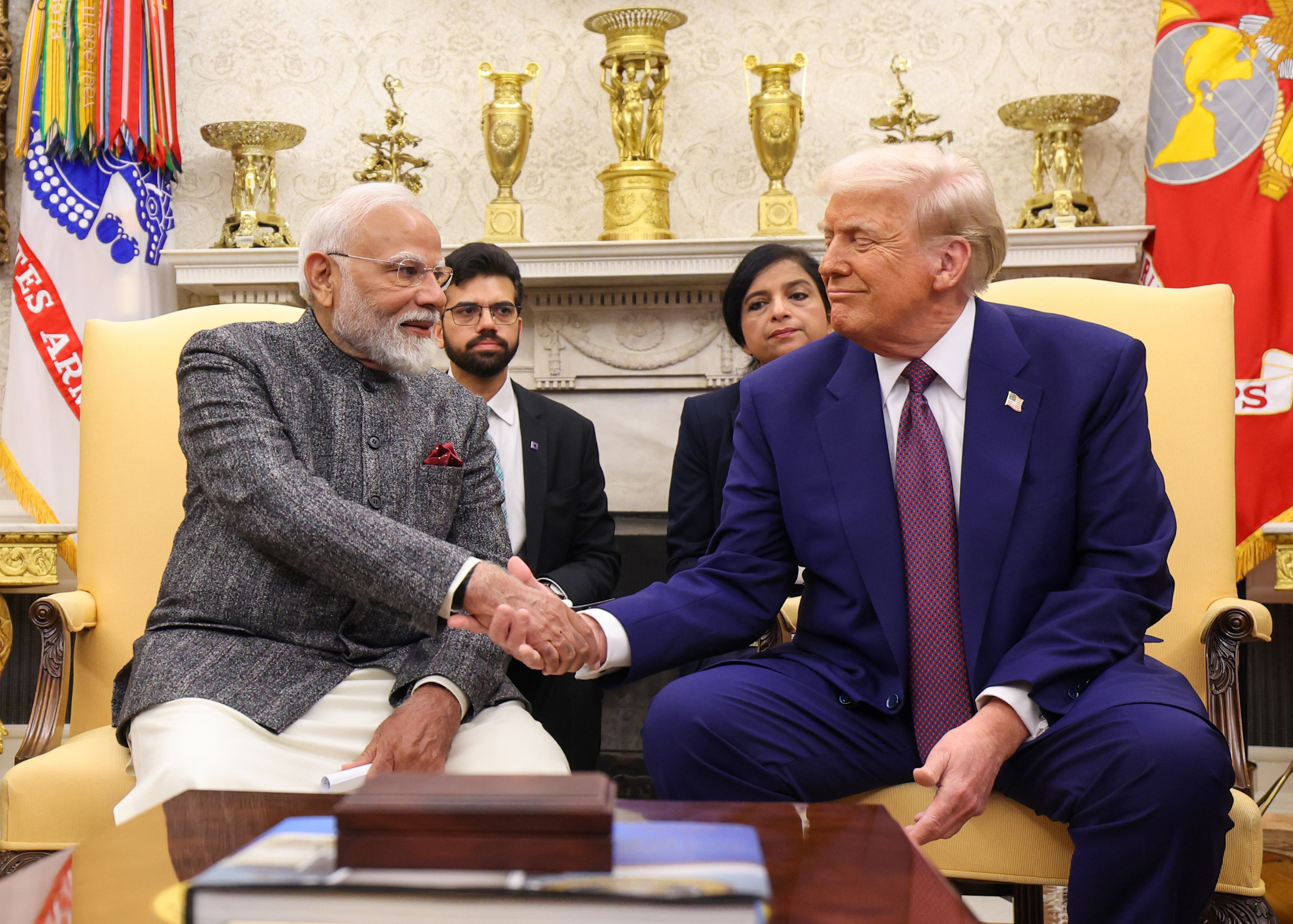
Earlier this month, President Donald Trump announced a sweeping new set of tariffs on India, beginning with a 25 percent levy on Indian goods, quickly followed by an additional 25 percent penalty tied to India’s purchase of Russian oil. Together, the 50 percent tariff shock threatens a generation of progress in U.S.-India relations.
 For more than two decades, successive U.S. administrations — Democratic and Republican alike — have invested time, political capital, and trust in strengthening ties with New Delhi. Trump’s sudden escalation risks eroding that progress.
The U.S.-India relationship, in its current form, is the product of sustained bipartisan effort across five presidencies. President Bill Clinton’s historic 2000 trip to India symbolized a new era of engagement. George W. Bush pushed through the landmark 2008 U.S.-India Civil Nuclear Agreement, a deal that effectively recognized India as a responsible nuclear power.
Frank F. Islam: How ideology contributed to flood devastation in the Texas Hill Country (July 18, 2025)
Barack Obama elevated the partnership further, visiting India twice. On his first trip, which I was privileged to be part of, the president famously called the relationship one of the “defining partnerships of the 21st century.” Even Trump’s own first term, despite transactional overtones, had moments of warmth, such as the “Howdy Modi” rally in Houston and Prime Minister Narendra Modi’s return gesture at the “Namaste Trump” event in Ahmedabad.
But Trump has jolted that positive trajectory. As CNN’s Fareed Zakaria observes, “Donald Trump’s sudden, inexplicable hostility toward India reverses policies pursued under five administrations, including his own previous one. If it holds, this reversal may be the biggest strategic mistake of the Trump presidency so far.”
To examine why that might be the case, let’s put the India-US economic relationship into context.
India and the United States traded goods worth nearly $130 billion in 2024, underscoring the depth of their economic ties. Indian exports to the U.S., which range from carpets, textiles, and garments to furniture, gems, and jewelry, provide livelihoods for millions of Indian families.
According to The New York Times, one sector that is particularly vulnerable to new trade barriers is the carpet industry, as nearly three-fifths of India’s carpet is exported to the United States.
Frank F. Islam: A third Gulf War could rattle markets and strengthen China’s hand (June 23, 2025)
India also serves as the largest supplier of generic pharmaceuticals to the United States, a cornerstone of affordable healthcare for American consumers. Yet, the Trump administration is now weighing tariffs on these medicines that could soar between 150 and 250 percent, a move with far-reaching consequences for both economies.
India, however, is not as vulnerable to American tariffs as Trump might believe. With exports accounting for just over 20 percent of GDP, India remains a largely domestically driven economy, powered by its enormous consumer base. Tariffs will hurt, but they are unlikely to derail India’s growth trajectory.
Admittedly, in spite of the substantial progress through the years, the trade relationship between India and the U.S. has not been perfect. Washington and New Delhi have sparred on trade issues for decades.
Intellectual property rights, agricultural subsidies, and market access are perennial points of contention between them. U.S. businesses have long argued that India’s protectionist tendencies keep out American products, from Harley-Davidson motorcycles to medical devices.
Frank F. Islam: Trump’s tariffs are undermining the U.S. economy(May 17, 2025)
Yet, no U.S. president has crossed the line into public insults. That changed with Trump, who has accused India of “taking America for a ride” and calling it a “dead economy”.
What makes this escalation even sharper is that it appears deliberate, not impulsive.
On Monday, August 18, the president’s long-time trade advisor Peter Navarro, a leading tariff hawk within the administration, denounced India in an opinion piece for the Financial Times.
Navarro accused India of acting as a “global clearinghouse” for Russian oil, buying embargoed crude at a discount, refining it, and then selling it abroad.
“The proceeds flow to India’s politically connected energy titans, and in turn, into Vladimir Putin’s war chest,” he wrote. His swipe is widely seen as a reference to Indian billionaires Mukesh Ambani and Gautam Adani, who dominate the country’s energy sector.
Navarro coupled that charge with renewed criticism of India’s “excessively high tariffs” blocking U.S. exports.
Read more columns by Frank F. Islam
This framing aligns neatly with Trump’s worldview: foreign nations as competitors unfairly exploiting American openness. The tariffs were not an isolated outburst; they reflected the Navarro doctrine of economic nationalism that has guided Trump’s second-term trade policies.
Trump’s tariffs on India are definitely problematic. What may leave deeper scars, however, are his public insults. Trump’s language will be long remembered in New Delhi, where the political and diplomatic class prizes dignity and recognition. Washington may roll back tariffs, especially if they fuel inflation at home or risk tipping the U.S. into recession but repairing trust after such rhetoric will prove harder.
Trump prides himself on being a deal-maker. And, he is known for employing short-term political theater, bluffs, and shock-and-awe moves as part of his deal-making portfolio. In this case, the imposition of tariffs and name-calling may not produce the desired results and have long-term negative consequences.
Whether seeking to score domestic points or to punish India for nonalignment, President Trump risks alienating a partner that successive administrations viewed as critical to balancing China’s rise. Washington’s bet for the past two decades has been that a strong U.S.-India relationship is in America’s long-term interest. By putting that at risk, Trump may well be squandering a generational opportunity.
In the aftermath of the communist victory in China in 1949, U.S. policymakers asked: “Who lost China?” Today, as tariffs and insults pile up, one might soon be asking: “Who lost India?”