


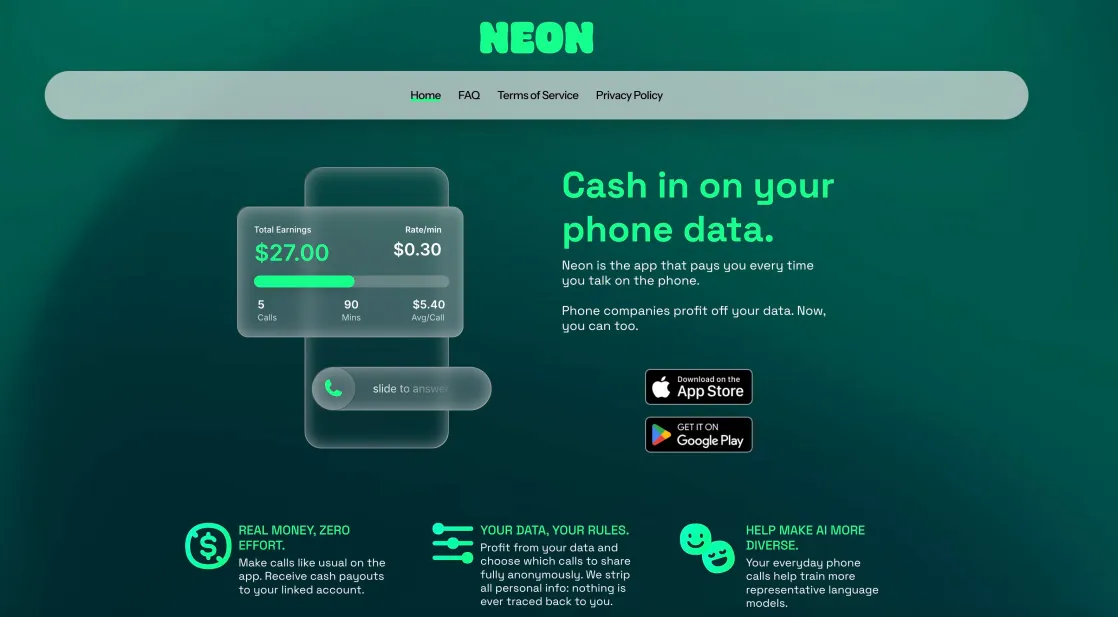
Neon Mobile, a new app has recently climbed to the second position on the iPhone’s top free charts for social apps. The app offers to record phone calls, and pays users for the audio, which it sells to artificial intelligence companies.
The app pitches itself as a “moneymaking tool,” offering “hundreds or even thousands of dollars per year” for access to audio conversations. Neon’s website says the company pays 30¢ per minute for calls with other Neon users and up to $30 per day maximum for calls with anyone else. The app also pays for referrals.
While many have gravitated towards this app seeing it as an easy way of making quick money, it has also raised serious concerns regarding privacy. While big companies like Meta, OpenAI and Google have been harvesting large amounts of user data without paying users directly, Neon offers an opportunity for payment in exchange for the data. However, this comes at a cost, with users’ voice data becoming company property.
READ: Meet Hour unveils sleek new UI designed for smarter, more human collaboration (
Neon mobile’s disclaimers are very broad. By submitting recordings, users grant the company an exclusive, irrevocable, and transferable license to sell, modify, display, or distribute their recordings across any media, now or in the future. So once uploaded, the data no longer belongs to users.
Neon’s terms include a very broad license to its user data, where the company grants itself a “worldwide, exclusive, irrevocable, transferable, royalty-free, fully paid right and license (with the right to sublicense through multiple tiers) to sell, use, host, store, transfer, publicly display, publicly perform (including by means of a digital audio transmission), communicate to the public, reproduce, modify for the purpose of formatting for display, create derivative works as authorized in these terms, and distribute your recordings, in whole or in part, in any media formats and through any media channels, in each instance whether now known or hereafter developed,” according to TechCrunch.
The terms also include an extensive section on beta features, which have no warranty and may have all sorts of issues and bugs.
READ: New social platform Front Page lets users post and connect in their own language (
Naturally this has raised a number of red flags, with The Tech Times calling the disclaimer “dystopian.” It follows a commonly-seen pattern with tech companies — Anthropic confirms it employs users’ interactions with Claude to train AI and keeps them for five years, and Amazon has moved the Alexa+ assistant off-device, so all voice commands now flow through cloud servers. Overall, Neon Mobile’s strategy indicates just how far AI has encroached into people’s lives.
Regarding the legality of this, Jennifer Daniels, a partner with the law firm Blank Rome‘s Privacy, Security & Data Protection Group, told TechCrunch that “recording only one side of the phone call is aimed at avoiding wiretap laws.”
“Under [the] laws of many states, you have to have consent from both parties to a conversation in order to record it … It’s an interesting approach,” she said.
Peter Jackson, cybersecurity and privacy attorney at Greenberg Glusker told TechCrunch that the language around “one-sided transcripts” sounds like it could be a backdoor way of saying that Neon records users’ calls in their entirety but may just remove what the other party said from the final transcript. Legal experts have also raised concerns around just how anonymized the data might really be.