


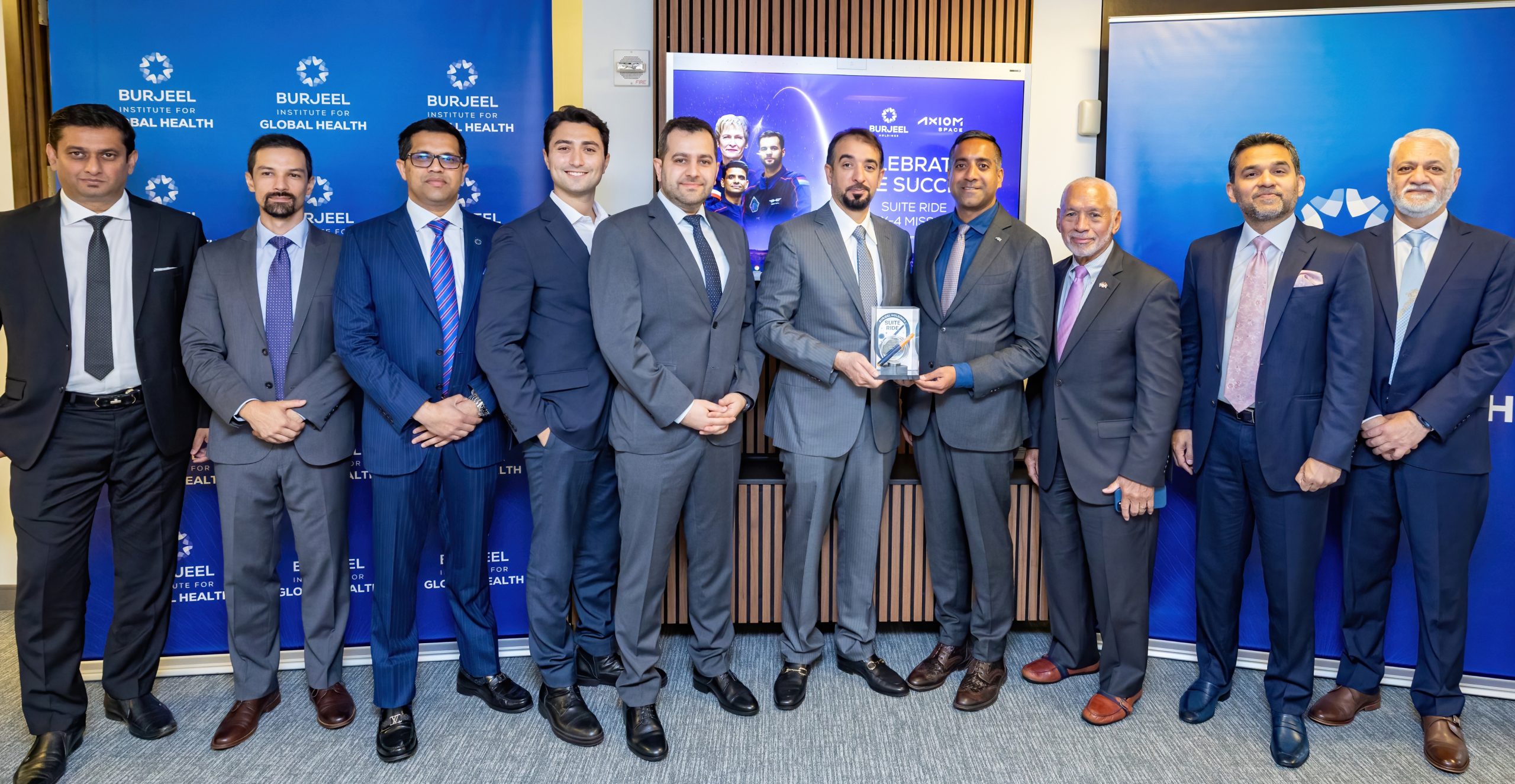
First-of-its-kind research aboard Axiom Mission 4 shows diabetes monitoring tools can function reliably in space, signaling new possibilities for inclusive space travel and remote healthcare.
Findings from the “Suite Ride” study aboard this summer’s Axiom Mission 4 mark a breakthrough for astronauts with diabetes and pave the way for new models of remote healthcare on Earth.
Preliminary results from a joint study by Axiom Space and UAE-based Burjeel Holdings show that common diabetes monitoring tools can work reliably in space, offering a complete cycle of tracking from Earth to orbit and back.
The findings from the “Suite Ride” study conducted during the recent Axiom Mission 4 mark a potential breakthrough for astronauts with diabetes and open new frontiers for remote healthcare solutions.
The results were unveiled on September 25 in New York, during an event attended by space and healthcare experts as well as teams from Axiom and Burjeel.
Burjeel Chairman Dr. Shamsheer Vayalil welcomed guests to the event, held at the Burjeel Institute for Global Health at Columbus Circle. Featured speakers included Omran Sharaf, Assistant Foreign Minister for Advanced Science and Technology Affairs at the UAE Ministry of Foreign Affairs; Axiom Space CEO Tejpaul Bhatia; and Charles Bolden, former NASA Administrator. Astronaut Peggy Whitson, who commanded Axiom Mission 4, addressed the event remotely.
Building on the findings, Burjeel also announced its goal of helping send the first astronaut with diabetes into space. Burjeel, founded in 2007 by Dr. Vayalil, an Abu Dhabi-based Indian billionaire, is a leading provider of super-specialty healthcare services in the UAE and Oman, with a growing presence in Saudi Arabia’s specialized healthcare sector.
READ: Burjeel teams up with Axiom Space for diabetes study in orbit (June 9, 2025)
The private Axiom Mission 4 (Ax-4) to the International Space Station, conducted by Axiom Space in collaboration with SpaceX and NASA, provided the platform for the Suite Ride study. Launched on June 25, 2025, from Kennedy Space Center in Florida, the mission spanned 20 days, including 18 aboard the ISS.
The Suite Ride research program tested a range of remote care tools to see how diabetes can be managed in space, representing an important step toward making space travel possible for individuals with conditions that were previously considered disqualifying.
The study showed that continuous glucose monitors (CGMs) and insulin pens can function reliably in the harsh conditions of space. Early data indicate that CGMs can deliver readings with accuracy similar to those on Earth, allowing astronauts to track glucose levels in real time and transmit the information back to mission control. Insulin pens used aboard the space station are now undergoing post-flight testing to ensure the medication remains effective.
The Suite Ride study achieved a series of historic milestones. It marked the first time crew members aboard the International Space Station were continuously monitored for glucose, the first deployment of insulin pens in orbit, and the first validation of glucose measurements across multiple methods in the station’s microgravity environment.
The research also builds on earlier commercial spaceflight experiments. For example, Virgin Galactic’s Galactic 07 mission demonstrated that commercial insulin pens can accurately dispense doses in microgravity, in line with International Organization for Standardization guidelines.
“This is about inspiring people everywhere,” said Gavin D’Elia, Global Head of Pharma for Axiom Space. “A diagnosis shouldn’t end your dream of space exploration. Together, we’re advancing the potential to fly the first astronaut with diabetes and to unlock innovation in healthcare,” D’Elia added.
The research could also have broader impacts on healthcare in remote and underserved areas. “From 250 miles above Earth in space to 25 miles offshore on oil rigs, we’re pioneering new models in remote care,” said Dr. Mohammad Fityan, Chief Medical Officer of Burjeel Holdings.
As part of the study’s unveiling, the Suite Ride campaign was displayed in Times Square.
The Suite Ride findings are expected to influence healthcare far beyond space missions. By demonstrating that diabetes monitoring and management can work reliably in extreme and isolated environments, the research opens the door to better care for people living in remote locations or working in challenging conditions around the world, according to Axiom Space and Burjeel Holdings.
Axiom is developing the world’s first commercial space station, Axiom Station.
(Correction: An earlier version of this article misstated the name of the UAE minister who spoke at the event.)