



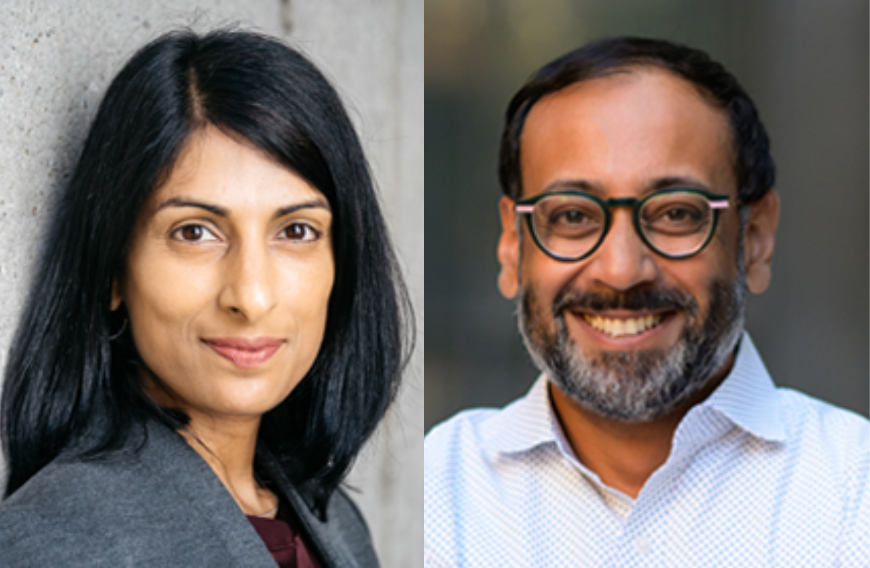
Two Indian American researchers, Teresa Puthusser and Nabarun Dasgupta, are among this year’s 22 MacArthur Fellows, a prize often called the “genius award.”
The MacArthur Fellowship is a $800,000, no-strings-attached grant for individuals who have shown exceptional creativity in their work and the promise to do more, according to The John D. and Catherine T. MacArthur Foundation.
“The 2025 MacArthur Fellows expand the boundaries of knowledge, artistry, and human understanding,” said Kristen Mack, Vice President, Communications, MacArthur Fellows, and Partnerships.
Teresa Puthussery, a neurobiologist and optometrist, has received the award for exploring how neural circuits of the retina encode visual information for the human brain.
Her research into retinal ganglion cells is filling a long-standing gap in knowledge about the human visual system. It also has implications for treating retinal neurodegenerative diseases such as glaucoma and macular degeneration.
READ: Rajesh Davé gets Upstate Medical President’s Award for Distinguished Service (
Drawing on her training in optometry, deep knowledge of eye anatomy, and facility with neuroscientific experimental techniques, Puthussery discovered direction-selective ganglion cells (DSGCs) in the primate retina.
DSGCs detect the direction in which a visual scene is moving and prompt the eye to follow it, thereby maintaining a stable and clear image. They were first identified in the rabbit retina nearly 60 years ago.
Research had not previously revealed DSGCs in primates, and scientists speculated that this complex visual feature was encoded in the primate brain, rather than in the retina.
Puthussery laid this speculation to rest, identifying DSGCs in primate retinas through a novel combination of genetic, electrophysiological, and imaging technologies.
In another line of work, Puthussery is investigating how retinal neurons are affected by photoreceptor degeneration. She is also working with collaborators to assess whether stem cell–derived photoreceptors can be used to restore vision in diseases that cause photoreceptor loss, such as age-related macular degeneration.
Puthussery’s insights into the complex circuitry of the primate retina are laying the foundation for a more complete understanding of human vision and for treatments of debilitating eye diseases.
Puthussery received a BS (2000), a PhD (2005), and a postgraduate degree (2006) from the University of Melbourne, Australia. She was a postdoctoral research fellow and assistant research professor at Oregon Health and Science University prior to joining the faculty at the University of California, Berkeley, where she is an associate professor in the Herbert Wertheim School of Optometry and Vision Science.
Nabarun Dasgupta is an epidemiologist and harm reduction advocate creating practical programs to mitigate harms from drug use, particularly opioid overdose deaths.
He has received the award for combining scientific studies with community engagement to improve the wellbeing and safety of people who use drugs and people living with debilitating pain.
READ: Indian American Karthik Nayani receives $500,000 NSF CAREER Award (
He collaborates with people who have experience with drug use or its consequences to design effective, evidence-based interventions that respond to the needs of people who use drugs and community-based organizations that support them.
Much of Dasgupta’s work focuses on broadening access to inexpensive or free naloxone, which reverses opioid overdose, for people who use drugs and their families and friends.
In early work, he co-founded Project Lazarus, a nonprofit in rural Wilkes County, and partnered with the North Carolina Medical Board to enable direct distribution of naloxone to individuals with a doctor’s prescription. Project Lazarus’s efforts drastically reduced overdose deaths in the county.
In another line of work, Dasgupta has developed a nationwide drug checking program for unregulated substances (that is, street drugs). He devised a collection mechanism that renders drug samples unusable but still testable, so samples can be legally sent through the mail.
With compassion, collaboration, and creative vision, Dasgupta brings much-needed leadership to the critical work of understanding and reducing deaths and other harms from drug use.
Dasgupta received an AB (2001) from Princeton University, an MPH (2003) from Yale University, and a PhD (2013) from the University of North Carolina. Since 2013, he has been a senior scientist at University of North Carolina’s Injury Prevention Research Center, where he directs the Opioid Data Lab. In 2020, he was named an Innovation Fellow in the UNC Gillings School of Public Health.