


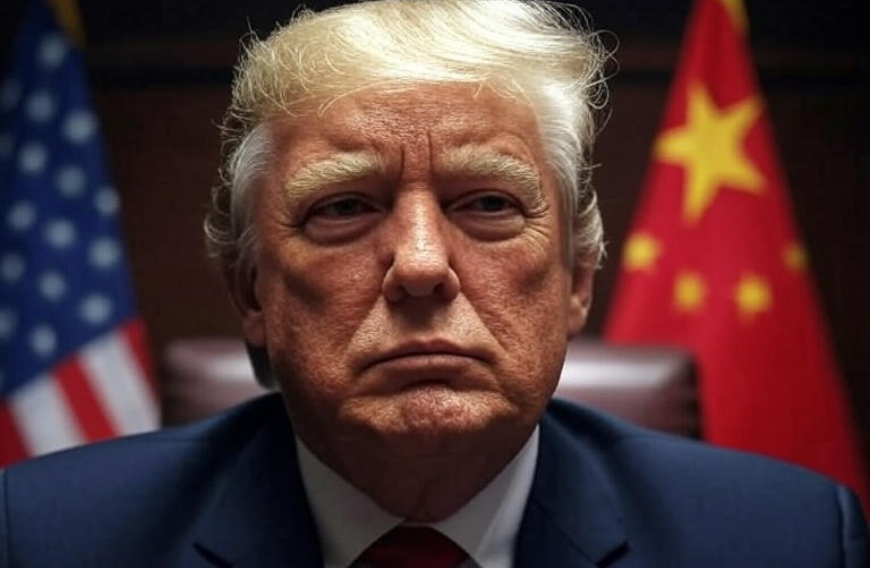
It looks like China has had enough of President Donald Trump’s tariffs. Just hours before Trump said that the United States would impose a new tariff of 100% on imports from China “over and above any Tariff that they are currently paying,” starting on Nov. 1, China will open an investigation into Qualcomm, one of America’s most important semiconductor companies.
Trump’s move came in direct response to China’s expanded export controls on rare earth elements, which are critical for manufacturing in sectors like electronics, defense, and renewable energy. The U.S. Trade Representative’s office confirmed the measure, framing it as retaliation for what Washington views as China’s attempts to weaponize critical material exports.
China’s State Administration for Market Regulation announced Friday, Oct. 10, an antitrust investigation into Qualcomm regarding its acquisition of Israeli chip designer Autotalks.
READ: US moves to widen restrictions on chipmaking tools for China (
In June, Qualcomm completed its acquisition of Israeli chipmaker Autotalks, a company specializing in vehicle-to-everything (V2X) communication technologies. This strategic acquisition aimed to strengthen Qualcomm’s footprint in the automotive sector, particularly in areas such as V2X deployments, road safety, and automated driving solutions.
The deal was finalized at under $100 million, significantly lower than the initially proposed $350 million, reflecting negotiations influenced by regulatory considerations and market conditions.
The probe centers on Qualcomm’s failure to notify Chinese regulators about the deal, which is required under China’s anti-monopoly laws. Qualcomm acknowledged this oversight but has not publicly commented further on the investigation.
Despite the regulatory scrutiny, Qualcomm continues to integrate Autotalks’ technology into its automotive product lineup, signaling its commitment to advancing V2X technology amidst a complex global regulatory environment.
READ: Nvidia, AMD directed to prioritize US over China in chip supply (
These developments place major technology companies like Qualcomm under increased regulatory pressure in both the U.S. and China. As geopolitical tensions rise, enforcement actions and trade policies are increasingly affecting the operations of multinational corporations, particularly in the semiconductor and technology sectors.
Both governments have signaled that control over critical technologies and materials is now a central aspect of their strategic and economic agendas.
The escalation in trade and regulatory tensions between the U.S. and China has created significant uncertainty for multinational corporations, especially in high-tech sectors like semiconductors and telecommunications.
Companies such as Qualcomm face complex challenges as they navigate divergent regulatory frameworks, trade barriers, and heightened scrutiny on mergers and acquisitions.