



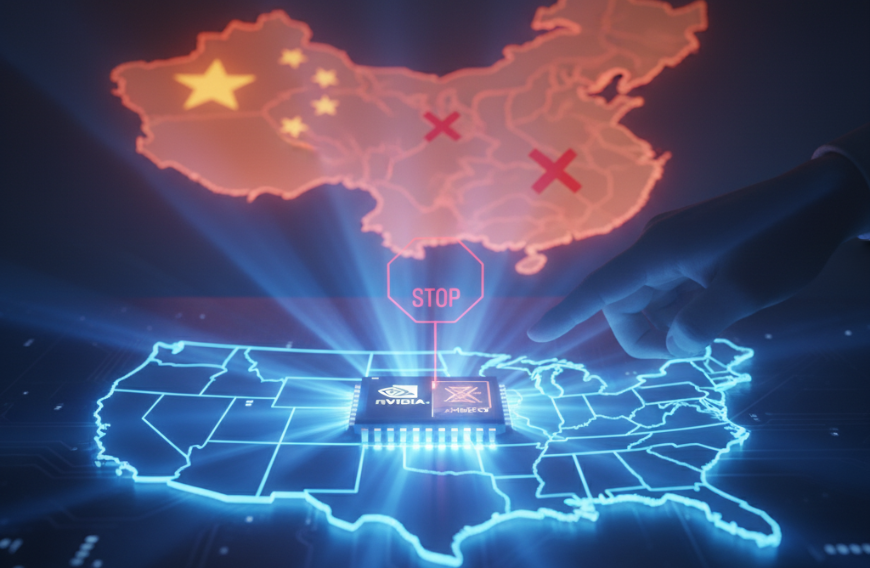
It appears chipmakers Nvidia Corp. and Advanced Micro Devices Inc. (AMD) may soon have to pick sides to stay in business. Under new legislation passed by the U.S. Senate, the companies would be required to give priority access to American customers before supplying their products to China — a setback for the semiconductor industry’s efforts to block the measure.
In August, Nvidia and AMD entered into a groundbreaking agreement with the U.S. government, agreeing to pay 15% of their revenues from advanced AI chip sales to China.
The revenue share deal, tied to obtaining export licenses for key chips like Nvidia’s H20 and AMD’s MI308, represents a significant shift in U.S. trade policy. By conditioning chip exports on revenue sharing, the government aims to exert greater control over the flow of critical AI technology to China, a major geopolitical competitor.
READ: What does Nvidia’s $100 billion investment in OpenAI mean? (
However, the deal has sparked legal and constitutional debates, with critics arguing it may violate U.S. laws prohibiting export taxes. Despite concerns, the arrangement has moved forward with the Department of Commerce establishing the legal framework to enforce it.
For Nvidia and AMD, the agreement opens access to China’s lucrative market but at the cost of sharing a significant portion of their revenue, raising questions about long-term impacts on their profitability and shareholder value. This precedent-setting move could reshape future technology trade negotiations, illustrating how governments might increasingly use financial mechanisms to influence the global distribution of critical tech resources.
With this latest legislation, it looks like the U.S. wants to exert its dominance over semiconductor and chip manufacturing.
READ: Nvidia to continue sponsoring H-1B visas despite Trump’s $100,000 fee (
This bipartisan legislation is designed to bolster U.S. competitiveness in cutting-edge industries and curb exports to China and other foreign adversaries, according to lead co-sponsor Senator Jim Banks, an Indiana Republican.
The accompanying legislation mandating prioritization of U.S. customers before foreign buyers, particularly China, further complicates Nvidia and AMD’s supply chains and market strategies.
These measures collectively underscore a tightening regulatory environment where business decisions are influenced as much by national security and political considerations as by market forces.