


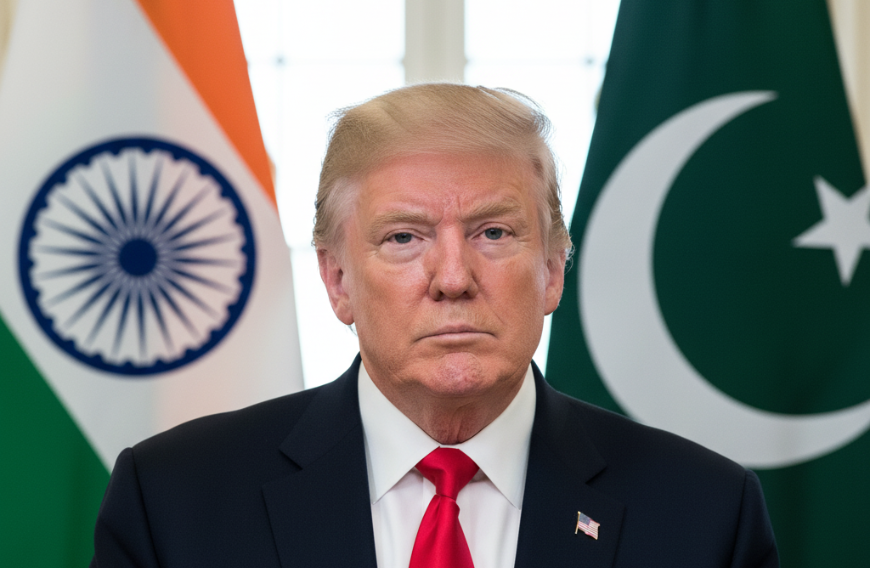
It looks like President Donald Trump may still be sore over the loss of the Nobel Prize. Trump has touted his tariff threats as the real peacemaker between India and Pakistan during the military conflict earlier this year.
Though there was no indication that it was his to lose, it seems like the recent awarding of the Nobel Peace Prize to Venezuelan activist María Corina Machado who dedicated her award to Trump has made the president of the United States dig his heels on the claim that he was responsible for solving the recent skirmish between India and Pakistan.
Speaking to reporters as he flew to the Middle East ahead of a hostage-prisoner swap between Israel and Hamas, the American leader said he wouldn’t have been able to “solve” eight global conflicts that he claimed to have ended.
“I settled a few of the wars just based on tariffs. For example, between India and Pakistan. I said, If you guys want to fight a war and you have nuclear weapons, I am going to put big tariffs on you both, like 100 per cent, 150 per cent, and 200 per cent,” Trump said while speaking to reporters en route to Egypt for a peace summit where a truce between Israel and Hamas is expected to be finalized.
READ: Trump snubbed of Nobel Peace Prize; Venezuelan activist Maria Corina Machado wins (
“I said I am putting tariffs. I had that thing settled in 24 hours. If I didn’t have tariffs, you could have never settled that war,” he added.
India has repeatedly rejected the United States’ claim of intervening in Operation Sindoor or the resulting ceasefire with Pakistan.
Trump’s rhetoric also reflects a broader shift in how he approaches foreign policy, favoring transactional, high-pressure tactics over traditional diplomacy. His claim that tariffs alone defused a potential nuclear conflict is emblematic of this approach. While it plays well to his domestic base, who view him as a tough negotiator, many foreign policy experts and international observers have criticized the oversimplification of complex geopolitical dynamics.
India’s firm denial of any external intervention in its conflict with Pakistan highlights this disconnect.
Addressing his Nobel Prize snub, he said, “In all fairness to the Nobel committee, it was for 2024. This was picked for 2024. But there are those who say you could make an exception because a lot of things happened during 2025 that are done and complete and great. But I did not do this for the Nobel. I did this to save lives.”
READ: White House calls Trump ‘The Peace President’ amid Nobel Prize talk (
Furthermore, Trump’s decision to intertwine economic leverage with military de-escalation efforts has raised concerns among diplomats, who warn that such tactics risk inflaming tensions rather than calming them if misapplied.
At the same time, Trump’s focus on the Nobel Peace Prize has become a recurring theme in his second presidency. His public statements suggest a deep desire for international validation, particularly after being passed over for the award despite claiming credit for several global developments.
While the Nobel Committee has acknowledged Trump’s eligibility for future consideration, it remains bound by its rules, emphasizing peace-building grounded in verified, multilateral efforts. For now, Trump’s peace claims are mired in controversy, uneven recognition, and political theater, leaving the true impact of his foreign policy legacy open to debate as global actors continue to contest the facts on the ground.