



The 12th edition of the World Tamils Economic Conference was held in Washington, D.C., from Oct. 3 to 5. The event aimed to foster dialogue among the international community, business leaders, and professionals, promoting cooperation, partnerships, and networking opportunities.
According to its official website, the conference is one of the largest networking events for Tamil professionals, offering participants the chance to explore new markets and identify potential business partners.
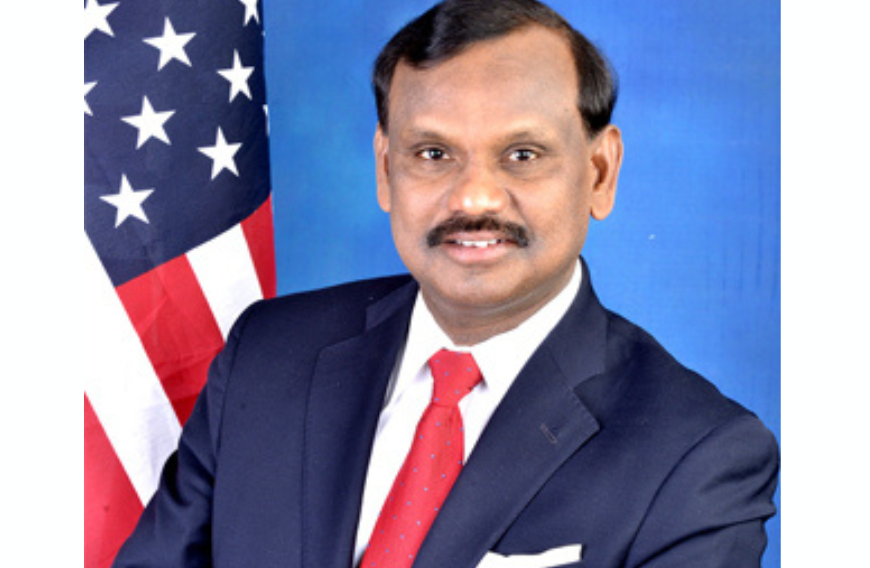
Dr. Rajan Natarajan, founder and CEO of Global Alliant Inc., served as chairman of the conference. Over the course of his career, Dr. Natarajan has worn many hats — including Deputy Secretary of State in Maryland, board member of the Maryland Security Council, and member of the Board of Visitors at the University of Maryland.
In an exclusive interview, Natarajan spoke with The American Bazaar about his role in the Tamil Economic Conference.
The American Bazaar: Could you give a brief overview of the 12th World Tamils Economic Conference?
Dr. Rajan Natarajan: The original founder of the World Tamil Economic Foundation is Dr. [V.R.S.] Sampath. He hosted similar conferences 11 times, across 11 years and in 11 different countries — including India, Malaysia, Mauritius, Singapore, and Dubai — before we hosted it here in the U.S.
I think the timing was perfect. The relationship between the U.S. and India is challenging right now, so we wanted to see how we could serve as a bridge. We brought in policymakers as well as business leaders, and the conference turned out to be very successful. We expected around 200 people, but ended up with 450 — far beyond expectations. To me, it was a historic conference.
It wasn’t easy to keep the audience engaged, but we did. There wasn’t much talk of movies or drama — maybe a little bit of cultural programming to showcase our heritage — but it was packed with speakers discussing technology, policy, entrepreneurship, and U.S.-India relations.
READ: 12th World Tamils Economic Conference concludes in Washington, D.C.(
Tell us about the Tamil diaspora and their contribution to Tamil Nadu and India. You’ve been a leader of the diaspora for a while.
The Tamil diaspora is globally spread. Wherever they go, they are involved in business and technology — they are intellectual people, luckily. Tamil Nadu ranks high in India’s GDP, right after Maharashtra. Tamil Nadu’s GDP is around $300 billion, while Maharashtra’s is about $420 billion. Gujarat is third, and Uttar Pradesh has now overtaken Karnataka for fourth place.
Uttar Pradesh also has nearly three times Tamil Nadu’s population.
Exactly. They’ve moved from tenth to fourth place, while Tamil Nadu has consistently remained number two. It’s striving for the top spot, but there’s still a way to go.
The Tamil business community worldwide is very vibrant. The diaspora is influential wherever they live and drives a lot of investment back into Tamil Nadu. The state’s infrastructure is booming — from technology and automobiles to IPs and pharmaceuticals. Tamil Nadu also leads in education, with many universities, including medical schools, and it’s number one in attracting medical tourism.
How significant is the Tamil diaspora in the U.S.?
The Tamil diaspora in the U.S. is vibrant. There are many involved in politics, business, and especially technology. You see Tamil Americans leading in biotech and AI — look at Aravind Srinivas of Perplexity, or [Arvind] Krishna from IBM, who was recently invited to the White House.
They’re slowly entering the mainstream and becoming influential politically and in policymaking. There’s a lot of innovation happening in Silicon Valley. Jay Vijayan, for instance, runs a $4 billion company and was formerly with Tesla. The community is really taking advantage of opportunities.
What are your main takeaways from this conference?
Rather than focusing only on Tamils, I wanted to broaden the conversation to Indian Americans as a whole. The Tamil population is relatively small, but through this conference we were able to promote India and the Tamil community together.
One key takeaway is where India and the U.S. currently stand on policy. India is now less dependent on the U.S. Tariffs have affected the global economy, including India, but not significantly. The U.S., however, absolutely wants to work with India — it can afford to ignore other nations, but not India. India has become a global player in economics, technology, and investment, with strong trade links to Africa and Southeast Asia.
We tried to convey that the U.S. and India must continue working together — on policy, tariffs, trade, and investment. India is now the number one consumer of AI, and that growth is phenomenal. The U.S., of course, remains the innovation leader. We made the case that both countries can drive global innovation together.
We also discussed how to help budding entrepreneurs scale up their concepts into startups. We provided roadmaps for those with ideas to take them to the next level.
Another unique aspect of the conference was our session on “power couples.” Living together as husband and wife is one thing, but building and running a business together is another. We brought in three such couples to share their stories, which was very inspiring.
READ: Hopkins India Conference makes a bold debut in nation’s capital (
Were there any other goals you hoped to achieve through this conference?
This conference was unique because we didn’t focus on just one area. We tried to bring diverse leaders together so they could understand both supply and demand.
Some conferences only have the supply side — people looking to sell ideas — while others have only the demand side — people looking for opportunities. Ours brought both together. We had innovators, investors, policymakers, and entrepreneurs in one place. Someone might be looking to sell an idea, another to acquire an IT company, another to secure a government contract. Bringing them together created a powerful exchange.
As a businessperson, I value time. I wanted attendees to feel their time was well spent. After the conference, I received messages from people saying, “I’ve got an idea,” or “my wife has an idea.” Even if only a few new businesses emerge from this, that’s a great outcome.
During the fireside chat, you spoke with Napoleon Duraisamy.
Yes, we had a wonderful conversation. Napoleon and I are good friends — we talk about many things, and he’s very open. He’s truly unique. I’ve never met another person who has succeeded in politics, cinema, and business, and is now building a new life in America. I feel blessed to have interviewed him. My wife reminded me that he moved here for his son — how many politicians would give up everything for their children? He’s one of a kind.
You mentioned innovation and artificial intelligence. Are there specific sectors where the Tamil diaspora is making a key impact?
As a biotech scientist, I’m particularly interested in how we can leverage quantum mechanics and quantum computing for drug discovery. There’s growing discussion about combining quantum technology with AI to transform healthcare — enabling more personalized and accurate treatment.
We also had participants from Microsoft and experts like Ganesh Radhakrishnan who talked about the role of quantum in the future. We’re considering a short conference focused on AI and quantum applications in healthcare. These technologies can be game-changers not just in healthcare but across multiple industries.
You’ve just wrapped up this conference — do you have plans for another one soon?
Honestly, I don’t have another big conference in mind right now. I might consider a smaller event focused on AI and quantum technology, especially in healthcare, because those two fields can truly revolutionize the industry. But I’m definitely not planning another three-day conference anytime soon!