



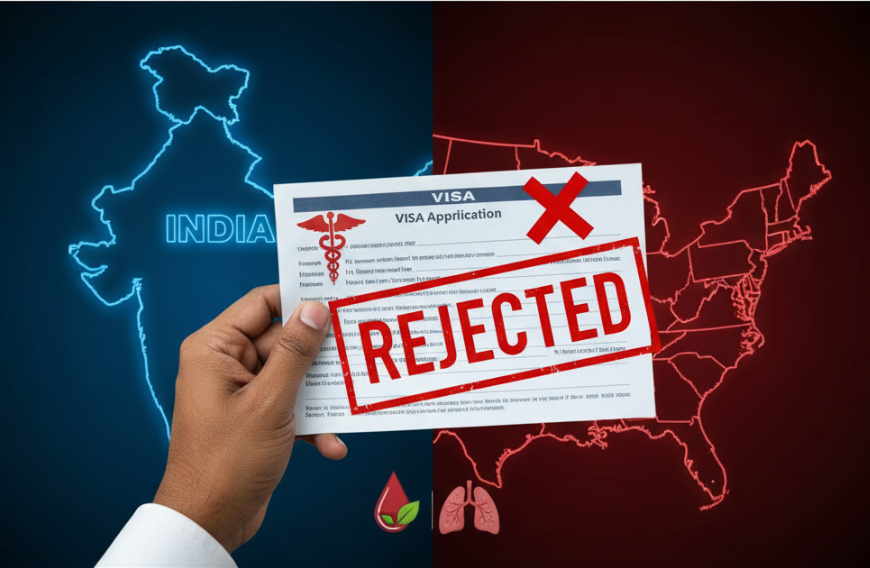
An internal State Department cable suggests that chronic illnesses may soon influence U.S. visa eligibility — a change that could disproportionately affect Indians, given the country’s higher rates of diabetes and heart disease.
For those chasing the American dream, these are testing times — quite literally. The latest visa update appears to place health squarely at the center of immigration scrutiny.
According to an internal State Department cable, consular officers will reportedly be instructed to apply a broader health-based assessment when determining visa eligibility. The move, sources say, aims to ensure that applicants are unlikely to become a “public charge” — a person dependent on government assistance in the United States.
This expanded health review is expected to factor in common chronic conditions such as diabetes, asthma, and cardiovascular disease. The development has already sparked anxiety among both current visa holders and those preparing to apply for U.S. visas, immigrant and non-immigrant alike.
Talking about the possible impacts of this update, seasoned immigration and federal litigation attorney Heidi J. Meyers, owner of NY-based Law Office of Heidi J. Meyers, advises a patient-measured approach. She says, “It must be stressed that what we have so far is only news reports of the cable, but not the actual cable or Department of State instructions. Therefore, we cannot say anything definitive at this time. Hopefully we will get something in a few days and have a primary source of information.”
The reports say that the guidance was issued in a cable that the State Department sent to embassy and consular officers. According to a report by KFF Health News, the cable instructs U.S. visa officers to consider applicants ineligible for entry on new grounds—such as age or the likelihood of depending on public benefits—suggesting that those with health conditions or advanced age could be deemed a potential “public charge,” or burden on public resources.
READ: US visa new rule targets applicants with chronic Illnesses like obesity, diabetes (
On the likelihood of which immigrant groups may likely feel the heat, Gnanamookan Senthurjothi, an immigration attorney and founder of The Visa Code—a boutique firm specializing in U.S. visa and consular practice—says, “The change is likely to have the strongest impact on immigrant visa applicants applying for permanent resident status through U.S. consulates abroad. In general, all immigrant visa applicants undergo a panel physical exam (at U.S. consular posts) as a part of their immigrant visa application.”
The expanded review described in the cable would include a much broader range of health conditions in a public charge determination, including diabetes, asthma, high blood pressure, cardiovascular disease, sleep apnea, cancer, respiratory, neurological, or metabolic diseases, mental health conditions, or obesity as negative factors in a public charge review.
Meyers says, “The listed common chronic medical conditions are generally not the basis of medical grounds inadmissibility. The common grounds of inadmissibility include contagious diseases of public health significance, a mental or physical condition that poses a risk to oneself or to the society, and drug addiction.”
Officers are also instructed to consider the health of an applicant’s relatives. Jihan Merlin, who leads Immigration Strategy at Alma, a legal tech start-up that helps professionals navigate U.S. immigration, elaborates, “The cable also reportedly tells officers to consider the health conditions of an applicant’s nonapplicant family members when evaluating whether the applicant may become a public charge.”
After the initial reports, many expat groups across social media and WhatsApp were flooded with discussions on how to navigate the upcoming changes and how the new consideration may affect the ability of thousands of green card hopefuls to attain a residency as well as impact many aliens who routinely sponsor B-1/B-2 visas for their relatives for short stays in the U.S.
Attorney Meyers offers some much-needed clarity. She says, “For those already in the United States, there seems no cause for concern. The directive comes from the State Department, not USCIS—the agency that handles status adjustments and green cards. It applies mainly to applicants seeking visas from abroad. For instance, if someone’s parents have previously visited the U.S. without ever using public assistance, their visa renewals are unlikely to be affected.”
READ: U.S. visa applicants must now apply in their home country: State Department (
Attorney Senthurjothi adds, “Since we do not have a copy of the cable at the moment, it is unclear from the available information whether the new DOS policy will have a significant impact on nonimmigrant visa applicants. Currently, unless there is a history of substance use, nonimmigrant visa applicants generally are not required to undergo a medical examination or provide detailed medical information.”
On if Indians who remain amongst the highest recipients of immigrant visas in the U.S. should worry, Senthurjothi says, “This could have an impact, as some of the listed diseases are very common health ailments for a vast majority of Indians.”
His views are supported by statistics. According to the International Diabetes Federation (IDF), an estimated 94.7 million adults in India (10.5%) have diabetes. The IDF estimates that the number of people with diabetes in India will increase to 156.7 million by 2050. A review on cardiovascular disease prevalence in Asians by PubMed Central said, “There is a significant decline in the prevalence of CVD among American citizens when compared to the steady increase in the number of cases among South Asians, which is attributed to the unique genetic predisposition of South Asians to be more prone to CVDs.”
When asked whether the reports of a cable indicate that changes may be coming, or if this could be another case of reports without actual implementation, Meyers says, “While at this stage, everything is speculation, it is quite likely that some kind of cable or new policy may be underway, and we haven’t yet gotten it.”
She adds, “The issue with the current administration is that they often release such broad-brush policy statements without providing the details. So, we don’t know the nitty-gritty and are left figuring out details later. What we await is an official statement and details of who is included in the rule.”
Attorney Jihan Merlin suggests some practical steps: “Employers should brief staff on possible visa questions about insurance or finances, coordinate early with immigration counsel to guide documentation, and monitor State Department updates to manage timelines and expectations.”
Meyers also warns that such rules can give consular officers considerable leeway in visa adjudications. “What rules such as this do,” she says, “is significantly increase the discretion exercised by individual consular officers in granting visas.”