



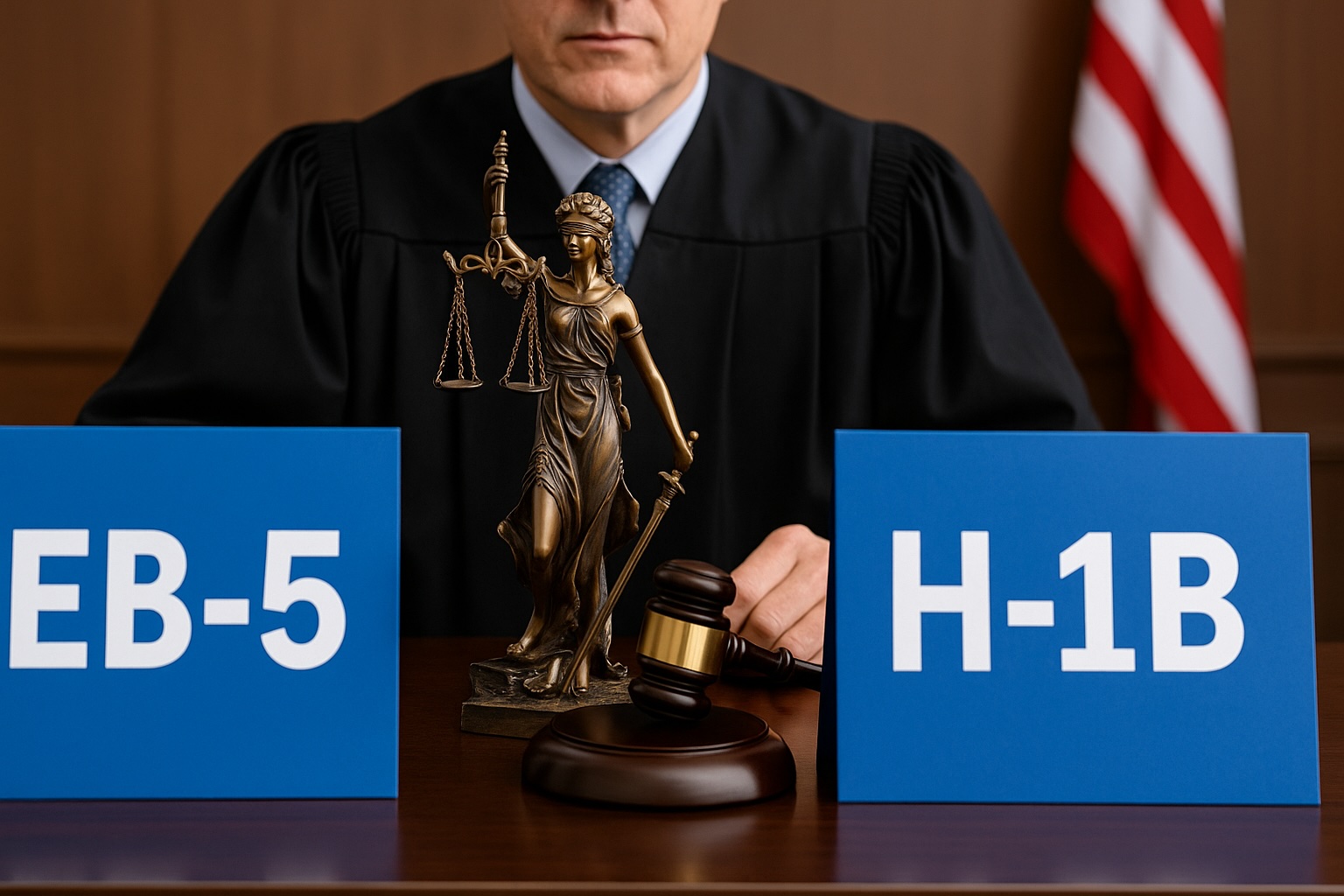
A Colorado court ruling invalidating steep EB-5 fee increases is being hailed as a victory for investors — and a potential precedent for challenges to President Trump’s controversial $100,000 H-1B visa fee.
In a significant legal setback for U.S. Citizenship and Immigration Services (USCIS), on November 12, a federal judge in Colorado has struck down the steep 2024 fee increases the agency announced for the EB-5 Immigrant Investor Program. The decision prompted USCIS to immediately roll back the fees to their pre-2024 levels. The ruling has been hailed as a major victory for EB-5 investors.
In immigration legal circles, the ruling is also being viewed as a ray of hope for another high-stakes battle — the lawsuits challenging President Trump’s $100,000 H-1B visa fee proclamation.
“I’m not sure if the EB-5 case has any bearing on the H-1B tax case, but it’s another signal that judges are looking skeptically at many of the immigration policies being pushed out using shortcuts that don’t comply with a number of legal requirements and they are basing the policy changes on highly questionable legal theories,” prominent Immigration attorney Greg Siskind, one of the co-counsels in “Global Nurse Force v. Trump,” the lawsuit challenging Trump’s $100,000 H-1B fee, told The American Bazaar.
The Colorado ruling raised a key question: Is USCIS following the law as written by Congress?
Under the EB-5 Reform and Integrity Act, the agency is required to conduct a detailed fee study before raising EB-5 filing costs. However, in this case, USCIS pushed through some of the steepest fee increases across all visa categories.
READ: Immigration attorneys prepare lawsuits against Trump’s $100,000 H-1B visa fee (September 20, 2025)
Legal experts say this was done without the completion of a mandatory study. The judge found the fee hikes “contrary to law,” violating both the statute and the Administrative Procedure Act.
Explaining the ruling, Jihan Merlin, head of immigration strategy at immigration law firm Alma, said, “What the judge said in the EB-5 case is, basically, ‘USCIS has to follow the rules Congress wrote before it can raise fees.’ That principle matters a lot in the H-1B lawsuits, because one of the core arguments there is that the $100,000 charge isn’t tied to any fee authority Congress actually gave.”
As of now, the 2024 fee schedule has been effectively paused, and investors can once again file at the earlier, lower rates. For many who were watching the lawsuit carefully and were potentially planning to invest, the ruling has opened an unexpected, welcome window to submit new petitions at significantly reduced costs.
.
What does this ruling mean for H-1B lawsuits?
“There is no doubt that the President far exceeded his legal authority in fixing an illegal fee as an entry ban for certain H-1B visa holders,” said Charles H. Kuck, co-counsel in “Global Nurse Force v. Trump” and founder, managing partner at the immigration law firm Kuck Baxter. “We are confident the Court will strike this down.”
So, can those hoping for an H-1B fee reversal draw a similar parallel here?
Merlin says, “I would say the EB-5 ruling gives people a reason to feel cautiously hopeful.” But she adds, “At the same time, the two situations aren’t identical. The EB-5 case dealt with a USCIS regulation. The H-1B fee comes from a presidential proclamation, and the courts may be more deferential to the President’s broad power under INA 212(f) over the entry of noncitizens.”
The $100,000 H-1B fee has remained one of the most explosive and controversial proclamations affecting work-based visa holders.
Ever since its announcement, it has faced immediate legal pushback from employers, universities, and immigrant-rights groups. Plaintiffs argue that the proclamation invents a fee Congress never authorized under the Immigration and Nationality Act. Unlike normal filing fees, which must be tied to the cost of adjudication, the $100,000 charge functions more like a punitive barrier to deter skilled immigration.
RELATED: Trump administration finally targets H-1B, set to impose $100,000 for coveted visas (September 19, 2025)
Even though the Colorado ruling doesn’t decide the H-1B issue but it does reinforce an important point: Courts are willing to scrutinize whether the government stayed within the boundaries Congress set. And when a fee looks nothing like a traditional cost-based visa charge, judges may be skeptical.
Legal experts caution that the EB-5 decision does not automatically translate to a victory for H-1B plaintiffs. But last week’s order offers a meaningful data point. It shows courts are prepared to look closely at fee authority, statutory intent, and procedural compliance issues that lie at the core of the H-1B lawsuits as well. As Merlin says, “While it’s not a crystal ball for the H-1B cases, the EB-5 decision is encouraging, because it shows courts are paying attention to whether the Executive Branch stayed within the limits Congress set.”