


By Soumoshree Mukherjee
Editor’s note: This article is based on insights from a podcast series. The views expressed in the podcast reflect the speakers’ perspectives and do not necessarily represent those of this publication. Readers are encouraged to explore the full podcast for additional context.
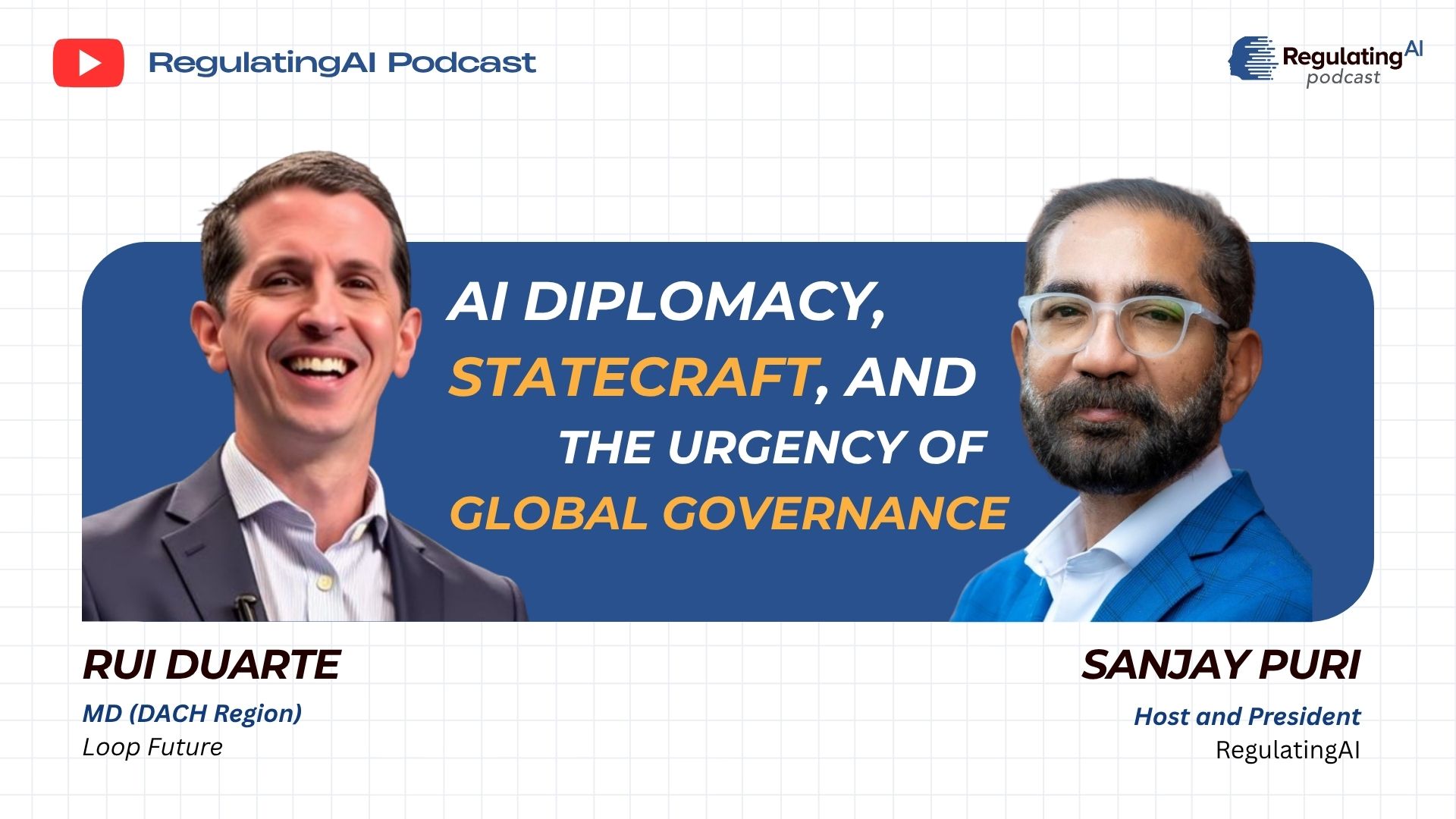
At a time when artificial intelligence is evolving faster than laws can be written, the question of who governs AI and how has become urgent. On an episode of “Regulating AI,” host Sanjay Puri speaks with Rui Pedro Duarte, managing director of Loop Future Switzerland and author of “The Age of AI Diplomacy,” to unpack why traditional statecraft is struggling to keep pace with technological acceleration.
Duarte’s perspective is shaped by an unusual journey across politics, publishing, and technology. Having served as a member of parliament and city councilor in Portugal, and later worked in open-access science publishing, he has witnessed both.
“I spent 16 years between two very different worlds. One was politics… serving in parliament, shaping policy, working inside the slow machinery of statecraft, sometimes running at the glacial pace. And the other was the private sector, in which also I had the opportunity to work for Open Science in an open access company,” Duarte said.
On his book, he says, “‘The Age of AI Diplomacy,’ really began with a haunting question. What happens when the art of diplomacy is no longer human only?”
READ: Shaping the future of AI: Tomas Lamanauskas on the UN’s ITU role (
For Duarte, the problem lies in tempo. Classical diplomacy was designed for slowness, treaties negotiated over decades, institutions evolving over generations. “That pace worked because politics and technology advanced at roughly the same tempo,” he explains, but AI has shattered that balance.
While diplomats debate autonomous weapons, AI-driven systems are already deployed in conflict zones. The result is a dangerous mismatch between political deliberation and technological reality.
This is where Duarte introduces the idea of AI diplomacy, or what he calls “quantum diplomacy,” a model built for acceleration. It is diplomacy that is “…about having treaties behaving more like software instead of running at the glacial pace, self-updating as risks change.”
Crucially, it expands the negotiating table beyond nation-states. “AI doesn’t stop at borders as we used to see with traditional diplomacy,” Duarte notes, arguing that corporations, open-source communities, civil society, and even decentralized networks must become part of governance conversations.
One of his most provocative claims is that AI may ultimately force politicians out of short-termism. “In AI time, a two- or four-year mandate is a century,” he says, suggesting that leaders may finally be compelled to think intergenerationally. In this sense, AI could paradoxically “save diplomacy from its own inertia.”
Duarte is also clear-eyed about global risks. Fragmented regulation like Brussels’ AI Act, Washington’s executive orders, Beijing’s state-driven approach resembles. He explained, “Companies like OpenAI or Anthropic, they’re setting their own constitutions, their own statements of purpose. None of these frameworks speak to each other yet. It’s like having multiple traffic systems with different rules all on the same road. So, this ultimately makes collisions inevitable.”
His solution is an AI diplomacy network: a permanent, Geneva-like multilateral hub where governments, companies, and communities coordinate in real time, set ethical baselines, and “… ensuring that Global South is a co-author, not a bystander.”
Throughout the conversation, Duarte resists fear-driven narratives. AI, he insists, is not destined to deepen inequality. “It can and should be, and has all the potential to be a positive disruption. It just depends on us,” he says but only if treated as critical public infrastructure rather than a private monopoly.
The choice, ultimately, is collective. As Duarte gives a clear message: “I think we need to build trust… among the players that have the responsibility to shape AI. And we have to have the conscience that AI will do it for us if we don’t do it ourselves.”
In an age where machines move faster than ministers, the future of diplomacy may depend on whether governance can finally learn to keep up.