



By Soumoshree Mukherjee
Editor’s note: This article is based on insights from a podcast series. The views expressed in the podcast reflect the speakers’ perspectives and do not necessarily represent those of this publication. Readers are encouraged to explore the full podcast for additional context.
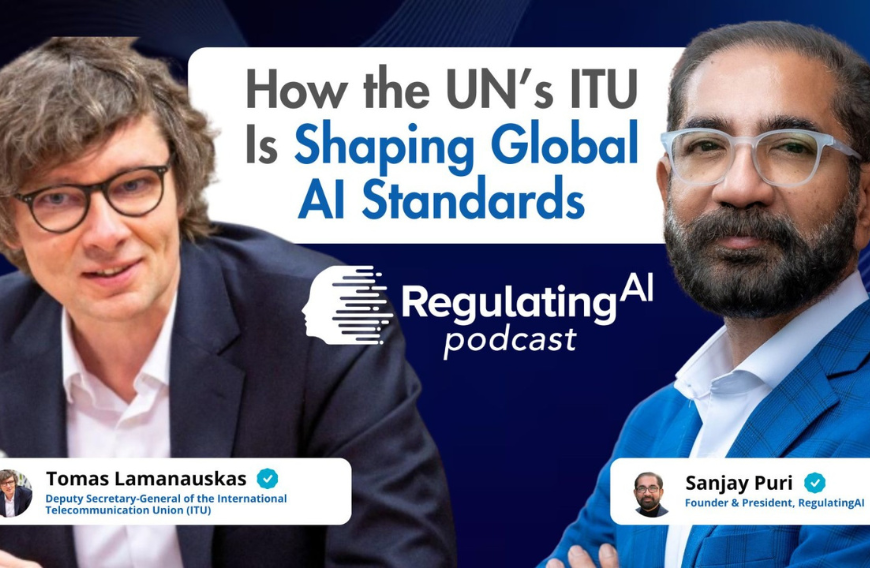
At the recent “AI for Good” summit in Geneva, “Regulating AI” podcast host Sanjay Puri engaged in a wide-ranging conversation with Tomas Lamanauskas, deputy secretary-general of the International Telecommunication Union (ITU), exploring the organization’s historic role in global communication and its evolving responsibility in governing artificial intelligence.
Founded 160 years ago, ITU is one of the oldest UN agencies, created originally to standardize the telegraph. “When telegraph was invented, initially it would work only within the borders and then to make sure it works across the borders, that’s needed to be agreed among the nations. And that’s why they set up International Telegraph Union, signing International Telegraph Convention in Paris,” Lamanauskas explained. Over the decades, ITU has overseen wireless communication, satellite regulation, and mobile networks laying the groundwork for today’s digital era.
Today, ITU finds itself at the heart of another revolution: artificial intelligence. While AI may seem new to many, Lamanauskas reminded listeners that AI didn’t start in 2022 with ChatGPT.
READ: Dr. Debarag Banerjee on driving ethical and scalable innovation at L&T Finance (
“I give this example to people, for a few decades, every time you get a speeding ticket and the camera takes the picture of your number plate and then translates from the picture to numbers, that’s AI at work,” he said. Although more simplified than ChatGPT which is a neural network, Lamanauskas added.
ITU launched its “AI for Good” summit in 2017 and has been convening international discussions on AI governance since then.
The challenge, Lamanauskas noted, is balancing rapid innovation with global standardization. “You encourage interoperability… that means that different islands of technology can work together. So, these worlds actually drive each other,” he said.
“We need innovation to go very fast and bring these new ideas and opportunities,” he noted, “then, standardization comes there to play to actually make sure that that innovation can spread and can be adopted by many people.”
ITU’s unique structure, which includes 194 member states and over 1,000 sector members from academia, government, and industry, allows it to build consensus quickly and inclusively.
On the question of enforcement, Lamanauskas emphasized ITU’s collaborative role rather than direct policing. “ITU is a part of ecosystem, you so it’s not a beginning or end of all… It’s the enforcement role, most of the times, falls into national governments, then national governments can actually have these policy decisions and then enforcement actions to actually ensure compliance. What ITU is there is to help those national governments in many ways do the job.”
The discussion also touched on the geopolitical divides in AI governance, with the EU, U.S., and China charting different paths. Lamanauskas pointed out that diverse approaches are not new. He explained that even in telecom history, they had competing standards like GSM and CDMA. Over time, convergence came. The role of ITU is to provide a platform for dialogue, so countries can learn from each other and smaller nations are not left behind.
One of the most striking issues raised was the fragility of global connectivity. Lamanauskas highlighted that 99% of international internet traffic depends on undersea cables, a network of just around 500 cables worldwide.
With 200 breaks in these cables a year, resilience has become critical. ITU has convened governments, regulators, and private players to streamline repairs, improve monitoring, and ensure small island states are not left out of digital infrastructure.
Lamanauskas expressed, “we hope to really progress that dialogue with everyone and to make sure that the AI, is not just a kind of this fancy technology that we can talk about few countries in the world that can benefit of that, but the AI power, the positive power is really felt around the world by everyone.”
From the telegraph’s beeps to the rise of AI, ITU’s mission remains unchanged: to build bridges across borders and ensure technology serves humanity. As Lamanauskas believes that innovation moves fast, but common standards make it possible for everyone to benefit.