



By Soumoshree Mukherjee
Editor’s note: This article is based on insights from a podcast series. The views expressed in the podcast reflect the speakers’ perspectives and do not necessarily represent those of this publication. Readers are encouraged to explore the full podcast for additional context.
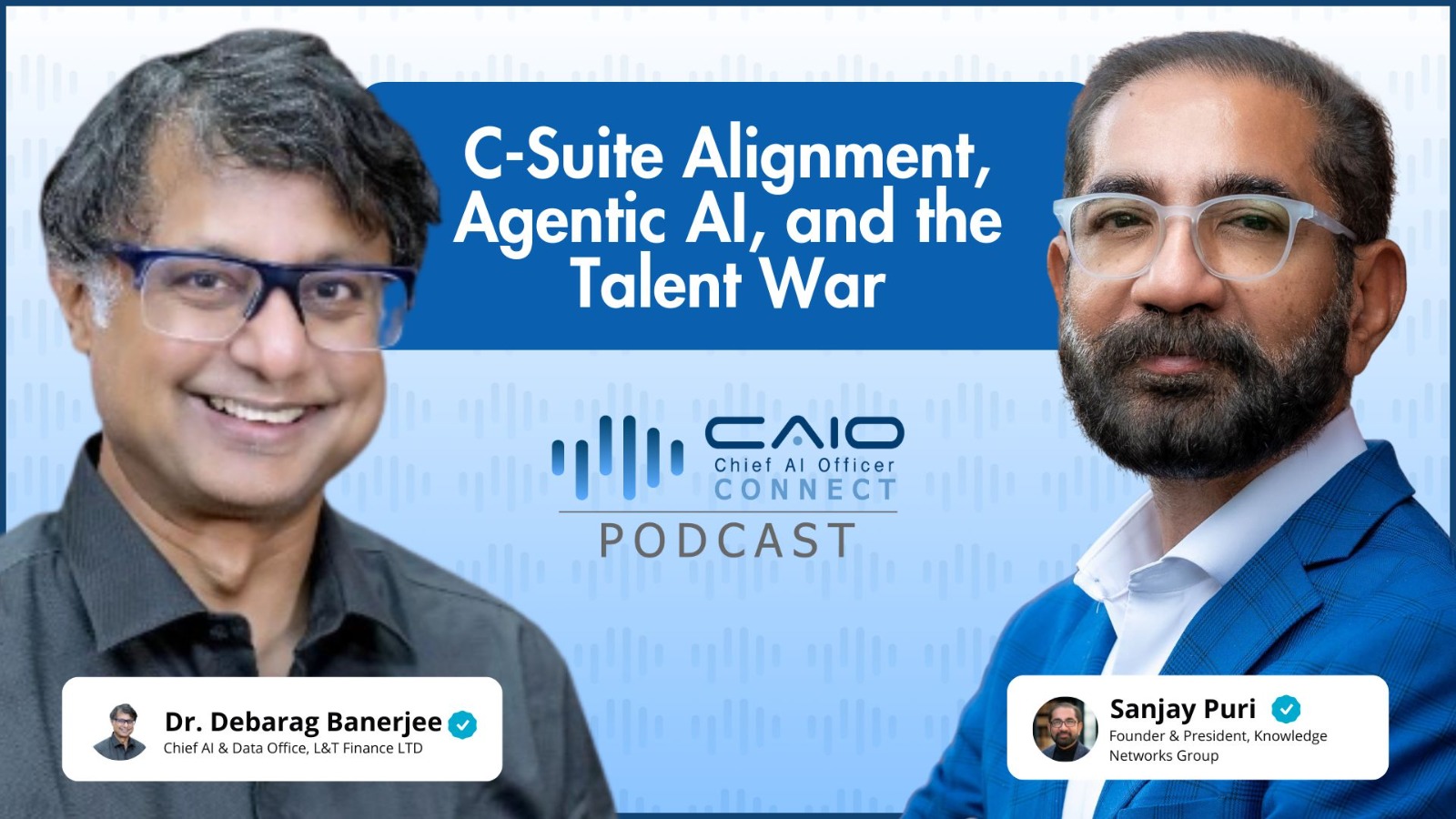
On the latest episode of the CAIO Podcast, host Sanjay Puri sat down with Dr. Debarag Banerjee, Chief AI and Data Officer at L&T Finance, to unpack the real-world challenges and opportunities of enterprise AI. With a Stanford PhD, 15 patents, and a career spanning Silicon Valley, telecom, e-commerce, and finance, Dr. Banerjee brings both global expertise and local commitment to the conversation.
Banerjee’s journey into AI began long before it was fashionable. “I’ve been in the AI from way before it was cool. I think my first Neural Networks paper was back in 1993 or 1994,” he recalled, “I was instrumental in building it up from the data and the data science and AI perspective but that experience opened my eyes to a new India which had left almost 20 years ago and it stayed on a little bit longer.”
From Intel and Lockheed Martin to founding startups and shaping Reliance Jio’s massive 4G rollout, he has repeatedly harnessed data to drive transformation. His work at Flipkart, Agoda, and now L&T Finance underscores a career defined by pushing AI into uncharted territories.
READ: ‘Agentic AI factory’ offers a model for responsible leadership, says Kristie Grinnell (
At L&T Finance, Banerjee is modernizing a $12 billion lending portfolio serving over 10 million borrowers across India. The challenge: balancing innovation with inclusion, particularly for underserved communities. To do this, his team developed Cyclops, a real-time underwriting engine that approves loans in seconds.
By blending traditional credit scores with alternative data such as spending patterns and bank statements (with customer consent), Cyclops sharpens credit decisions and expands access to first-time borrowers. Banerjee explained, “…things that we have incorporated in our brand-new real-time underscoring engine called Cyclops, which looks all of this data up, sends them through multiple models, comes up with the right decision all in a matter of less than 4 seconds.”
Central to Banerjee’s philosophy is RODI, Return on Data Investment. He explained it as a metric to measure whether new data sources yield more accurate lending outcomes relative to their cost. “The concept paper that I wrote on RODI specifically showed how to measure whether a particular piece of data is giving you returns and if that return is more than the cost of the data itself in the context of a lending business,” he said. Interestingly, some non-traditional data sources outperformed established credit bureaus, offering a fresh playbook for financial inclusion.
But technical innovation alone doesn’t guarantee success. Banerjee emphasized the importance of executive alignment. One of his first moves at L&T Finance was organizing a hands-on AI boot camp for the board and C-suite. Rather than just showcasing possibilities, he let leaders build simple applications themselves. The exercise, he noted, sparked “aha moments” and made them co-creators in the AI journey.
Banerjee is equally excited about the future of agentic AI. “Cyclops is our machine learning driven underwriting disk chaining engine… in the same line of business of our previous customers, we have built up a machine learning model that can predict much more accurately than using only one source of data,” he said.
Looking ahead, Banerjee sees agentic AI systems that mimic and extend human workflows as a frontier in lending. “What we optimize on today is how appropriate is a particular LLM for the workflow that it needs to do in terms of accuracy, latency,” he mentioned.
For peers wrestling with AI adoption, his advice is pragmatic: focus on short-term wins like collections bots or sourcing optimizations to show value quickly, but educate stakeholders that enterprise-level shifts like underwriting require patience. “If there’s anything that convinces the C-Suite and the board, it is results,” he said.
At the heart of his vision is a simple principle: AI must serve people, not just profits, “in a way, LLMs are the compilers that we have all been dreaming about… so thankfully now we can we can you know release a lot of humans out of that tragedy.”
As enterprises worldwide navigate talent wars, governance pressures, and the open vs. closed AI debate, Banerjee’s message is clear: listen first, co-create with stakeholders, and never lose sight of ethical, transparent impact.