



BY Soumoshree Mukherjee
Editor’s note: This article is based on insights from a podcast series. The views expressed in the podcast reflect the speakers’ perspectives and do not necessarily represent those of this publication. Readers are encouraged to explore the full podcast for additional context.
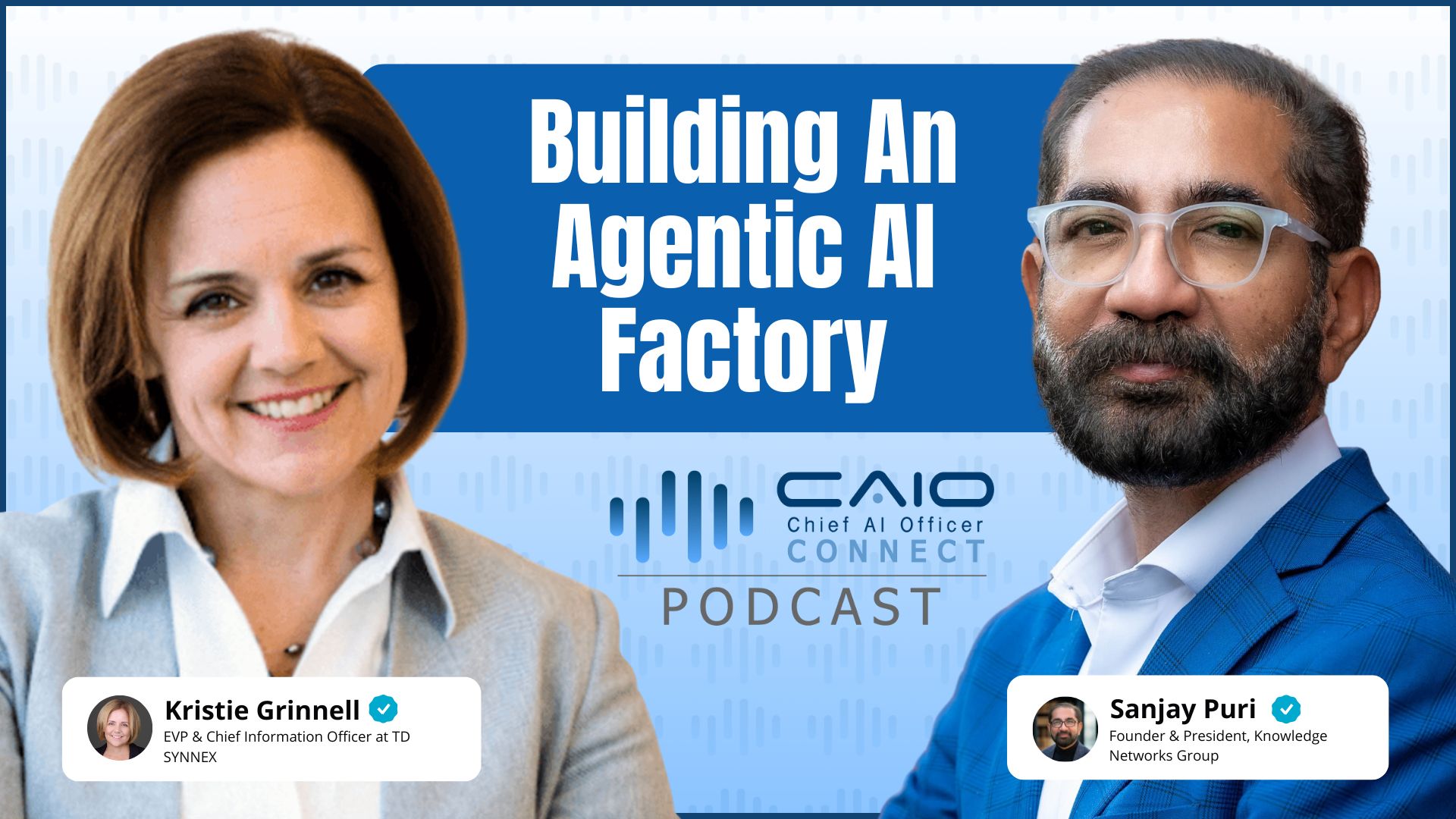
Artificial intelligence may be transforming businesses at breakneck speed, but for Kristie Grinnell, Senior Vice President and Chief Information Officer at TD SYNNEX, leadership in this space means more than just deploying the latest technology. In a recent episode of CAIO podcast, Grinnell shared her journey into AI leadership, underlining the importance of responsibility, mentorship, and vision in shaping the future of digital transformation.
“People first of all need to understand the technology and what it does… So, we want to help them understand what these different types of technologies are and how they can use them. We also have to help them understand some of the risks associated with it,” Grinnell said. For her, effective AI leadership starts with awareness, ensuring employees and executives alike know both the opportunities and risks that AI brings to the workplace.
A central theme of the discussion was the concept of an “agentic AI factory,” which Grinnell described as a transformative approach to integrating AI into business operations. She explained that it’s about streamlining processes, encouraging innovation among employees, and ultimately, creating efficient workflows.
Much like an app store for AI, this factory model serves as a hub where secure agents can be created and tested, allowing different business functions to innovate while staying compliant. “This is the factory you should use, where you should create these agents, and so that they can talk to one another and become more efficient together as we grow,” she said.
Her leadership vision emphasizes building a strong digital foundation to enhance interactions with customers and vendors. She mentioned the importance, “digitalizing those interactions and transactions that we have with our customers and vendors. But also, how do we do it to ourselves? How do we use all of this digital technology, automation, AI, data in order to operate in a better way as well?”
Leveraging automation and AI, she added, allows companies to scale sustainably: “We’re not having to scale at the same rate, but we can use a augmented workforce using AI to help us grow.”
But Grinnell is also mindful of the human side of AI transformation. She argued that AI must be seen as “a helpful tool, a sidekick, rather than a fear-mongering.” Dismissing fears about AI replacing workers, she insisted that employees should embrace the technology as a tool that augments human capability, freeing people to focus on meaningful and creative work.
The role of leadership is vital in this process. “If we have a CEO who’s motivating our workforce to really be thinking differently, changing their mindset and how we can use technology to augment all of our co-workers to achieve these big goals we have over the next several years… we want to be able to give them that,” Grinnell said, stressing that executive support is key for any AI initiative to succeed.
She also highlighted the evolving responsibilities of CIOs, who are increasingly becoming chief AI officers and change agents. This shift, she explained, mirrors earlier transitions when cybersecurity became a collective responsibility across organizations.
Looking ahead, Grinnell believes in investing in AI labs and secure environments for experimentation, ensuring companies can test solutions before rolling them out. She said that implementing AI in business requires a shift from bureaucratic processes to practical testing in labs.
Ultimately, for Grinnell, successful AI leadership balances technological innovation with human compassion. “…be naturally curious in the technology and the business, and then be that critical thinker as well,” she said, adding that fostering a culture of curiosity and collaboration will be essential for building inclusive, future-ready organizations.”