



By Soumoshree Mukherjee
Editor’s note: This article is based on insights from a podcast series. The views expressed in the podcast reflect the speakers’ perspectives and do not necessarily represent those of this publication. Readers are encouraged to explore the full podcast for additional context.
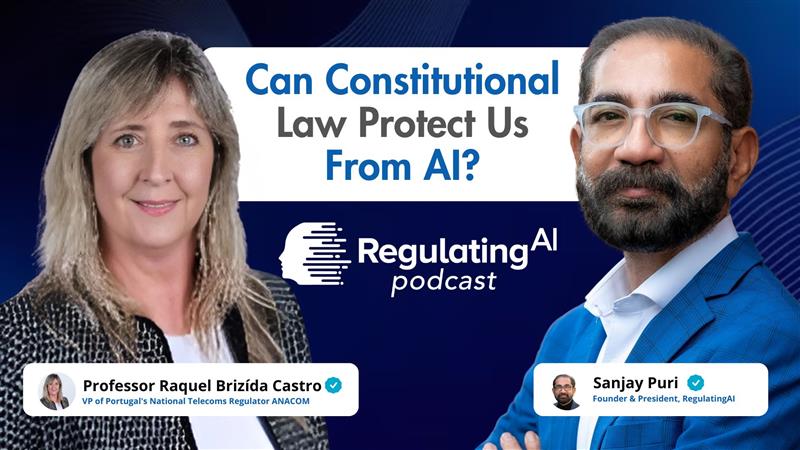
On a recent episode of “Regulating AI,” host Sanjay Puri sat down with Professor Raquel Brízida Castro, vice president of ANACOM, Portugal’s National Communications Authority and a distinguished constitutional law scholar, to unpack the constitutional challenges raised by artificial intelligence and the implications of the European Union’s landmark AI Act.
Castro, who also teaches constitutional law at the University of Lisbon, brings a rare blend of expertise in academia, journalism, and regulation. Her central argument is clear: AI represents nothing less than “a kind of artificial intelligence driven revolution” that demands a fundamental rethinking of constitutional principles such as the rule of law, separation of powers, and the protection of rights.
READ: ‘We were AI before AI was cool’: Emerson CTO Peter Zornio on boundless innovation (
She emphasized that Europe must urgently develop what she calls a “constitutional digital pact” to safeguard democracy in the age of AI. “Ultimately the constitution is our last defense and also the last safeguard,” she argued. This includes not just protecting traditional rights but defining new ones such as the right to explainability, human oversight, and even the right to disconnect from harmful AI systems. Without these protections, she warned, “If we [forget] the relevance of this fundamental right, we [risk converting] the rule of law into the rule of algorithm.”
A recurring theme in the conversation was the EU’s risk-based regulatory approach. While critics argue that the AI Act could burden companies and stifle innovation, Castro pushed back: “One thing is bureaucracy and bureaucracy is not regulation. There’s a trend in confusing those concepts and it doesn’t make sense.” She acknowledged the Act’s reliance on self-certification and voluntary codes of conduct, but insisted that effective enforcement and auditing mechanisms are essential.
Castro also highlighted tensions between Europe’s regulatory-first stance and America’s innovation-first model, noting that “there is a false dilemma between regulating and innovation… I don’t believe in any kind of artificial intelligence innovation that [doesn’t] care about fundamental rights.”
READ: ‘Bring Your Own Agents’: Claudionor Coelho Jr. on adopting AI securely (
The conversation touched on broader issues such as the emerging “Brussels effect” versus the “Washington effect,” data sovereignty, and the role of latency as a new economic driver. Yet for Castro, the real challenge lies in ensuring that citizens are not left powerless in the face of opaque systems. “I think it’s very important now to guarantee that no digital powers, no digital power, public or private, make decisions that impact the legal sphere of citizens without a clear basis, without transparency rules and without mechanisms of accountability.”
Asked whether she is optimistic or concerned about AI’s future, Castro didn’t hesitate: “AI is not future, it’s present. I’m completely optimistic.”
For listeners navigating the complex terrain between innovation and rights, Castro’s constitutional lens offered both a warning and a roadmap reminding policymakers that democracy, dignity, and human oversight must remain at the heart of AI governance.
1 Comment
Bhai ko itni saja na mile