



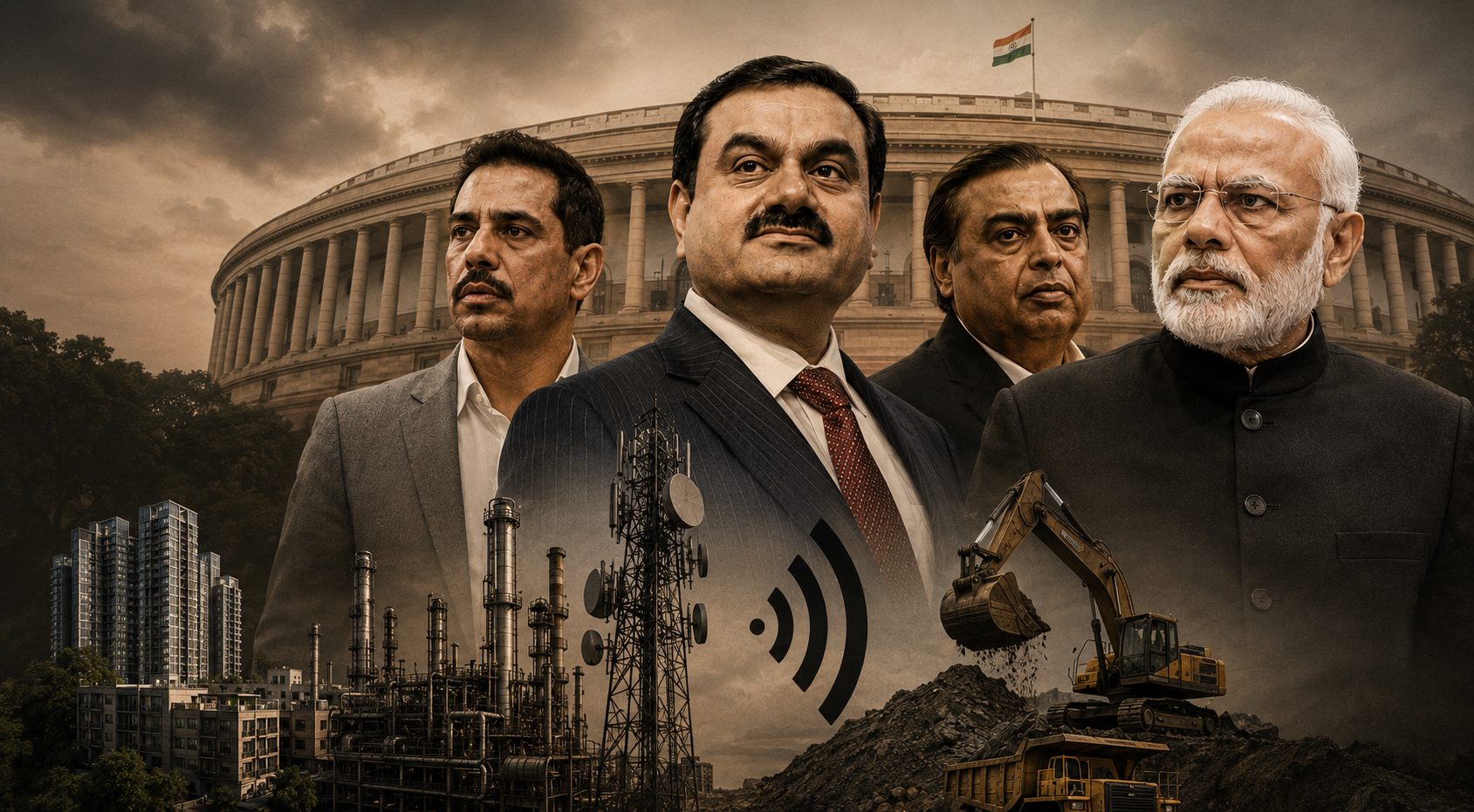
Let’s be honest about something that Indian political discourse rarely admits: the marriage between big business and political power is not a BJP invention. It is as old as the Republic itself.
When critics point to Gautam Adani’s meteoric rise under Narendra Modi, the standard defense from BJP supporters is swift and not entirely wrong — what about DLF and Vadra? What about Reliance and the KG Basin? What about 2G, the coal scam, the Commonwealth Games? Congress ran a crony state for sixty years. Why the selective outrage?
It is a fair question. And it deserves a straight answer before we can understand why the Adani case is still something different.
The Congress Template
Congress perfected what you might call distributed cronyism. The spoils of state — land, spectrum, coal blocks, gas pricing, defense contracts — were spread across a wide enough network of industrialists that the system retained a veneer of competition. Reliance got the KG Basin. DLF got Haryana land through Robert Vadra. A Raja handed out 2G spectrum. Manmohan Singh’s PMO presided over coal block allocations that enriched a range of favored houses.
The system was rotten. The difference was that it was rotten for many, not one.
When Jaipal Reddy as Petroleum Minister tried to resist Reliance’s gas pricing demands, he was simply moved out of the ministry. Policy bent to serve corporate interest. This was not occasional or incidental — it was structural. India’s license-permit raj never really died; it just got privatized.
Enter Modi — Same Game, Different Scale
When Modi came to power in 2014, the expectation — or at least the stated promise — was a clean break. Minimum government, maximum governance. No more policy by proximity.
What followed was something else entirely.
Gautam Adani, a school dropout from Gujarat who built a port and commodities business in Modi’s home state during Modi’s years as Chief Minister, began a wealth accumulation trajectory that has no precedent in Indian business history. From a rich-but-regional player, Adani became — briefly in 2022 — the third wealthiest person on earth, ahead of Elon Musk. His group today controls six major airports, the country’s largest port complex, power generation and distribution networks, defense manufacturing, a major news network, and is expanding into data centers and green energy.
This is not just a businessman who got rich. This is a businessman who came to control the physical and informational infrastructure of the Indian state itself.
READ: India’s electoral roll crisis: How democracies fight back (
Three things distinguish the Modi-Adani relationship from its Congress-era predecessors — and they matter.
The first is concentration. Congress spread patronage across a competitive field. What has happened under Modi is the systematic consolidation of strategic national assets into a single private group. Six airports handed to Adani in one transaction. Port capacity, power distribution, defense supply chains — all flowing toward the same conglomerate. Even by the standards of Indian crony capitalism, this concentration is historically unusual.
The second is speed. No Congress-era businessman — not Ambani, not Tata, not Birla — went from regional player to global titan in a single decade. The velocity of Adani’s rise maps almost perfectly onto the decade of Modi’s national rule. That correlation is not proof of wrongdoing. But it is not coincidence either.
The third — and most consequential — is the use of foreign policy as personal protection. This has no real Congress-era parallel, and it is what transforms a domestic cronyism story into something genuinely alarming.
When the state goes abroad for one man
In early 2025, American prosecutors charged Adani with paying $265 million in bribes to Indian government officials to secure solar energy contracts. It was a serious indictment — the kind that ends business careers. Then the Trump administration dropped the charges after Adani pledged a $10 billion investment in the United States.
Weeks later, Modi flew to Norway — the first Indian Prime Minister to visit in 43 years. The stated agenda was green energy cooperation. The unstated context was this: Norway’s $2 trillion sovereign wealth fund had blacklisted Adani Ports and Adani Green Energy over corruption and governance concerns. A delisting from that fund would be a significant rehabilitation for Adani’s global standing.
Modi did not answer when a Norwegian journalist raised the question at a press conference. He walked away from the podium.
Rahul Gandhi asked publicly: did Modi personally request Norway to remove Adani from their blacklist? No answer came.
READ: West Bengal election proves that the Great Muslim Vote Fraud is finally over in India (May 10, 2026)
The hidden architecture
The most explosive allegation in circulation — that Modi himself holds a hidden financial stake somewhere in the Adani structure — has never been proven with documentary evidence. It remains an allegation. But the allegation does not come from nowhere.
India’s securities law requires that any listed company maintain at least 25 percent of its shares in genuinely public hands. This exists to prevent promoters from owning 90 percent of their own company, inflating the stock price artificially, borrowing against that inflated valuation, and draining the system.
Hindenburg alleged that large portions of Adani’s supposed public shareholding were in fact held by offshore shell entities — associates of the Adani family operating through opaque funds in Mauritius and Singapore. OCCRP, the world’s leading investigative journalism network, subsequently obtained banking documents showing that two foreign investors had confirmed in writing to their bank that they held Adani stakes because of personal relationships with the Adani family. If those investors were acting as proxies for Adani insiders, total promoter ownership would breach the 75 percent legal ceiling — a serious securities violation.
India’s Supreme Court appointed an expert committee to oversee the investigation. That committee reported that SEBI, the market regulator, had suspected for years that some of Adani’s public shareholders were fronts for promoter interests — yet no agency was able to identify them because they were hidden behind secretive offshore structures.
The question that follows is unavoidable: why didn’t SEBI act? The answer critics give is not complicated. SEBI’s leadership is a government appointment. The government had no interest in puncturing the Adani balloon. And Modi had literally flown on an Adani Group aircraft during his 2014 campaign — the personal entanglement was never a secret.
How the state protects one man
Ownership in a legal sense may never be proven. But something arguably more powerful has been on display: a state apparatus comprehensively deployed in the service of one private interest.
SEBI investigations stall. The CBI and Enforcement Directorate — weaponized aggressively against opposition politicians throughout the Modi years — show no curiosity about Adani. The State Bank of India and LIC, both government-controlled institutions managing the savings of ordinary Indians, are heavily exposed to Adani Group debt and equity. They bought into Adani even during the Hindenburg crisis, effectively placing a government-backed floor under the stock price.
And then there is the diplomatic dimension. The US criminal case evaporates after a well-timed investment pledge. The Prime Minister makes a 43-year-first visit to Norway while Adani sits on a sovereign wealth fund blacklist. Foreign policy bends in the direction of one man’s balance sheet.
READ: How India’s Congress party keeps building leaders for the BJP — A pattern it doesn’t want to admit (May 13, 2026)
The real question
This is not about whether Indian capitalism is corrupt. It is. It has always been. The Congress record is indefensible and must not be whitewashed.
The question is whether something qualitatively new has happened — whether the line between the Indian state and one private businessman has been erased in a way it never was before.
When a Prime Minister’s foreign travel schedule appears to serve the reputational interests of a single industrialist, when a US criminal prosecution evaporates after a well-timed investment pledge, when airports and ports and media and power grids flow toward one group — the issue is no longer merely cronyism. It is the privatization of the state itself.
India has survived corrupt governments before. What it has never tested is whether it can survive a government that has, to this degree, become indistinguishable from a single private interest.
That is the Adani question. And it does not have a comfortable answer.