



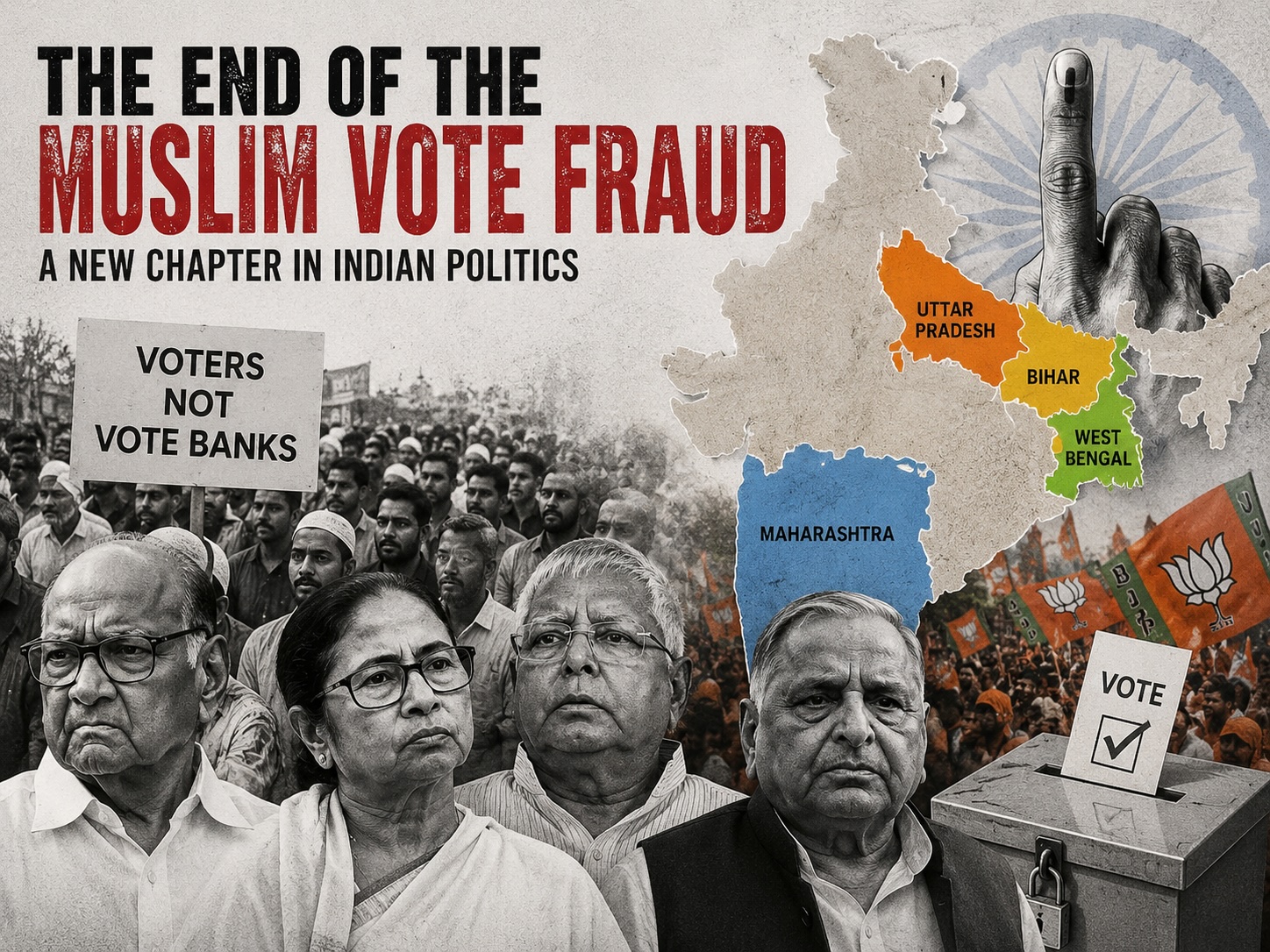
India’s regional strongmen built their careers on a single, ruthless transaction: They sold fear to Muslim voters, collected their votes, and delivered nothing in return. That transaction is now collapsing — and the political consequences will define the next decade of Indian democracy.
Let me be direct. The Bharatiya Janata Party did not win the West Bengal assembly elections last week because it suddenly became attractive to Muslims. It won because Mamata Banerjee spent fifteen years treating Muslim voters as a captive asset rather than a constituency with legitimate demands.
When that captivity cracked — when Muslim votes fragmented across the Left Front- Indian Secular Front (ISF) alliance, the Aam Janata Unnayan Party (AJUP), the Indian National Congress, and the All India Majlis-e-Ittehadul Muslimeen (AIMIM) — it wasn’t Muslims going to the BJP.
It was Muslims walking away from a party that had given them fear management instead of political dignity. The arithmetic did the rest. Hindu votes consolidated solidly behind the BJP. Fragmented Muslim votes went nowhere. The BJP swept 207 seats.
Bihar told the same story a year earlier. Tejashwi Yadav, leading a party built on the Muslim-Yadav axis, watched AIMIM win five seats in the Seemanchal region of the state — seats that came directly out of Mahagathbandhan’s margins.
The Rashtriya Janata Dal (RJD) was reduced to 25 seats against 202 won by the BJP-led National Democratic Alliance (NDA) in the Bihar legislative assembly election last November. The party that once held Bihar’s Muslims in its palm ended the election with its bungalow on Circular Road deserted, workers saying it felt like someone had died in the family.
These are not isolated defeats. They are the simultaneous bankruptcy of a political model that was always fraudulent.
The four who destroyed Congress, and then destroyed themselves
To understand where Muslim voters are today, you must understand how they got here.
Sharad Pawar, Mamata Banerjee, Lalu Prasad Yadav, and the Samajwadi tradition built by Mulayam Singh Yadav were the four pillars of what I call the Great Muslim Vote Fraud. Each of them captured the Muslim constituency that naturally belonged to the Congress party, positioned themselves as more locally credible secular alternatives, and systematically prevented Congress from rebuilding in their states. Maharashtra, Bengal, Bihar, and Uttar Pradesh — India’s four most consequential states — became Congress graveyards.
Here is what makes it fraudulent: None of them actually delivered for Muslims.
Look at the numbers. In the 2024 general election, the Samajwadi Party (SP) fielded four Muslim candidates. The RJD fielded two. Trinamool Congress (TMC) fielded six from forty-two Bengal seats despite Muslims being over a quarter of the state’s population.
These parties wanted Muslim votes but were structurally unwilling to give Muslims meaningful representation — because an empowered Muslim voter with genuine political agency wouldn’t need them anymore. The fear vote only works on a community kept deliberately dependent.
Now look at what has happened to each of them.
Sharad Pawar watched his own nephew Ajit Pawar break away in 2023, join the BJP, and walk away with the official Nationalist Congress Party (NCP) name and symbol. The man who left Congress in 1999 to build an independent secular empire ended up handing that empire directly to the BJP through family betrayal. He is eighty-four years old and fighting under the name “NCP Sharadchandra Pawar” — a footnote in a story he once controlled.
Mamata Banerjee spent years fighting an internal war between her old guard and nephew Abhishek Banerjee’s corporate “young brigade.” Dual candidate lists. Disbanded committees. Open public feuding. She lost Bengal, then lost her own seat of Bhabanipur to Suvendu Adhikari by fifteen thousand votes. Politically finished at the national level.
Lalu’s elder son Tej Pratap was expelled from RJD during the 2025 Bihar campaign, formed a rival party, and publicly attacked Tejashwi at the worst possible moment. After the results, Tejashwi disappeared. His bungalow fell silent. The man who was meant to inherit one of India’s most powerful Muslim-Yadav machines couldn’t hold his own family together.
READ: Why the Wall Street keeps soaring while the world struggles (May 8, 2026)
A word on Mulayam — because this requires honesty. Mulayam Singh Yadav was never in Congress. He was a lifelong socialist, inspired by Ram Manohar Lohia, mentored by Charan Singh. His explicit political goal, inherited directly from Lohia, was the destruction of Congress in UP — and he achieved it. Congress has not recovered in UP since 1989. Mulayam’s betrayal was not of Congress but of his mentors’ principles. He abandoned Lohia’s socialism, anti-elitism, and genuine social justice and replaced it with dynasty, cronyism, and transactional politics. He was called Little Napoleon by Charan Singh. He proceeded to betray everything Charan Singh and Lohia stood for.
His son Akhilesh is the last man standing from this generation of regional satraps — and he is standing very unsteadily. His allies Mamata and Tejashwi both lost miserably in 2025 and 2026. Jayant Chaudhary’s the RLD has moved to the BJP. Fearing sharp debates with Yogi Adityanath in UP’s assembly, Akhilesh retreated to Parliament — where his attendance runs at thirty-six to forty-four percent. He is now scrambling for Gurjar votes in western UP, trying to patch holes in a coalition that has lost its structural coherence. The Muslim-Yadav formula without Muslim consolidation and without a credible alternative majority coalition is not a formula. It is a hope.
Muslims are not stupid. They are fed up.
The narrative that Muslim voters are irrational — that they vote only from fear, that they can be herded by whoever shouts “BJP will destroy you” loudest — is itself a form of political condescension. Muslim voters have been highly sophisticated tactical voters for three decades. They consolidated behind TMC in 2021 when it was the most credible barrier to BJP in Bengal. They consolidated behind SP-Congress in 2024 when that was the most credible barrier in UP. They are not confused. They are exhausted.
READ: Siddiqi: Iran’s hardball and Trump’s bluff: The market time bomb ticking before April 21 (April 18, 2026)
Exhausted by being told every five years that their votes are the most important in the country, then discovering they are not important enough to get genuine cabinet representation, not important enough to get a Deputy CM, not important enough to get a proportionate share of tickets. Exhausted by secular parties that speak the language of Muslim protection while quietly distancing themselves from Muslim identity to avoid looking “too Muslim” to Hindu voters.
The fragmentation we saw in Bengal and Bihar is not chaos. It is the beginning of a renegotiation. Muslim voters are in the process of asking: if you will not actually represent us, why should we vote as a bloc for you?
The Azam Khan question — and what it actually tells us
There is a powerful hypocrisy that must be named before we discuss where Muslim politics goes next.
Mulayam Singh Yadav had no problem with Azam Khan — for decades. Azam Khan was aggressive, polarising, legally embattled, and deeply controversial. Mulayam kept him regardless, because Azam delivered Muslim energy in western UP that no sanitised politician could replicate. He fired up young Muslim men. He made them feel their identity was being defended, not managed. That energy translated into votes, into booth-level mobilization, into the difference between winning and losing close seats.
Lalu Prasad had no problem with Mohammad Shahabuddin — a man convicted of murder, acid attacks on journalists, kidnapping. Lalu stood by Shahabuddin because Shahabuddin delivered Siwan and delivered the kind of street-level credibility in that belt that conventional politicians cannot manufacture. The “secular” credentials of the RJD never extended to applying a cleanliness standard to its Muslim allies.
I am not celebrating Azam Khan or Shahabuddin. I am pointing out that the secular parties have always made these calculations on pure electoral utility, not principle. They accommodated firebrands when they needed the energy, and distanced themselves only when the political cost became too high. This is important to remember when the same parties now claim that Akbaruddin Owaisi is too controversial to work with.
Revanth Reddy already gave the answer
When Revanth Reddy became Chief Minister of Telangana in December 2023, he appointed Akbaruddin Owaisi as Pro-tem Speaker of the Telangana Legislative Assembly. A public constitutional appointment. Sworn in at Raj Bhawan. On day one of his government.
This is the same Akbaruddin Owaisi that the BJP describes as dangerously communal. Revanth Reddy, a Congress chief minister who had just won sixty-four seats in a convincing election, looked at that characterization and appointed him anyway. BJP’s response was predictable — Raja Singh called it appeasement, refused to take oath before Owaisi. Nobody in Telangana cared. Revanth Reddy governed, Akbaruddin served, and Congress’s position in the state was strengthened rather than damaged.
This is the lesson that the Hindi heartland Congress refuses to learn: strength immunises against the appeasement accusation. When you have won convincingly, Muslim representation is democratic normalcy. When you are defensive and losing, every Muslim appointment becomes evidence of appeasement. The solution is not to avoid Muslim representation. The solution is to stop losing.
Kerala proved the model. Now apply it.
While Bengal fell to BJP and Bihar crumbled, Kerala delivered a landslide in the opposite direction. The Congress-led UDF won one hundred and two of one hundred and forty seats — its biggest mandate since 1977. Congress itself won sixty-three seats. Its open, unapologetic ally, the Indian Union Muslim League, won twenty-two.
Congress in Kerala did not treat its Muslim ally as a liability to be minimised. It gave the Muslim League twenty-seven seats to contest, won twenty-two, and built a governing majority on a coalition that openly included Muslim political identity. There was no catastrophic Hindu backlash. There was a landslide.
The argument that open Muslim alliance inevitably triggers fatal Hindu consolidation is contradicted by the Kerala result, the Karnataka result, and the Telangana result. It is contradicted by every state where Congress governs confidently rather than apologetically. The timidity about Muslim alliance is a strategic choice the Hindi heartland Congress has made. It is not a law of political physics.
The case for Owaisi — made seriously
Asaduddin Owaisi is a five-time Member of Parliament, a barrister from Lincoln’s Inn, and a Best Parliamentarian award winner in 2013, 2014, 2019, 2021, and 2022. He asks more questions per parliamentary session than almost any other opposition MP. He is, by any serious assessment, the only Muslim politician in India with genuine pan-national following — capable of drawing crowds in Bihar, Maharashtra, UP, and Telangana simultaneously.
AIMIM formally joined the Congress-led UPA in 2008. Owaisi himself said later: “As long as I was with the Congress, I was secular, but the moment we left the UPA, we immediately became politically untouchable.” That is not the statement of an enemy. That is the statement of someone who was made untouchable by the political convenience of others and has not forgotten it.
The case for a Congress-AIMIM alliance is not sentimental. It is structural.
AIMIM currently fragments the anti-BJP Muslim vote in every state it contests. In Bihar 2025, five AIMIM seats came at the direct cost of Mahagathbandhan margins in dozens of constituencies. That is the spoiler dynamic operating in BJP’s favour. Bring AIMIM inside the alliance and the spoiler converts into a consolidator. The arithmetic flips.
Beyond arithmetic, Owaisi represents something no Congress leader currently offers Muslim voters: the politics of aspiration and dignity rather than the politics of fear. He does not ask Muslims to vote for him because the BJP is dangerous. He asks them to vote for him because they deserve genuine representation. That is a qualitatively different political offer — and it is why young Muslim voters respond to him in ways they do not respond to the careful, hedging language of alliance politicians.
Every successful Muslim vote mobilization in Indian political history has required an energizer — a figure who speaks without calculated hedging, who makes young Muslim men feel their identity is being defended rather than quietly managed. Mulayam had Azam Khan for that function. Lalu had Shahabuddin. Without such a figure, Muslim political energy disperses. That dispersal is exactly what we saw in Bengal and Bihar — and it delivered the BJP its victories.
Owaisi is that figure, at a national scale, without a criminal conviction to his name, with a parliamentary record that stands comparison with any opposition leader.
The objection that Akbaruddin’s past speeches make the alliance politically impossible deserves an honest answer. Azam Khan faced dozens of criminal cases while SP governed UP. Shahabuddin was convicted of murder while the RJD ran Bihar. The secular parties never applied a cleanliness standard to Muslim allies. They applied a utility standard. Suddenly applying a rigorous standard only to the Owaisi family is not principle. It is the old hypocrisy in new clothing.
The window is open. It will not stay open.
The structural obstacles that four regional strongmen spent thirty-five years constructing are crumbling simultaneously and for the first time. Pawar is neutralised by his own family. Mamata is politically finished. Lalu is a shadow. Akhilesh is isolated and retreating.
Muslim voters are fragmented, angry, and searching. They are not searching for BJP. They are searching for a politics that takes them seriously as a constituency with interests and aspirations, not just as a fear-driven bloc to be periodically activated and otherwise ignored.
Congress is the only party with the pan-Indian reach, the historical Muslim credibility, and the structural capacity to fill this space. In the states where it governs confidently — Kerala, Karnataka, Telangana — it has already demonstrated it knows how to do this. In the states where it defers to regional satraps and treats Muslim representation as a liability — UP, Bihar, Bengal — it has watched those satraps collapse and left Muslim voters with nowhere coherent to go.
The 2027 UP election is the test. If Rahul Gandhi contests it as Akhilesh Yadav’s junior partner, subordinating Congress’s identity to a formula that is already failing, the result will not be different from what we have seen in Bengal and Bihar. If he contests it as Congress — bold, present, openly courting Muslim voters as citizens deserving of representation rather than as a bloc to be borrowed from regional machines — the political arithmetic of northern India could shift in ways not seen since 1989.
That is the opportunity. The question is whether Congress has the courage to take it.