



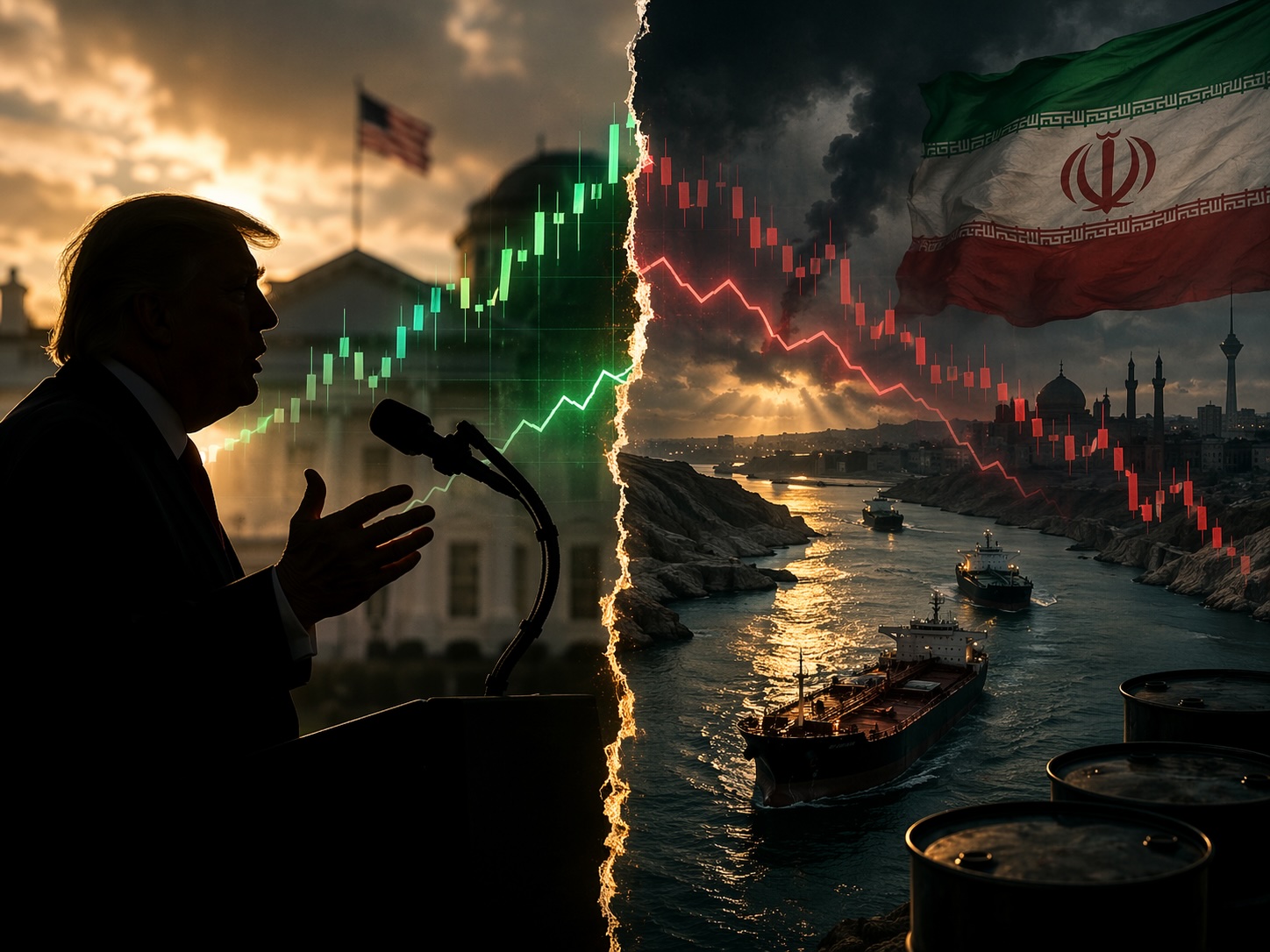
Last week’s Wall Street rally was built on a presidential promise, not economic reality. If the Iran ceasefire collapses, so does Trump’s market credibility — and the consequences will reach far beyond the Strait of Hormuz.
When US markets surged last week, financial commentators rushed to attribute the bounce to resilient corporate earnings, cooling inflation data, or some elusive sign of economic stabilization. But strip away the noise and the picture is far simpler — and far more precarious. Markets moved on one thing: Donald Trump’s mouth.
 Trump told reporters, posted on Truth Social, and signaled through surrogates that a deal with Iran was “very close,” that the Iranians had agreed on nuclear concessions, and that the ceasefire was holding. Investors, starved of good news after months of tariff shocks and war premiums baked into every asset class, chose to believe him. Oil futures eased. Defense stocks trimmed gains. The S&P breathed.
There were no new earnings revisions. No Federal Reserve pivot. No resolution of the tariff war with China that has already carved an estimated 1.2% off projected US GDP growth. The market moved on presidential talk — the most fragile foundation imaginable for a sustained recovery.
Iran holds more cards than Washington admits
The conventional Western narrative frames Iran as the desperate party — battered by strikes, its supreme leader assassinated, its nuclear infrastructure degraded, its economy in freefall. That narrative is not wrong, but it is dangerously incomplete.
Iran possesses a specific, targeted form of leverage that cuts directly at Trump’s most vulnerable political nerve: the ability to inflict economic pain on American consumers in an election-adjacent environment. The Strait of Hormuz is not merely a waterway. It is a pressure valve on the global oil market, and Iran’s finger remains on it.
→ 20% of the world’s traded oil passes through the Strait of
Hormuz — any escalation spikes prices globally within hours→ Trump has repeatedly and publicly tied his presidency’s
success to stock market performance and consumer prices
→ A sustained oil price rise of $20–30 per barrel would reignite
US inflation and kill any remaining talk of Fed rate cuts
→ US naval blockade of Iranian ports risks military confrontation
— any incident triggers an immediate risk-oJ selloJ
→ Iran’s negotiating team has returned to Tehran for approval —
signalling the regime is not acting from desperation
Beyond oil, Iran understands something that is rarely stated plainly in diplomatic circles: Trump cannot afford a prolonged conflict. Not because of moral constraints, but because of market ones. A boots-on-the-ground escalation, even a limited one producing American casualties, would send shockwaves through an already brittle market that has already absorbed a 20% correction earlier this year. Trump knows the scoreboard. The Dow is his approval rating.
The credibility problem is enormous
Here is the political trap Trump has constructed for himself. By publicly declaring that a deal was “almost done,” that Iran had agreed to give up its enriched uranium stockpile, and that the ceasefire was essentially a victory lap, he set a benchmark. Wall Street priced in that benchmark. Institutional investors adjusted positions. Retail investors exhaled.
If April 21 arrives and the ceasefire expires without a deal — or worse, if fighting resumes — the market’s reaction will not simply be a reversal of last week’s gains. It will be an amplified unwind, because traders will not only be selling on bad news; they will be recalibrating their entire trust in Trump’s statements as a market signal.
This is not a partisan observation. Markets do not care about politics. They care about predictability. And Trump has now made himself the single most important variable in the Iran-market equation, which means any failure is his failure — publicly, measurably, and immediately.
The world is watching — and quietly stepping back
There is another dimension to Iran’s strength that is often underreported: the degree to which the United States has alienated the very allies it would need to sustain economic and diplomatic pressure on Tehran.
Europe is not supportive of the US-Israeli strikes. China has been quietly facilitating Iranian oil sales for years and has every incentive to see Washington tied down in a Middle Eastern quagmire. Russia, despite its own complications, is no ally to American pressure. Even Gulf Arab states — historically aligned with US containment of Iran — are uncomfortable with the precedent set by the February 28 strikes and are hedging their positions accordingly.
The United States is also navigating this moment while its own economic credibility is under pressure. The tariff regime has already strained relationships with Canada, the EU, Japan, and South Korea. The dollar’s reserve currency status — long considered untouchable — is being quietly questioned in several central banking circles. At precisely the moment Washington needs maximum allied leverage over Iran, it finds itself with minimum diplomatic capital to spend.
Iran’s weakness is real — but time is on its side
To be balanced: Iran is not negotiating from a throne. Its economy was crippled before the first American bomb fell. Inflation, currency collapse, mass protests, and the assassination of its senior leadership have created genuine internal instability. The regime is not invincible, and its population’s patience is not unlimited.
But here is the asymmetry that matters: Iran only needs to survive the next few weeks intact. Trump needs a winnable headline before the ceasefire expires, before markets re-test recent lows, and before the domestic political cost of the war compounds further. Iran can afford to wait. Trump cannot.
The Iranian negotiating team’s willingness to counter-propose — offering a five-year enrichment freeze against America’s demand for twenty years, proposing to down-blend rather than export enriched uranium — suggests a side that is engaging tactically, not capitulating. They are keeping the deal alive without giving Trump the clean victory he needs to claim total success.
The negotiating gap — Where the deal is stuck
Enrichment freeze: US demands 20 years — Iran has offered 5 yearsUranium stockpile: US wants it shipped abroad — Iran offers to down-blend inside Iran
Strait of Hormuz: Iran insists on continued control — a US red line
Frozen assets: Iran wants $6B+ released — US reluctant post-2018 political backlash
Lebanon: Iran insists any deal covers Hezbollah — Israel and US refuse
Trump’s unpredictability — asset or liability?
Defenders of Trump’s approach argue that his unpredictability is itself a strategic asset — that Iran cannot risk calling a bluff that might not be one. This is not an unreasonable argument. The threat of irrational escalation has deterrent value, and Tehran has reason to respect it.
But unpredictability cuts both ways. It has also made US allies unwilling to coordinate pressure, made markets unwilling to price in a durable resolution, and made Iranian hardliners within the regime able to argue that no deal with Washington is worth the paper it’s signed on — because the next American president, or even the next Trump tweet, might void it anyway. The 2018 withdrawal from the Obama nuclear deal haunts every Iranian calculation.
There are also serious questions — raised not by opposition partisans but by former senior officials and international observers — about the coherence of the US negotiating position. Steve Witkoff, Trump’s lead envoy, was described by arms control experts as poorly prepared on the technical nuclear file. Jared Kushner’s presence alongside him raised further eyebrows among career diplomats. Iran’s team, by contrast, has been disciplined, coordinated, and has consistently advanced a clear set of positions.
What happens if the deal fails
Let us be direct about the scenario markets are not yet fully pricing in. If the April 21 ceasefire expires without a deal or extension, several things happen in rapid sequence.
First, oil prices spike — probably sharply, as traders who repositioned last week are forced to reverse. Second, the credibility-driven market gains of the past week evaporate, and we likely overshoot to the downside as sentiment sours. Third, Trump faces a choice: escalate militarily (with all the market and human costs that entails) or back down, which is politically devastating for a president who declared “we win regardless.”
Fourth, and perhaps most consequentially, institutional investors — the “big boys” of sovereign wealth funds, the large asset managers, the bond market participants — will conclude that Trump’s deal declarations cannot be used as a reliable signal. That is not a small thing. It means every future market-moving Trump statement comes with a credibility discount baked in. The boy who cried deal.
Iran is playing hardball from a position of real leverage, and it is playing it intelligently. The asymmetry of time pressure, market sensitivity, and diplomatic isolation all favour Tehran’s ability to wait Trump out — or extract better terms than Washington is currently offering.Last week’s market rally was not a recovery. It was a sentiment trade on a presidential promise. If that promise is not delivered by April 21, the market correction will be swift, significant, and deeply corrosive to the one currency Trump values most in any negotiation — his credibility with the money.
The question is not whether Iran can survive this war. It already has. The question is whether Trump can survive a deal that fails to materialise — and whether Wall Street, which has so far given him the benefit of the doubt, will extend that grace one more time.
The clock is not running out on Iran. It is running out on Washington.
Read more from Mohammad Akhlaq Siddiqi:
From ceasefire collapse to blockade: How Pakistan rose and India stood still in the US-Iran crisis (April 13, 2026)
The diplomatic shift: Why JD Vance’s possible Pakistan mission signals a turning point in the Iran conflict (March 27, 2026)
The celluloid state: Decoding the polarizing power of Dhurandhar(March 26, 2026)