



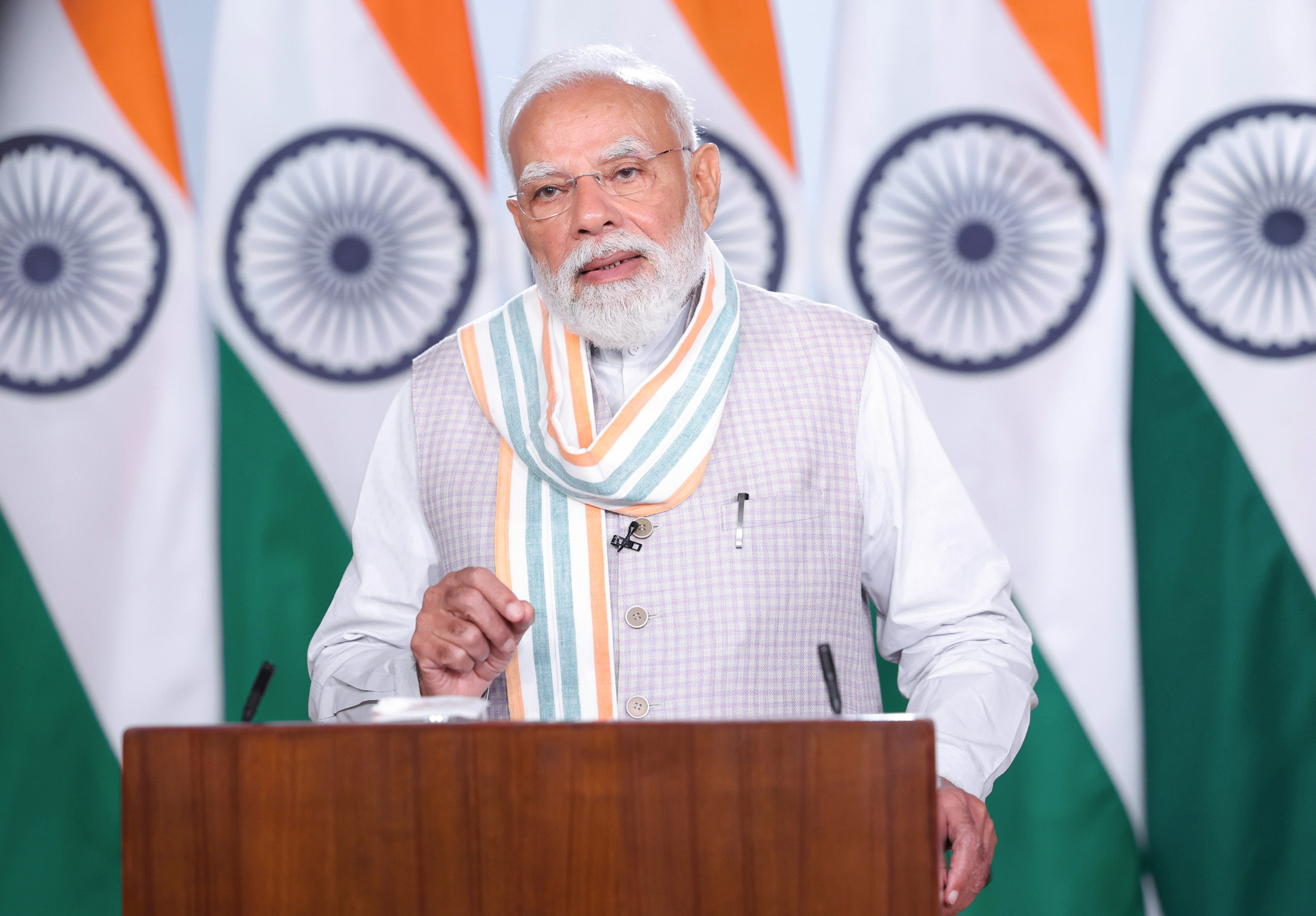
On May 26, 2014, Narendra Modi stood in the forecourt of Rashtrapati Bhavan and took the oath of office. The crowd was enormous. The hope was larger. India had elected not just a prime minister but a promise — that a chai-wala from Gujarat, a self-made man who had clawed his way up from nothing, would finally deliver the India that had been talked about for decades but never quite arrived.
Twelve years later, it is worth pausing. Not to celebrate, and not to condemn. Just to look.
Today, petrol prices rose again. The fourth hike in less than two weeks. Crude oil has crossed a hundred dollars a barrel, driven by the U.S.-Iran conflict and the closure of the Strait of Hormuz. In Delhi, in Mumbai, in every city where a working family fills a tank or pays an auto fare, the anniversary is being marked in the only currency that matters — the cost of getting through the day.
This is not entirely Modi’s fault. Global oil markets do not answer to South Block. But twelve years ago, when prices rose under Manmohan Singh, Modi called it governance failure. He was not wrong then. He cannot ask to be judged differently now.
That is the first entry in the ledger.
Let us be fair about what these twelve years delivered.
India’s infrastructure was transformed. Highways that used to be nightmares became real roads. Airports that embarrassed the country became airports worthy of it. The UDAN scheme brought air travel to cities that had never seen a commercial flight. Jan Dhan accounts banked the unbanked. Toilets were built — hundreds of millions of them — in a country where open defecation had been a public health catastrophe for generations. The Ayushman Bharat health insurance scheme extended a safety net to families who had none.
These are not small things. They are large things. A fair accounting must say so.
READ: Crony capitalism didn’t start with Modi- But it has never looked like this (May 23, 2026)
Modi also gave India something harder to quantify but impossible to ignore — a renewed sense of national confidence. Whether one agrees with its ideological shape or not, the India that sits across the table from Washington today is not the India that used to nod politely and hope for the best. When Rubio arrived last week carrying a White House invitation and promises of American energy deals, India received him on its own terms. That posture did not emerge from nowhere. Twelve years of deliberate strategic autonomy built it.
And then there was the Melody toffee.
It sounds trivial. It was not. During his visit to Italy, Modi pulled out a packet of Melody — a ten-rupee Indian candy — and handed it to Italian Prime Minister Giorgia Meloni. Meloni smiled, called it a “very, very good toffee,” and the moment went viral across the world within hours. The hashtag was already there — the internet had long called them “Melodi,” a combination of their names — and Modi, with one simple gesture, played it perfectly.
In the entire history of diplomacy, no ten-rupee toffee had ever done so much work. No head of government had ever walked into a G7 summit with a packet of candy and walked out having won the internet. It was spontaneous, it was confident, it was unmistakably Indian — and it could only have been done by a leader who was completely comfortable in his own skin on the world stage. That is not nothing. That is, in fact, quite something.
Credit where it is due.
Now the other side of the ledger.
The promise of two crore jobs a year — the central economic pledge of 2014 — was never kept. India’s unemployment rate among the educated young remains a quiet crisis that no infrastructure project has solved. The economy grew, sometimes impressively, but the growth did not reach far enough down. The man selling vegetables, the woman doing piecework at home, the graduate with a degree and no offer letter — they are still waiting.
The NEET paper leak scandal is in the Supreme Court today, on this anniversary. It is a fitting coincidence. India’s examination system — the gateway through which millions of young people hope to escape poverty and enter the professions — has been repeatedly compromised. The government that promised to clean up institutions has struggled to protect the most basic one: the integrity of a fair test.
And then there is the question that twelve years have made unavoidable.
Modi came to power promising minimum government, maximum governance. What India got was something different — maximum Modi. The Prime Minister’s face is on vaccination certificates, on government scheme advertisements, on the walls of railway stations. The party has become the man, and the man has become the state. Ministers do not speak without calibrating what he would want. Institutions that were meant to be independent have learned to be careful. The press that was meant to ask hard questions has, with honourable exceptions, learned to ask soft ones.
READ: India’s electoral roll crisis: How democracies fight back (
This is not dictatorship. Let us be precise. India holds elections, and they are contested, and sometimes the BJP loses them. But democracy is not only elections. It is also the quality of disagreement, the freedom to dissent, the confidence of institutions to act without looking over their shoulder. On these measures, the twelve years have not been kind.
There is a particular sadness in watching a leader of genuine ability — and Modi has ability, this column will not pretend otherwise — slowly become unable to distinguish between himself and the country he leads. When criticism of the government becomes, in the ruling party’s framing, criticism of India itself, something important has been lost. Not just for the opposition. For everyone.
The greatest leaders leave institutions stronger than they found them. They build systems that outlast them. They make themselves, over time, unnecessary. The test of Modi’s twelve years — and the three that remain in this term — is whether he is building an India that will thrive after Modi, or a Modi-shaped India that will struggle to find itself when he is gone.
Twelve years in, that question does not yet have a comfortable answer.
The forecourt of Rashtrapati Bhavan was full of hope that evening in May 2014. Some of it was justified. Some of it is still waiting. And some of it, quietly, has been given up.
That is not nothing. But it is not enough.