



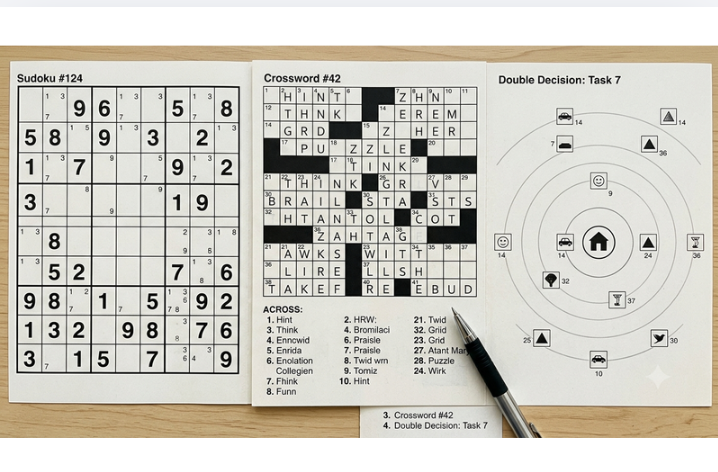
For years, we have been told that the way to keep our brains healthy as we age is to keep them active. Do crossword puzzles, play Sudoku, read, learn something new and challenge your memory? The logic seems straightforward: if the brain is like a muscle, exercise it. But emerging research suggests that we may have been thinking about brain training too broadly. The more important question may not be whether we exercise the brain, but which cognitive functions we are exercising and whether those functions actually influence how the brain ages.
The Advanced Cognitive Training for Independent and Vital Elderly, or ACTIVE, study. The followed 2,802 adults age 65 and older who were randomly assigned to memory training, reasoning training, speed of processing training or a control group. The results are challenging the assumption that all forms of cognitive training provide the same benefit.
The original study found that participants who received speed of processing training had approximately a 29 percent lower risk of dementia after ten years compared with controls. The memory and reasoning groups did not demonstrate the same statistically significant reduction.
A more recent twenty year follow up found that participants who received speed training along with booster sessions had approximately a 25 percent lower rate of diagnosed Alzheimer’s disease and related dementias compared with the control group.
These findings do not prove that playing a computer game prevents Alzheimer’s disease. The outcome was based on diagnosed dementia, and there are important questions about how broadly the findings should be interpreted.
READ: Sreedhar Potarazu | If AI gives professional advice, does it need a license? (August 9, 2026)
The eye is not simply a camera
As an ophthalmologist, I find this question particularly compelling because we have traditionally treated the eye and brain as separate systems. We think of the eye as a camera that captures an image and sends it to the brain for interpretation. Biologically, however, the relationship is far more complicated. The retina is neural tissue, the optic nerve is a neural pathway, extension of the brain, and visual information is processed through networks that interact with attention, memory, spatial awareness, executive function and decision making.
Vision is therefore not simply the ability to see an object. It is the ability of the brain to extract meaningful information from an enormous amount of visual input.
At any given moment, our eyes are receiving more information than our conscious brain can process. The brain has to determine what deserves attention, what can be ignored and what requires a response. As we age, processing speed and the ability to divide attention can decline even when visual acuity remains relatively good.
That distinction is important. A person can still see 20/20 and yet become slower at recognizing an unexpected object in the peripheral visual field or shifting attention between competing sources of information.
This is where the ACTIVE research becomes particularly interesting.
The game is about processing, not memory
The training discussed in the recent study is called Double Decision now available through The exercise presents an object in the center of the screen while simultaneously presenting another object somewhere in the peripheral visual field. The participant must identify both, and as performance improves, the program progressively increases the difficulty.
What is being trained is not simply memory. The participant must see, divide attention, discriminate between competing visual stimuli and respond rapidly.
This type of training is related to the concept of the useful field of view, which refers not simply to everything a person can physically see, but to how much visual information the brain can effectively process while attention is directed elsewhere.
Consider driving. You are looking at the road ahead, but at the same time your brain must monitor what is happening to the sides. A pedestrian, cyclist or vehicle can suddenly enter your peripheral field. Your eyes may detect the object, but detection alone is not enough. The brain has to recognize what it is, determine whether it matters and respond quickly enough for that response to be useful.
That is both a visual and cognitive function.
The brain may need progressive overload
One of the most interesting aspects of the ACTIVE intervention is that the training was adaptive. As participants improved, the task became more difficult, requiring the brain to process information more rapidly and accurately. That is similar to the principle of progressive overload in physical exercise. If we continue lifting the same weight, eventually the body adapts and the stimulus becomes smaller. To continue improving, we increase the challenge. The objective is not simply to keep the brain occupied. It is to repeatedly challenge a specific neural function at the edge of its current ability.
READ: Sreedhar Potarazu | AI is burning through free cash flow (July 25, 2026)
The finding that booster sessions were associated with the long-term benefit makes this even more interesting. Cognitive fitness may require maintenance just as physical fitness does. We would not expect someone to exercise for several weeks and remain physically fit for the next twenty years. Why should we assume the brain is different?
What does this mean for vision and dementia?
The relationship between vision and cognitive health extends beyond this particular study. Vision impairment has increasingly been recognized as a potentially modifiable factor associated with dementia risk, although the relationship is complex and does not establish that poor vision directly causes Alzheimer’s disease.
There are obvious behavioral pathways. When people lose vision, they may stop driving, become less physically active, withdraw socially, read less and avoid unfamiliar environments. Their world becomes smaller, which can reduce both physical and cognitive stimulation.
But there may also be a deeper connection. Vision is one of the primary ways the brain interacts with the external world. The visual system is constantly delivering information that requires attention, interpretation and response. That raises a provocative question: perhaps maintaining cognitive health requires not only preserving vision, but preserving the brain’s ability to process visual information efficiently.
Today, an eye examination primarily asks how well a person can see and whether there is disease affecting the eye. In the future, we may also want to know how efficiently the brain processes what the person sees. Can the individual divide attention? Can they detect peripheral information? How rapidly can they respond to competing visual stimuli?
READ: Sreedhar Potarazu | Chatbots can Auto-Tune our minds and voice: The Maya of AI (July 21, 2026)
We might describe this emerging concept as neurovisual fitness.
The larger question
The most important finding from the ACTIVE research is not that a particular game may reduce dementia risk. It is that we may have been thinking about cognitive aging too narrowly. We tend to think of dementia as beginning with memory loss, but cognition does not begin with memory. It begins with perception, attention and information processing. Much of that information enters the brain through vision.
If we can preserve the health of the eye, maintain the quality of visual information reaching the brain and potentially train the brain to process that information more efficiently, we may be able to influence one component of cognitive resilience.
This does not mean that vision training will prevent Alzheimer’s disease. Dementia is biologically complex, and genetics, vascular health, metabolic disease, sleep, physical activity, hearing, social engagement and many other factors matter. But the research gives us enough evidence to ask a different question about aging.
Perhaps the goal should not simply be to keep the mind active and learn how to train the eyes and brain together, measuring and strengthening the systems that allow us to see, process and respond to the world around us.
If that approach ultimately proves effective, the implications could extend well beyond ophthalmology. The eye may become not simply a window into the brain, but an important entry point for maintaining the brain itself.