



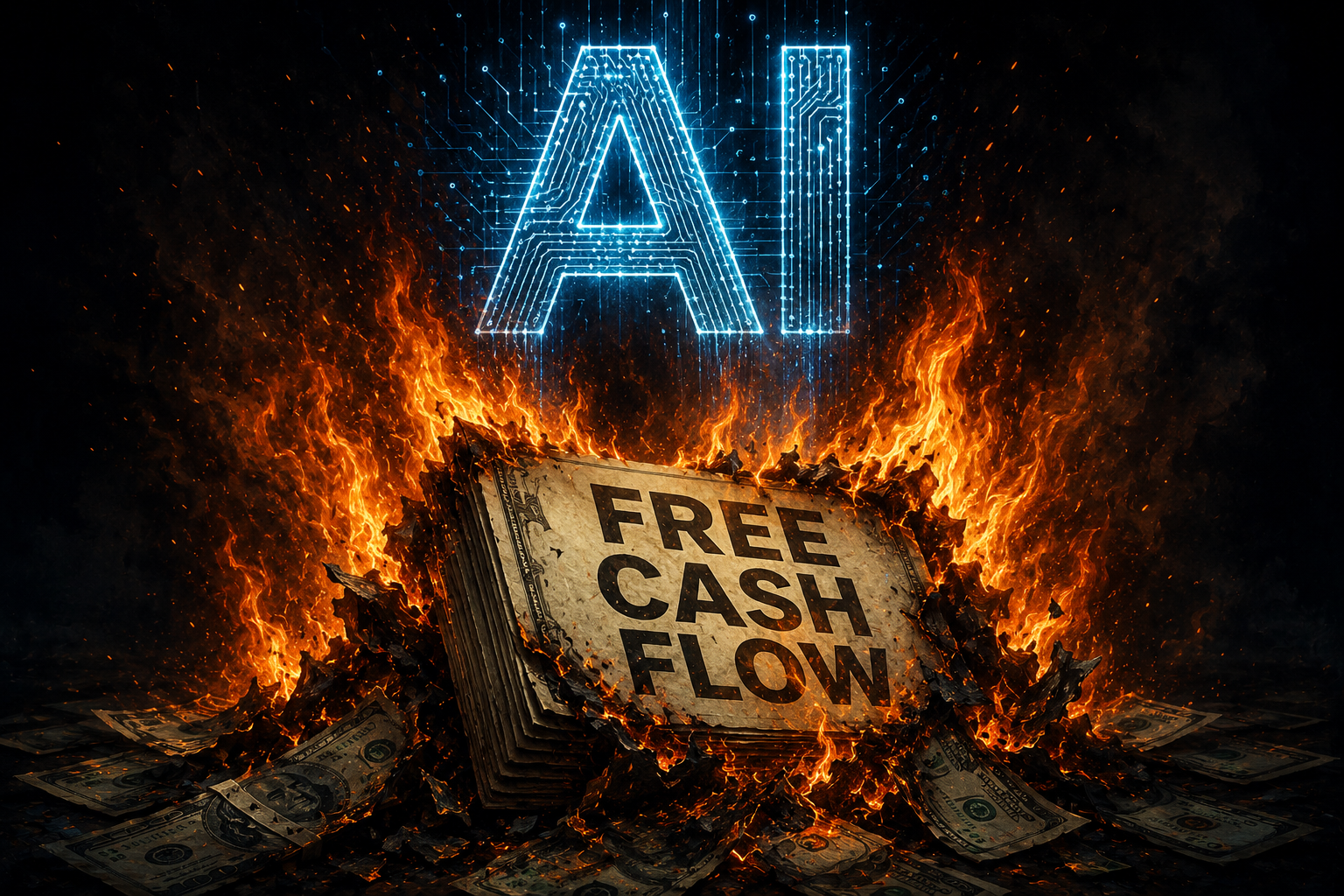
Free cash flow has been one of the clearest indicators of a successful business because most of these companies are able to develop products, attract customers, generate revenue, pay their operating expenses, invest in future growth, and still have substantial amounts of cash remaining at the end of the process.
That excess cash could then be used to repurchase shares, pay dividends, acquire other companies, or simply accumulate on the balance sheet, which is why companies such as Alphabet, Microsoft, Amazon, Meta, (hyperscalers ) and others came to be viewed as extraordinarily powerful businesses with financial resources that appeared almost limitless.
Artificial intelligence is now testing that model in a way that could fundamentally change how investors evaluate the industry, because hyperscalers are spending money on artificial intelligence infrastructure at a rate that is beginning to consume the very free cash flow that made their business models so attractive in the first place.
The latest warning sign came from Alphabet, which reported negative free cash flow of approximately $5.9 billion, its first negative result since the company became public in 2004, even as its revenue continued to grow. The company also raised its capital expenditure forecast to as much as $205 billion as it accelerates investment in artificial intelligence infrastructure, including data centers, computing capacity, and the chips required to support the growing demand for AI services.
READ: Sreedhar Potarazu | Chatbots can Auto-Tune our minds and voice: The Maya of AI (July 21, 2026)
The market’s reaction was revealing because investors did not respond primarily to the company’s revenue performance, instead focusing on what was happening to the cash that remained after the company paid its expenses and made the investments required to support its future.
Alphabet’s shares fell approximately 7 percent, wiping out roughly $293 billion in market value in a single day, while the broader selloff spread across the technology sector. Tesla also fell sharply as investors focused on the enormous cost of its ambitions in autonomous vehicles and robotics, while Meta and Oracle declined as investors increasingly questioned whether the scale of spending required to compete in artificial intelligence could ultimately produce returns commensurate with the capital being deployed.
The most interesting comparison with the dot-com era is not necessarily valuation, because the largest AI companies today are far more established than the internet startups of the 1990s. The more important similarity may be the increasing importance of what might be called the new burn rate.
During the dot-com boom, investors often treated a company’s willingness to spend money as evidence of its future potential. Startups were rewarded for hiring thousands of employees, entering multiple markets, building infrastructure, and expanding rapidly before they had demonstrated a sustainable business model. The companies that could raise the most capital and spend the most money were frequently viewed as the companies most likely to dominate the future because investors assumed that capital consumption today would inevitably lead to market dominance tomorrow.
That assumption worked until it didn’t.
READ: Sreedhar Potarazu | China’s open weight could break the trillion-dollar AI model (July 18, 2026)
When the dot-com bubble burst, investors rediscovered a basic economic principle that had temporarily been obscured by enthusiasm for the internet, which is that spending money is not the same thing as creating value.
The AI industry has developed its own version of this phenomenon, although the modern burn rate is measured differently. The companies competing in the AI race are not primarily competing to hire thousands of employees or occupy enormous office buildings, as many companies did during the dot-com era.
Instead, they are competing to acquire GPUs, construct data centers, secure electricity, develop networking infrastructure, train increasingly sophisticated models, and maintain the computational capacity required to process an enormous volume of AI queries.
The new burn rate is therefore not simply the amount of money a startup has left before it needs to raise more capital, as was commonly discussed during the dot-com era. It is the amount of free cash flow that established companies are consuming as they attempt to build the infrastructure they believe will determine who controls the next generation of computing.
Free cash flow for hyperscalers may increasingly give an incomplete picture of how much hyperscalers are actually spending on AI infrastructure. Traditionally, free cash flow reflects the cash left after a company pays its operating expenses and capital expenditures, but companies can now reduce the immediate impact on reported free cash flow by financing data centers and other AI infrastructure through bonds, leases, joint ventures, or arrangements in which another party owns the asset, while stock-based compensation can also reduce the amount of cash a company pays employees even though it represents a real economic cost to shareholders.
In other words, a hyperscaler may appear to preserve more free cash flow than it otherwise would, not necessarily because the cost of building the AI infrastructure has disappeared, but because the cost has been shifted into debt, lease obligations, equity dilution, or another part of the financial statements, meaning investors may need to look beyond traditional free cash flow to understand the full economic cost of the AI spending boom.
A company can therefore report extraordinary revenue growth while simultaneously confronting extraordinary costs associated with delivering that revenue, meaning that revenue growth alone may become a less reliable indicator of the economic strength of an AI business. The fundamental question is whether the returns from artificial intelligence will arrive quickly enough and at sufficient scale to justify the capital being deployed today.
Investors are increasingly valuing AI companies based on the expectation that artificial intelligence will eventually perform work currently carried out by software developers, analysts, consultants, customer service representatives, researchers, accountants, and other knowledge workers. This represents a profound shift in valuation logic because, during the SaaS era, investors generally valued companies based on recurring revenue, customer retention, operating margins, and expected future cash flows, while during the AI era investors are increasingly asking how much human economic activity a particular AI system might eventually replace or augment.
The central financial question of the AI era may therefore become surprisingly simple: how much free cash flow does a company generate after paying for the infrastructure required to deliver its AI products?
READ: Sreedhar Potarazu | Does Artificial Intelligence experience being Conscious or Consciousness ? The difference matters (July 5, 2026)
That is the metric that ultimately connects technological achievement to economic value because a company can have billions of users and extraordinary revenue growth while still consuming more cash than it generates. That may be perfectly rational for a period of time if the investment is creating durable future returns, but eventually the market will demand evidence that the capital being deployed today is producing economic value.
To measure free cash flow more realistically for hyperscalers, investors should look beyond the traditional formula of operating cash flow minus reported capital expenditures and calculate an “AI free cash flow” that includes the full cost of building and operating AI infrastructure. That would mean adjusting for data-center leases and other off-balance-sheet commitments, adding back debt-financed capital expenditures rather than treating them as economically free, and treating stock-based compensation as a real cost because it dilutes existing shareholders even though it does not immediately reduce cash.
The goal would be to measure how much cash the business truly generates after accounting for all the resources required to sustain its AI operations, rather than simply how much cash remains after the costs that happen to appear in the traditional free cash flow calculation.
The market has rewarded spending because investors fear missing the future, but at some point investors will demand proof that the future can pay for itself.