



Ever notice that mobs move with a murmur of certainty? In Salem, it was the rustle of skirts and scripture. In Paris, the scrape of pike against cobblestone. Today, it is the soft, relentless click of a thumb on glass, scrolling toward judgment at three in the morning.
Somewhere on Facebook right now, a woman with a golden retriever and a kind face is sharing a screenshot that claims the CDC has “admitted” the COVID-19 vaccine is the largest carcinogenic exposure in history. That post has six thousand hearts, seven hundred comments, and a caption of a single word: Horrific.

She does not know she is holding a torch because she believes she is holding a lantern. Soon, other social media warriors will repost, with additional likes from like-minded warriors, turning a slide about “temporal association” into a headline about “admitted” carcinogens, because they are trained to see causation in every coincidence, because no one has taught them to look for anything else.
The tools built to illuminate our lives have become so easily weaponized to inflame. Forget the town square. Today, the mob needs only a feed, an algorithm hungry for outrage, and a public increasingly untrained in the difference between correlation and cause, between a slide deck’s uncertainty and a scientist’s confession.
Here’s the takeaway: we have not lost our capacity for conviction, but have lost our patience for complexity, and complexity is the native language of science.
The mob is now moving once again with that same murmur of certainty after it heard silence fill the Senate hearing room a few days ago. On July 29, in the Dirksen building, Dr. Anthony Fauci sat before Senator Rand Paul’s committee and declined to answer, invoking his Fifth Amendment right against self-incrimination more than a hundred times over nearly three hours, reducing fifty-four years of public health testimony to a single repeated sentence about the advice of his attorneys. Paul promised a contempt vote, and on August 6, he got one: his committee voted 8-5, strictly along party lines, to hold Fauci in contempt of Congress, and referred the matter to the Department of Justice and the U.S. Attorney for the District of Columbia. Cable news has promised, in turn, to replay the moment on a loop through the fall. It will be riveting television AND the loudest possible cover for the quietest possible tragedy: a scientific platform that saved millions of lives is being starved of its future, while a public already primed by torch-lit Facebook posts watches the spectacle and concludes its suspicions were right all along.
This essay is about that platform, what it actually is, the decades it took to build, why it was ready the moment the world needed it, why the conspiracies about it collapse under five minutes of scrutiny, and why an election season is precisely the wrong moment to be making decisions about it. But we cannot get to the “why” until we get to the “what.”
READ: The Review by Ajay Raju | Deepfaking the presidency (August 3, 2026)
The Recipe Card, Not the Cookbook
Social Media Myth: MRNA Vaccines alter your DNA.
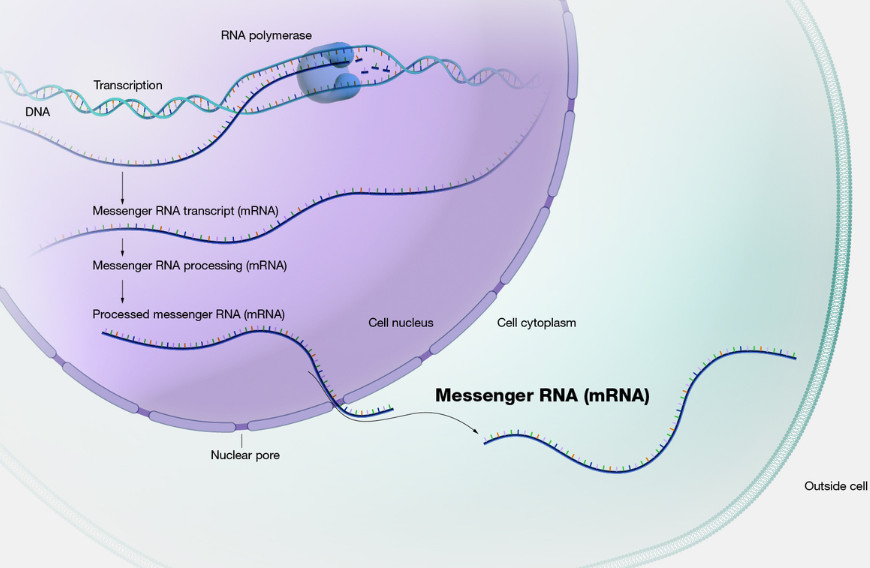
Picture your DNA as a cookbook, thick and irreplaceable, locked in the library of the cell, the nucleus. Your DNA never leaves that room. What mRNA vaccines do is far more modest than their critics imagine: they hand your cells a single photocopied recipe card, not the cookbook. The card carries one instruction: “build this one small piece of protein” and nothing else. In the case of the COVID vaccines, that protein was a single harmless fragment of the coronavirus’s spike, the part it uses to latch onto human cells.
Your cellular kitchen, the ribosome, a structure every cell already has and uses constantly to make its own proteins, reads the card and bakes the dish. Your immune system then studies that fragment the way a detective studies a wanted poster: it doesn’t need the criminal in the room, just an accurate likeness, to begin building a defense. Antibodies form. Memory cells are trained. And then, within a day or two, the card itself is torn up and discarded, the way your own cells constantly discard the mRNA they generate for their everyday business. It never entered the library and it could not rewrite the cookbook because it was never in the room with the cookbook to begin with. The nucleus and cytoplasm are separate compartments, and mRNA vaccines never cross that boundary.
This is not a matter of my opinion or the government’s reassurance. It is a matter of cellular geography. Human DNA sits inside the cell’s nucleus, and the mRNA delivered by a vaccine never reaches that compartment. It stays in the surrounding cytoplasm, doing its one job before being broken down. The messenger RNA also lacks the enzymatic machinery that would even let it communicate with or integrate into DNA in the first place. To put it plainly, the odds of mRNA altering human DNA are ZERO. Health authorities across the U.K., Canada, Germany, and Australia have each independently reached the identical conclusion, for the identical structural reason: the recipe card and the cookbook simply never occupy the same room.
Three Decades in the Making, Which Is Precisely Why It Was Ready
The second myth: this technology was slapped together in a political panic in 2020.
This myth is nearly the inverse of the truth. Research into mRNA vaccines had already been underway for more than three decades before COVID-19 ever gave it a global stage. Scientists had known since the early 1990s that synthetic mRNA, injected into an animal, could prompt cells to produce a chosen protein. The problem for years was that raw mRNA set off the body’s alarm systems as it caused dangerous inflammation, and it degraded before it could do its job. For most of the 1990s and 2000s, mRNA was a beautiful idea that kept failing in the lab, and it was unfashionable enough that funding regularly dried up around it.
The hinge moment came in 2005, when Katalin Karikó and Drew Weissman, Penn Medicine scientists, working, by then, on a shoestring, after years of rejected grant applications, discovered that chemically modifying one of mRNA’s building blocks let it slip past the body’s inflammatory alarm undetected. It was a single, elegant fix, and it is the reason a fast COVID vaccine could be safe rather than merely fast. Over the following fifteen years, that discovery was married to a second breakthrough: lipid nanoparticles, tiny fatty envelopes that protect fragile mRNA on its journey into a cell, solving the delivery problem that had also stalled the field for decades. By the time SARS-CoV-2 was sequenced in January 2020, the two hardest scientific problems, instability and inflammation, had already been solved, quietly, out of the public eye, for the better part of a generation. What the pandemic compressed was manufacturing scale and regulatory review. It did not invent the science overnight. What it did was simply cash a check that had been decades in the depositing. That is the real reason the vaccines could exist within a year: not haste, but readiness, the accumulated, unglamorous labor of scientists who kept working through years when almost nobody outside their labs believed the payoff would ever come.
The Nobel committee recognized exactly this in 2023, awarding Karikó and Weissman medicine’s highest honor. But if I was appointed King, I would have gone a step further than the Nobel committee. In my opinion, the more fitting prize for their work may not have been the one for Medicine at all. I would have honored them with the Nobel Peace Prize.
READ: The Review by Ajay Raju | Patience and trust — The real costs of finding cures (July 30, 2026)
Allow me to point to a precedent to defend my position. In 1970, the Nobel Peace Prize went not to a diplomat or a peacekeeper but to Norman Borlaug, an agronomist whose high-yield wheat varieties are credited with helping avert famines across Asia and Latin America, famines that history and demography both suggest would otherwise have fed directly into political collapse and armed conflict. The Nobel committee understood, correctly, that averting mass starvation was itself an act of peacekeeping, perhaps a more durable one than any treaty. I would ask you to run the same thought experiment forward from Weissman’s bench. A COVID pandemic that ran three, four, five years longer without a vaccine, with the mortality, the economic collapse, and the social fracture that implies, is not a hypothetical free of geopolitical consequence. Pandemics that grind on for years produce exactly the conditions like mass unemployment, collapsed supply chains, desperate governments, blamed neighbors, that make wars, insurgencies, and civil breakdowns more likely, not less. Weissman’s modified nucleoside did not just save individual lives, though it saved millions of those. It very plausibly kept the pandemic short enough that it never metastasized into the kind of prolonged global instability that has, throughout history, been a reliable precursor to conflict. If Borlaug’s wheat earned a Peace Prize for the famines it prevented, Weissman’s and Kariko’s chemistry deserves the same conversation for the wars it may have quietly made unnecessary.
The Cost of Making Policy from the Loudest Chair
Back to other recent news, which may have been buried beneath the hearing-room theater and beneath the six thousand hearts on a stranger’s Facebook post: on August 5, 2025, Health and Human Services Secretary Robert F. Kennedy Jr. announced the termination of 22 federal contracts for mRNA vaccine development, winding down roughly half a billion dollars in investment across projects with Pfizer, Sanofi Pasteur, Emory University, and others. Secretary Kennedy has previously described COVID shots as the deadliest vaccine ever made, a claim that reams of safety data directly contradict. The stated rationale was that mRNA “poses more risk than benefit” for respiratory viruses because a single mutation can blunt its effectiveness. Public health leaders across the political spectrum said, in effect, that this gets the science backward. A Harvard School of Public Health analysis called the claim that these vaccines fail to protect against respiratory infection simply false, noting the same vaccines have saved millions of lives in the U.S. and many more worldwide, a scientific promise now being strangled almost at its moment of Nobel-certified vindication.
The cuts have not stayed still since. By this spring, HHS had rewritten the charter governing the CDC’s vaccine advisory committee, broadening its mandate well beyond its traditional focus. By May, the FDA had reportedly blocked publication of several agency studies that supported the safety of COVID and shingles vaccines. Each move, individually, can be framed as a technical adjustment. Together, they describe a pattern: an administration substituting the loudest voice in the room for the deepest bench of evidence, and doing so in the exact season when a congressional spectacle guarantees no one is watching the substance, and when a viral graphic with a syringe emoji can do more to shape public belief than any peer-reviewed rebuttal ever will.
Here’s what should worry us about the timing. Midterm campaigns run on villains and clips, not footnotes. A Fauci hearing generates exactly the kind of tribal, replayable noise that a 24-hour news cycle rewards, and it generates it precisely when a defunded platform still has a chance to deliver, quietly, some of the most consequential medicine of this decade. Phase 3 cancer vaccine trials and rare-disease programs, including an mRNA therapy for propionic acidemia expected to report data by the end of this year, are advancing right now, built on the infrastructure the COVID vaccines proved out. Scientists working on an mRNA flu vaccine have called the funding freeze a bad day for science, warning it could hamper the country’s ability to respond to the next pandemic. None of that trended on the day of the contempt vote. All of it will be true the day after.
And, in fact, it is. On August 5, 2026, one year to the day after Secretary Kennedy pulled the plug on half a billion dollars of mRNA research, the FDA approved the country’s first mRNA-based flu vaccine, Moderna’s mFLUSIVA, for adults fifty and older. In a late-stage trial of more than forty thousand adults, the vaccine proved roughly twenty-seven percent more effective than a standard flu shot, precisely the kind of margin the platform’s harshest critics insisted mRNA could never deliver against a fast-mutating respiratory virus.
The Other Half of the Megaphone
I would be telling only half this story, and doing my own argument a disservice, if I let the record stop there because the right does not hold a monopoly on turning science into a weapon of convenience. For roughly eighteen months starting in early 2020, the idea that COVID-19 might have escaped from a laboratory in Wuhan was treated by much of the mainstream press and by the major social platforms not as an open scientific question but as a debunked fringe theory, unfit for discussion. Major outlets including the New York Times, Washington Post, CNN, and NPR ran early 2020 pieces that framed any lab-leak discussion as racist, incorrect and conspiracy-adjacent, and Facebook enforced an outright ban on the topic. That posture held until roughly May 2021, when, under mounting pressure from independent researchers and a shift in the political winds, the platforms reversed course and mainstream coverage began treating the theory as worthy of serious inquiry. A bipartisan congressional investigation and multiple U.S. intelligence assessments have since concluded that a lab leak is the more likely explanation for the pandemic’s origin, though the science on origin remains genuinely unsettled. Whatever the eventual answer, the eighteen months in between were not a triumph of scientific caution, but a demonstration that “misinformation” can be a label applied selectively, to protect a preferred narrative rather than an established fact.
The same pattern showed up around the vaccines themselves. Several senior public officials, echoed uncritically by outlets eager for a reassuring headline, told the public in 2021 that vaccination would make a person a “dead end” for the virus, unable to carry or spread it. Fact-checkers later confirmed that no CDC data ever supported the claim that vaccinated people could not transmit the virus at all, and by the following winter, breakthrough infections and transmission among the vaccinated were well documented in the medical literature. Public health experts have since acknowledged that the early messaging around vaccines and transmission was overstated and should have focused instead on the vaccines’ clearer benefit: preventing severe illness and death. In other words, the seatbelt doesn’t prevent accidents, but improves your chances against serious injury or death. Citizens who raised the obvious follow-up questions in real time were, in many cases, dismissed rather than answered.
Neither of these episodes makes the DNA-alteration myth true, and neither excuses HHS from a half-billion-dollar funding cut built on cherry-picked risk. But both episodes are proof that the instinct to treat scientific uncertainty as a communications problem, to be managed rather than disclosed, is not confined to one side of the aisle. The right learned to weaponize genuine uncertainty about mRNA into blanket distrust. The left learned to weaponize genuine confidence in vaccination into blanket suppression of inconvenient questions. Both moves optimized for the same thing: clicks, tribal reassurance, an audience that would not change the channel. And neither optimized for the only thing that actually mattered, which was getting the science right and getting it to the public honestly. I have watched neither side apologize for this in any way that suggests behavior has changed; the incentives that produced both failures, ratings, algorithms, an electorate primed to reward certainty over nuance, are exactly as intact today as they were in 2020.
The Oldest Voices Versus the Loudest Ones
What we silence when we shout is rarely the shouting itself. It is the patient, thirty-year, Nobel-anchored work of people like Karikó and Weissman, whose discipline was never designed to compete with cable-news velocity, or with a stranger’s late-night scroll, and was never supposed to have to. Scientists, career researchers, the unglamorous machinery of peer review are the oldest and, not incidentally, the smartest voices in this argument, and they are structurally incapable of shouting louder than a subpoena, a ban, or a viral graphic with a syringe emoji. A society that lets our loudest microphones, of either persuasion, set its scientific budget and its scientific consensus is not choosing caution over risk, or confidence over doubt. We are choosing spectacle over survival, on both sides of the aisle, and calling it conviction.
What a shame, and what a waste, that the loudest but least informed among us, the ones eager to brand the technology poison, and the ones equally eager to brand every honest question heresy, are now the reason a science with cancer, rare genetic disease, and the next unnamed pandemic in its sights is losing time it does not have. Not because the evidence changed, but because the microphone did, and neither side holding it has yet shown any sign of setting it down.
Expertise, patiently earned, should be the one form of authority that doesn’t need to shout to be right. The woman with the golden retriever is not the enemy. I believe she is misguided, standing in a crowd, holding a torch she was handed and told was a lantern.