



By Dr. Ajay Kothari
As artificial intelligence drives an unprecedented expansion of data centers across the United States, concerns over their enormous electricity demands, water consumption and impact on surrounding communities are fueling growing opposition to new facilities.
One proposed solution is to move data centers into orbit. But orbital data centers would be far more difficult and expensive to deploy and maintain than their terrestrial counterparts. They would also struggle to compete with the solution proposed here, both in terms of initial investment and ongoing maintenance costs.
Some argue that people simply do not want data centers in their communities. But with a U.S. land area of approximately 3.53 million square miles (9.15 million square kilometers), even if half were considered unusable, it is hard to imagine that we could not find 39 to 386 square miles (100 to 1,000 square kilometers) to accommodate 100 new data centers.
Even a data center measuring 1,640 by 1,640 feet (500 by 500 meters) would occupy just 0.1 square mile (0.25 square kilometer), and many facilities have smaller footprints.
The opposition is largely emotional, although concerns about electricity costs, water consumption and safety are legitimate. Such resistance could diminish if we found ways to operate data centers safely while providing electricity to nearby communities at lower rates.
I believe this is possible. And the solution lies not in putting data centers into orbit, but in finding a better way to power them here on Earth.
“Thor Baby Thor”
The “Thor Baby Thor” mantra needs to be added to “Drill Baby Drill”!
Data centers, increasingly referred to as “compute campuses,” are used every day, every hour, by virtually all Americans. But their power and water requirements are legitimate concerns, especially for nearby residents. This was made clear during the recent midterm elections, when voters in several states rejected or sought to restrict data center development, with one town in North Dakota being an exception.
It is a paradox that these same citizens relied on data centers that very day, whether for the votes they cast or the cell phones they used — and will continue to use in the future. Their usefulness is thus beyond question. These citizens can be reasoned with using the following arguments. The recent outage of some Microsoft data centers, even portions of them, caused considerable concern.
READ: Dr. Ajay Kothari | Thorium: The key to America’s energy independence (January 5, 2025)
What if we could solve this conundrum?
Do not think of “nuke” as a four-letter word. This is not your father’s nuclear technology. Advanced reactor technology can solve both of these problems, and more.
AI data centers will require about three to five times more power to operate. Most of the solutions proposed to power AI data centers are wrong. Pressurized water reactors (PWRs) need to be located near water supplies, which is very limiting and potentially problematic for nearby populations. They also carry the risk of explosions or leaks.
Using fossil fuels such as oil, gas or coal does not solve the pollution problem. In fact, it makes it worse. Nor is it possible or fair to burden local communities with higher electricity prices from the grid.
There is an astonishing solution that addresses all these concerns: thorium molten salt reactors (TMSRs).
These are advanced Generation IV nuclear reactors that use molten salt as both the coolant and the carrier for thorium fuel, making them much more efficient than PWRs.
A twofer.
Thorium-232 (Th-232) is 500 times more abundant than uranium-235 (U-235) and offers a significantly different and better solution.
We have 600,000 tons of thorium in the United States, mostly in Lemhi Pass on the Idaho-Montana border — enough to provide electricity and heat for the entire country for 400 to 500 years, possibly at cheaper rates.
It is a no-brainer.
We developed this technology to some extent in the late 1960s at Oak Ridge National Laboratory (ORNL) in Tennessee but abandoned it because it could not produce plutonium for nuclear bombs. Now that can become an advantage!
It is vastly different. We, as a country, need to look into it.
READ: Ajay Kothari | Returning humans to the moon without SLS and NRHO (February 14, 2025)
It can do wonders for powering data centers, but its potential does not stop there. It could power 50% of the country at potentially half the cost.
China has already used ORNL data to build a small TMSR-LF1 reactor in the Gobi Desert, which has been running successfully for the past two years.
This is also a national security issue.
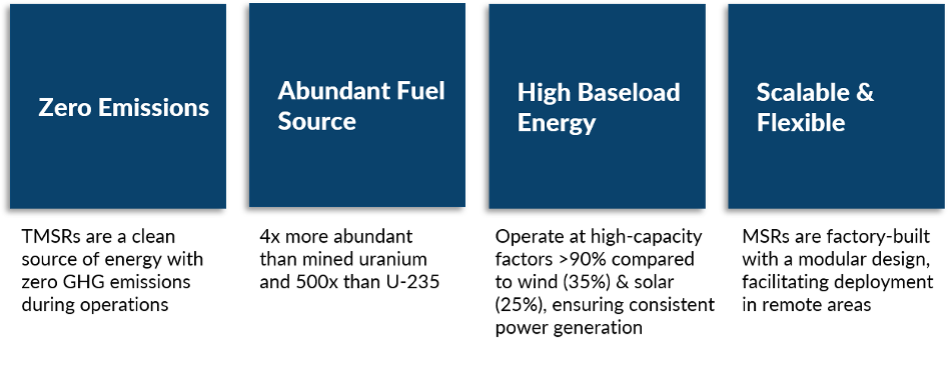
With TMSRs, there is no possibility of a high-pressure explosion because they operate at atmospheric pressure. They have inherent negative temperature and void coefficients of reactivity, along with natural, fail-safe mechanisms such as freeze valves.
They could achieve twice the efficiency of converting heat into electricity compared with PWRs. They would generate less than 1% radioactive waste products, compared with approximately 95% for today’s PWRs.
They would not require high-assay low-enriched uranium (HALEU), which many other advanced reactors need and which is in decidedly short supply.
And most importantly, they would not need to be located near water supplies — rivers, lakes or oceans. They could be used even in deserts, making them ideal for the Moon or Mars and allowing them to be distributed across the United States — anywhere those data centers need to be located.
They could be deployed as small modular reactors (SMRs) with electrical capacities of 10 to 50 megawatts, using U-233 bred from thorium at a central facility located far from population centers.
This facility would breed U-233 dissolved in molten salt, which could then be frozen into bricks at room temperature. These could be easily shipped to data center locations, as they cannot sustain fission in that form.
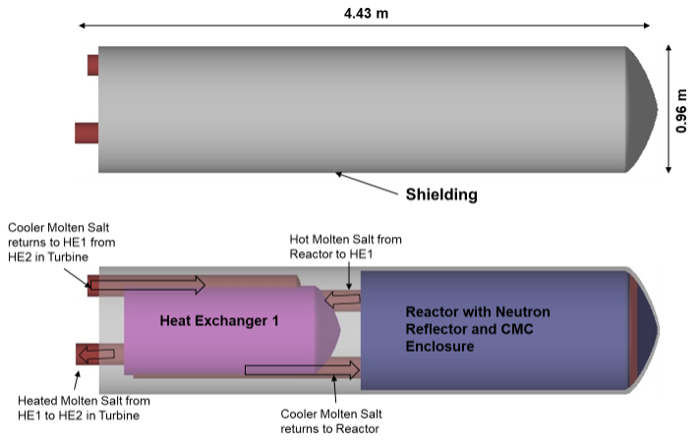
One such SMR design could be a compact unit measuring 5 to 10 meters (16 to 33 feet), as illustrated below. Conversion to electricity could be accomplished using closed-loop carbon dioxide or helium gas, eliminating the need for water at the reactor site. Some water might still be required, but nowhere near the amount needed for PWRs.
Rethinking nuclear energy
“Nuke” became a four-letter word because of earlier reactor designs using solid uranium-235 fuel — a wrong design pursued because of the need to produce plutonium for nuclear bombs in the 1960s.
We no longer need them to the same extent. These reactors should be phased out — surely not a pleasant proposition for today’s nuclear industry, but frankly, that should not matter.
Physics rules.
That was then. This is now.
READ: Dr. Ajay Kothari | The missed opportunity in space: How leadership gaps, priorities may cost U.S. the space race (October 22, 2024)
We face a different predicament and different priorities, particularly those related to climate change and energy security. We need a rethink.
In the 1950s, nuclear energy was touted as an incredible, almost infinite source of energy for humanity.
But even when controlled in nuclear reactors, it seemed dangerous because of the constant threat of explosions associated with the pressures of 200 to 300 atmospheres needed to keep coolant water in liquid form.
This requires extensive monitoring and double or triple redundancy in safety systems, tremendously increasing costs, as is still the case with the majority of reactors worldwide, most of which are light-water or heavy-water reactors.
These fears were reinforced by the accidents at Three Mile Island, Chernobyl and Fukushima.
What if this threat could be eliminated? How about addressing each problem, one by one, and finding ways to eradicate them?
Why can’t we conclude that the way we harnessed nuclear energy was wrong, rather than nuclear energy itself?
It is time to implement a better approach.
Give engineers the opportunity to engineer it.
The enormous potential of nuclear energy
The binding energy of the strong nuclear force offers almost a million times more energy per kilogram than the chemical energy released by burning fossil fuels, which involves electrons.
We have not been able to take full advantage of this potential so far. Now we can.
One ton of thorium is roughly equivalent to five million barrels of oil. It could run a 2.6-gigawatt thermal power plant for an entire year without requiring HALEU.
With a 50% efficiency rate for conversion to electricity, such a plant would provide 1.3 gigawatts of electric power.
Between 600 and 800 such plants could provide all the energy we need in this country, requiring approximately 1,000 tons of thorium annually — without adding any CO2 or pollutants to the air during operation.
READ: Dr. Ajay Kothari: We can spell, but we do not count? Asian and Indian Americans are scapegoated for the failing education system (June 1, 2019)
This vision could solve the country’s data center problem as well as our broader energy challenges, with zero CO2 emissions during operation. It may also offer the cheapest form of energy production.
The time has come for us to take advantage of this technological marvel.
It would not be fair to deny ourselves this opportunity. One hopes the administration will pay attention and find a reasonable path forward for all of us.
Soon.
Over the past 50 years, unfortunately, we have relied heavily on oil, gas, coal and other fossil fuels, adding not just CO2 but deadly pollutants to the air. China and India are particularly striking examples of the consequences.
Countries have also had to compete with one another for oil.
We do not need coal, oil or fracking.
With this solution, which offers energy 24 hours a day, seven days a week, combined with intermittent terrestrial solar power and perhaps wind energy — where it does not become an eyesore or threaten birds — we could solve our energy needs for a thousand years without adding CO2 during operation.
How does it work?
One of the forces physicists have long sought to incorporate into a unified field theory is the strong nuclear force, which overcomes the repulsive electrostatic force between protons bound within an atomic nucleus.
The binding energy residing in the nucleus is the great advantage of nuclear power, particularly nuclear fission.
About 200.1 million electron volts (MeV) of energy are released when an atom of uranium-233 (U-233) undergoes fission.
Per unit of mass, this is about a million times more energy than is released through chemical reactions such as burning fossil fuels or coal.
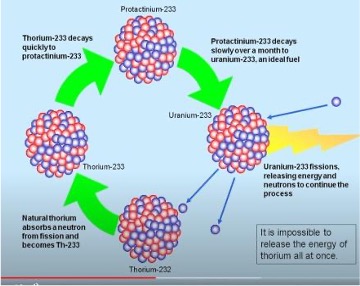
A thorium-232 (Th-232) atom, when bombarded by a neutron from an external source, absorbs that neutron to produce thorium-233 (Th-233). Its mass number increases by one, while its atomic number remains unchanged.
Because Th-233 is unstable, it releases an electron through beta decay, increasing its atomic number by one and transforming into protactinium-233 (Pa-233), with a half-life of approximately 22 minutes.
Pa-233 undergoes another beta decay, with a half-life of about 27 days, producing uranium-233 (U-233), which is fissile.
This atom can undergo fission into lighter elements, including strontium and xenon, releasing approximately the same energy per atom as U-235 — about 200.1 MeV.
How much do we need?
One ton of thorium is roughly equivalent to five million barrels of oil in terms of energy potential.
Consequently, total thorium resources, estimated at about six million tons worldwide, are equivalent to approximately 30 trillion barrels of oil. By comparison, total world oil reserves are approximately 1.8 trillion barrels.
The world’s electricity needs amount to about 55 billion gigajoules per year. This means approximately 667 tons of thorium annually could theoretically meet this demand.
Considering the efficiency of energy conversion, the actual requirement could be two to three times that amount. But with 6.3 million tons of thorium resources worldwide, we have enough to last several thousand years.
The United States alone has almost 600,000 tons of thorium resources. With our annual electricity needs at approximately 21 billion gigajoules — equivalent to 666 one-gigawatt power plants — we have enough to last many hundreds of years, potentially eliminating the need to import oil or gas for electricity generation.
Within that time frame, it is entirely plausible that we will have solved the problem of controlled nuclear fusion.
This vision could solve the world’s energy problems for thousands of years, with zero CO2 emissions during operation.
With substantially smaller reactor sizes and reduced pressurization requirements, thorium-based power may become the cheapest form of energy production for many poorer countries.
It would not be fair to deny those countries a future.
To summarize, here are the key advantages of thorium molten salt reactors over conventional nuclear reactors:
-
Abundant energy supply: Thorium resources could potentially meet global energy needs for several thousand years.
-
No direct CO2 emissions or air pollutants during operation.
-
No high-pressure coolant explosion risk.
-
Inherent safety features: Large negative temperature and void coefficients of reactivity, along with passive safety mechanisms such as freeze valves.
-
Twice the efficiency of converting heat into electricity compared with conventional pressurized water reactors (PWRs).
-
Less than 1% radioactive waste products, compared with approximately 95% for today’s PWRs.
-
No production of plutonium that could be used in nuclear weapons.
-
No need for proximity to major water sources: Reactors could be built even in deserts, allowing more flexible deployment across the United States and potentially on the Moon or Mars.
-
Continuous refueling: The potential to refuel through online chemical processing without shutting down the reactor, unlike conventional PWRs.
-
Nuclear waste reduction: The potential to use existing nuclear waste as fuel, helping reduce accumulated waste.
(Dr. Ajay Kothari is President and Founder of Astrox Corporation, an aerospace R&D company located in suburban Washington, DC. His PhD and MS in Aerospace Engineering are from the University of Maryland and BSc in Physics from Bombay University. He is an Associate Fellow of AIAA and member of the AIAA Aerospace Power Technical Committee. He has over 40 professional publications and has been PI on more than 35 NASA and DOD contracts. He can be reached at a.p.kothari@astrox.com.)