



Every generation gets one invention that quietly rearranges who holds power. For ours, it was the internet. I now believe two more are arriving at once, and neither is asking permission.
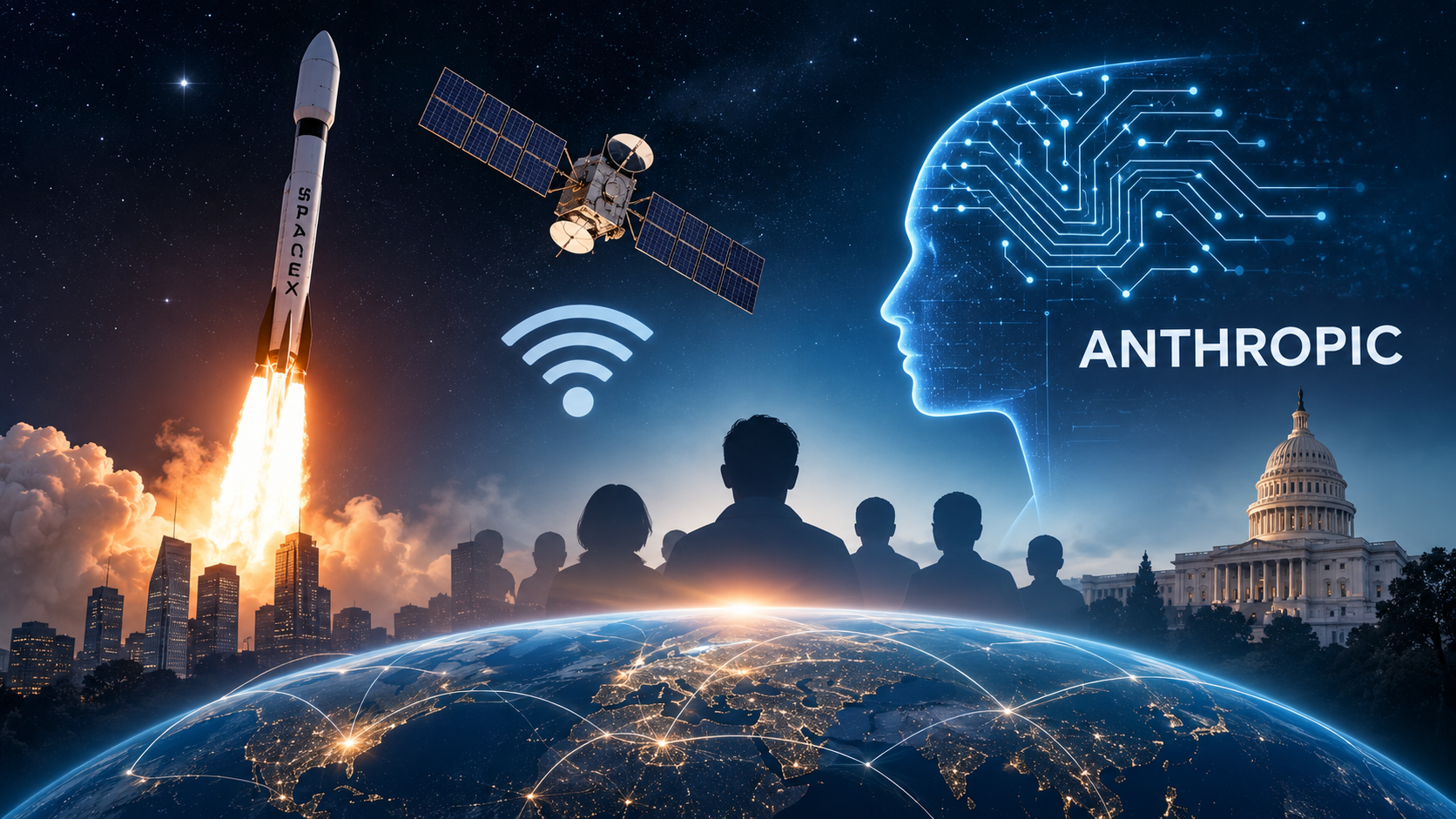
SpaceX sends rockets into orbit and brings them back to fly again. Anthropic puts sophisticated thinking within reach of anyone who can afford it. If their promises hold, and that “if” matters, they could rewrite the economics of entire industries, much as the internet did.
The scale is already hard to ignore. Anthropic is valued at nearly a trillion dollars, with annualized revenue reportedly in the tens of billions, despite having existed for barely five years. Starlink operates thousands of satellites, built and launched without government ownership. These are no longer startups in the conventional sense. They are becoming new institutions.
The threat to the corporate world is equally significant. Both companies are challenging businesses built on scarcity. Telecom companies and traditional satellite providers stand to lose as connectivity becomes accessible almost anywhere on Earth. Consulting, outsourcing, software services, and back-office operations face disruption as machines deliver competent analysis at a fraction of the cost. Any industry built around hard-to-find expertise faces a brutal repricing. India’s IT services sector, built largely on this very arbitrage, should be watching closely.
The threat to the political world may be even greater. Power once belonged to those who controlled territory, spectrum, and talent. Today, a private company can keep a war zone connected, while another builds systems that governments need but cannot develop themselves. When a company can refuse a state, or a state can suspend access to a company’s products, sovereignty becomes a negotiation. Washington is learning this now. Capitals across the Global South may soon face the same reality.
The new economics are taking shape. Reusable rockets could turn orbit into a place to build rather than simply visit. Affordable intelligence could make expertise a utility, much like electricity. Together, these developments point toward an economy in which access to capital, rather than credentials or geography, increasingly determines who gets to build. That favors nations and companies capable of financing infrastructure while putting pressure on economies whose competitive advantage rests on a skilled, low-cost workforce.
A “mega two”? Perhaps. Both are led by forceful personalities, both are moving toward public markets, and both are increasingly entering each other’s territory as AI and space infrastructure converge. But concentration cuts both ways. A world dependent on two or three private companies for connectivity and cognition has not escaped dependence. It has simply changed landlords.
For South Asia, the stakes are practical. A village clinic equipped with a satellite connection and an AI assistant could reach patients who have never had access to a hospital. The same technologies could also hollow out the jobs that built a generation’s middle class. Technology alone will not determine which future arrives. Policy will, and policy is already lagging behind.
The internet taught us that the winners of a new era are rarely the ones we expect, while the losers often fail to see it coming. The question is no longer whether these two companies will matter. It is whether the rest of us will be ready.
This column is opinion and analysis, not investment advice.