



Dear Philadelphia:
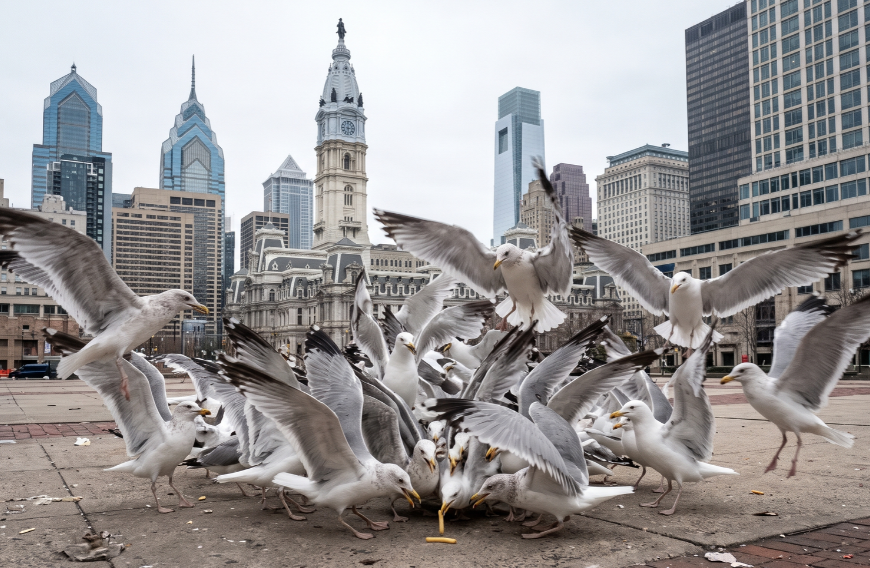
Here’s the scene: a child drops a single French fry on the Jersey Shore boardwalk, and within seconds thirty-two seagulls descend on it, shrieking, diving, knocking each other into the sand. One of them wins the French fry. Meanwhile, a few hundred yards out, the tide is carrying a whole shoal of fish past the jetty, and not one bird looks up.
I have watched our city’s insiders behave exactly like these seagulls. Many who read this will disagree, but allow me to explain.
Yesterday, three thousand miles to our west, one of the largest single creations of wealth in human history took place, and it will compound for decades in a few square miles of San Francisco. Here at home, we spent the season fighting over the fry.

This is not new. For eighty years, Philadelphia has kept inventing the future and then letting it leave, while our politics shrank into a contest over who gets the next slice of a shrinking pie. That contest is led too often by people who divide and blame instead of build, and by insiders who have learned that the surest way to wealth in this city is not to create value but to stand close to power and extract it. If we keep fighting over scarcity, the next hundred years will look like the last eighty, and our residents will pay for it.
Anthropic IPO
On November 19, Anthropic rang the Nasdaq bell under the ticker ANT, sold 980 million shares at $83, raised a record $81.3 billion, and closed its first day up 17% at $97.17, a fully diluted value of about $1.76 trillion. For context, the company was founded only 5 years ago, in 2021, and is now worth more than JPMorgan Chase or Walmart.
At the IPO price, the seven co-founders are each worth roughly $20 billion on paper, but the more important takeaway is the blast radius. Anthropic reported 5,300 employees as of September 30, and the pre-IPO platform Hill estimated that about 5,100 people would become millionaires, nearly 600 of them worth more than $100 million. In July, Redfin calculated that current and former Anthropic employees could, in theory, buy almost one of every ten homes in the San Francisco metro area, and together with OpenAI’s people, nearly a third.
READ: The Review by Ajay Raju | Fifty-six trips around the sun: Part 5 of a 7-Essay collection (November 16, 2026)
I know what you are thinking. The direct lift from this IPO to San Francisco’s budget will be modest. But that may be the point. This kind of wealth does not pour neatly into public coffers. Instead, it pours into neighborhoods, nonprofits, campaigns and, above all, the next generation of companies. Anthropic has already committed $50 million to Bay Area nonprofits through 2027. The economist Enrico Moretti estimates that each new tech job tends to create four to five more in the local economy, from restaurants to healthcare to architecture. A gold rush compounds where it lands.
The Mafia Effect
To see what happens next, look back to 2002. eBay bought PayPal for $1.5 billion, a modest sum by today’s standards. Yet its alumni went on to found or fund YouTube, Tesla, SpaceX, Palantir, LinkedIn and Yelp, and venture firms such as Founders Fund. They invested in one another, recruited one another and sat on one another’s boards. The press called them the PayPal Mafia. Two decades later, their influence reaches well beyond business: one became a U.S. ambassador, another, David Sacks, became the White House’s AI and crypto czar, and Palantir co-founder Joe Lonsdale, who got his start as a PayPal intern, is among the backers of Leading the Future, a super PAC trying to shape how America regulates AI.
Now multiply. PayPal’s alumni built all of that from a $1.5 billion sale. Anthropic’s first-day valuation is more than a thousand times higher in nominal dollars, and it went from founding to public company in five years. Because the company grew so fast, thousands of engineers are reaching liquidity at the same moment, with fortunes and fluency in frontier AI. History says few will retire. An ex-Anthropic engineer no longer needs to raise $50 million to hire 200 people. She can write a $2 million angel check to a three-person team that uses AI to automate an entire industry. Add SpaceX’s June listing, which minted some 4,400 millionaires, and OpenAI’s expected listing next year, and the Anthropic gang, the SpaceX crew and the OpenAI alumni will together form a cluster of capital, talent and political influence that makes the PayPal Mafia look like a book club.
The influence is already visible. Anthropic gave $20 million to Public First Action, a group pushing for AI safeguards, and later doubled it to $40 million. On the other side, Leading the Future is backed by OpenAI president Greg Brockman and Andreessen Horowitz. Whichever side you favor, notice where the argument is being held. The cities that host these companies host the debates that will write the rules of the century.
This is not an accident. Hendrik Bessembinder of Arizona State University studied every U.S. common stock from 1926 through 2025. Of roughly $91 trillion in net shareholder wealth, just 3.72% of firms created all of it, and 46 companies created half. From 2017 through 2025, just 30 firms captured 61% of new wealth. As of early November, the ten largest companies made up 39% of the S&P 500, up from about 36% two years earlier. Wealth follows the few, and the few follow each other. In the first quarter of this year, Bay Area startups took about 83% of all U.S. venture dollars. Even setting aside OpenAI’s single $122 billion round, the region still took roughly two-thirds. Behind each ticker stands a founder, and behind each founder stands a city.
Where Philadelphia Stands
In that same first quarter, Greater Philadelphia drew about $3 billion in venture capital, roughly 1% of the national total. Even that flatters us. Our largest deal that quarter was a $500 million raise by a company incorporated here but headquartered elsewhere. In the third quarter, the region posted $1.51 billion across 142 deals, yet at least $545 million came from Delaware-incorporated companies with little local footprint, and deal count fell from 181 to 142. A paper address does not hire a lab technician in Grays Ferry.
READ: The Review by Ajay Raju | Fifty-six trips around the sun — Part 4 of a 7-Essay collection (November 9, 2026)
Meanwhile, consider other sobering facts. In 2025, 20.4% of Philadelphians lived in poverty, the city’s first increase since 2011, returning us to the title of poorest of America’s largest cities. Pew’s 2026 State of the City report found median household income flat in 2024 at $60,521, about $20,000 below the national median; college attainment plateaued around 36%; and unemployment at 5.1% in 2025, the highest since 2021. The Census Bureau’s latest estimate puts our population at 1,574,281, still below its 2020 count. Pew’s verdict: the growth that marked our revival in the 2000s and 2010s has stalled.
Eighty Years of Missed Rushes
There is no shortage of seeds in Philadelphia, but we lack hospitable soil to generate local sprouts.
Eighty years ago this February, the University of Pennsylvania unveiled ENIAC, the first general-purpose electronic digital computer. Philadelphia, not Palo Alto, was the birthplace of the computer age. Within weeks, its inventors, J. Presper Eckert and John Mauchly, resigned from Penn in March 1946 after the university demanded rights to their patents. They started the nation’s first commercial computer company here, but it ran short of capital and was acquired by Remington Rand in 1950. The industry’s center of gravity drifted north to IBM and then west to a valley of apricot orchards. We invented the machine; others built the fortunes.
That same decade, Philadelphia reached its peak. The 1950 census counted 2,071,605 residents, and roughly 45% of the city’s jobs were in manufacturing. Today manufacturing is about 3% of jobs, and we have half a million fewer people. Between 1950 and 1990, the suburbs gained nearly four times the residents the city lost. Deindustrialization was a national storm, but cities chose how to weather it. Some reinvented themselves around new industries. We too often managed decline, and fought over what was left.
The pattern repeats in our own century. Two of the therapies that opened the age of genetic medicine trace their roots to Penn and the Children’s Hospital of Philadelphia: Kymriah, which in 2017 became the first gene therapy approved in the United States, and Luxturna, approved months later as the first for an inherited disease. The mRNA science behind the COVID vaccines was born in a Penn laboratory and won the 2023 Nobel Prize. Our science still ranks with the best: in Genetic Engineering & Biotechnology News’s 2026 rankings, our region placed fifth in patents, lab space and NIH funding, and our life-sciences workforce tops 88,000. Yet in last year’s rankings we placed ninth of ten clusters in venture capital, and some of our best companies have moved key operations to Boston or San Francisco to reach investors. Once again, Philadelphia risks becoming a pipeline of ideas for other cities to scale and commercialize.
ENIAC in 1946. mRNA in 2023. Same city, same ending. Anthropic is not happening here because, for eight decades, we have not been the kind of place where stories like Anthropic are allowed to stay.
The Politics of Scarcity
Soil, in a city, is its civic culture. And ours has gone sour.
Too many of the people who shape Philadelphia are still fighting the last war, the post-industrial scramble over dwindling resources. Every budget becomes a tug-of-war over a shrinking rope. Every new tower is a threat; every newcomer, a gentrifier; every successful founder, a suspect. Our politics too often runs on wealth-baiting and race-baiting, sorting neighbors into those who took and those who were taken from, because a fight over scarcity is easier to win than a plan for abundance. Thirty-two gulls, one fry.
By the way, the grievances are real. Redlining, deindustrialization and decades of disinvestment drew the map of who is poor in this city, and we cannot pretend otherwise. A household in Center City–Society Hill earns a median of $121,047; one in North Philadelphia–West earns $32,823. But a grievance is a diagnosis, not a treatment. Leaders who can only name culprits will never build anything, and every year spent dividing and blaming digs the hole deeper for the very residents they claim to defend.
Scarcity has another beneficiary: the insider. When the pie is small, the people who control the knife grow powerful. Consider how land is governed here. Under the custom of councilmanic prerogative, district Council members decide nearly every land-use question in their districts, and a Pew study found that 726 of 730 such bills passed unanimously from 2008 to 2014. Between 1981 and 2015, all six cases in which a Council member was convicted of wrongdoing involved land use. A gatekeeper economy rewards proximity to power, not the creation of value.
READ: The Review by Ajay Raju | Fifty-six trips around the sun: Part 3 of a 7-Essay collection (November 2, 2026)
Even if our public servants are honest and hardworking, a culture in which the surest path to wealth runs through City Hall rather than a laboratory or a startup will never produce an Anthropic. We will continue to produce more gulls.
The Next Hundred Years
It was not always this way. The city of Benjamin Franklin did not ask who was to blame for the absence of a hospital, a library, a fire company, a university or an insurance pool. It built them, one after another, with private ambition harnessed to public purpose. Franklin made himself rich, then spent his wealth and genius on institutions that outlived him by centuries. That is the Philadelphia I still believe in because that potential is still embedded in our DNA.
The next Bessembinder list, the one someone will compile in 2126, will be written by a few dozen companies. Some will cure diseases that today have no name on a pharmacy shelf. Philadelphia already has the universities, the hospitals and the scientists to found them. The question is whether the companies, the founders, the millionaire lab technicians, the angel checks and the next thousand startups will live here, or in a zip code three thousand miles away. That is a choice about culture before it is a choice about policy. A city that greets every success with suspicion, and lets insiders tax every ambition on its way through City Hall, teaches its builders to leave. A city that celebrates the builder, asks the builder to build here and give back here, and holds its leaders to a vision larger than the next budget fight, compounds.
Scarcity politics builds walls: neighborhood against neighborhood, old Philadelphians against new ones, the people who have against the people who have not yet. Behind the walls the insiders feel safe. Everyone else goes hungry.
Back to the gulls. When I see them fighting, I don’t see greed, but their certainty that the fry is all there is. Hunger narrows the eye until the whole Atlantic disappears behind a scrap of fried potato. When the next tide of fortune rolls past the jetty, and it will, will Philadelphia lift its head and fly out to meet it? Or will we still be on the boardwalk a hundred years from now, thirty-two of us, fighting over one French fry?
With love and impatience,
Ajay Raju