



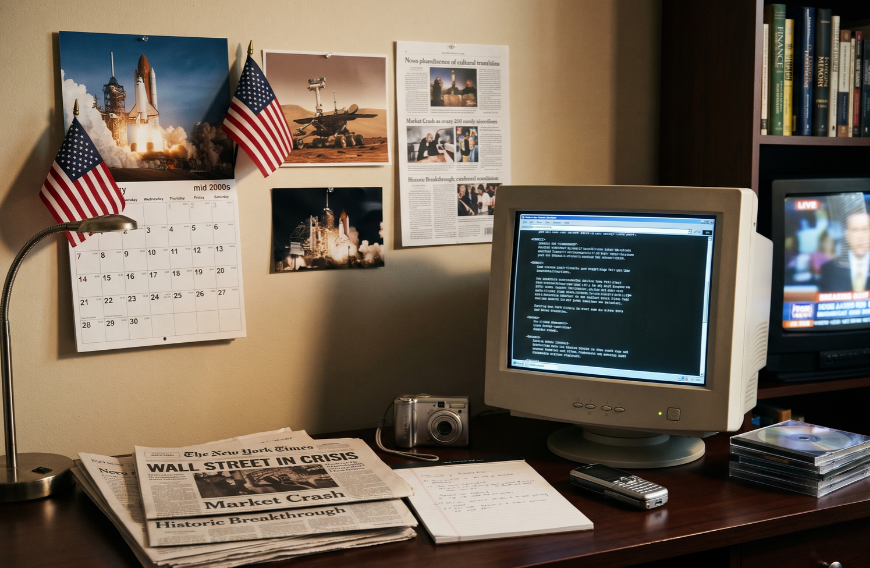
This is the fourth of a seven-essay collection measuring the distance between the decades of my life and the world we live in now.
The 2000s
The sky over the East Coast on September 11, 2001, was the bluest I can remember. Pilots have a name for that kind of morning: severe clear. Not a cloud from Philadelphia to Manhattan, visibility to the edge of the world, the kind of September sky that makes you believe summer might be persuaded to stay a little longer.
By ten o’clock, that same sky had become the most frightening thing in America.
Every decade has a hinge, a moment the door swings on. For the 2000s, the hinge arrived before the decade had even found its footing. Every American my age carries that morning the way our parents carried Pearl Harbor and the Kennedy assassination. We remember where we stood, which screen we were staring at, and whose voice we needed to hear first. Nearly three thousand people died, and something else died with them, something we never knew we owned until it was gone: the belief that two oceans made us an island.
But the 2000s cannot be told as a story of fear alone. While the clouds of this decade carried plenty of storms, beneath them, almost unseen, an entirely new world was being assembled. The decade built the phone in your pocket, the car you summon with a thumb, the vaccine in your arm, the machine that now answers your questions, and much of it was built in garages, dorm rooms, and forgotten laboratories, by people nobody was watching.
The 2000s were the years when the future we now take for granted became visible. Not finished, not yet ordinary, but visible.
For me, the decade was something else as well. It was the decade my family grew, my career caught fire, and I learned, more than once, that a crisis can be a door.
A Decade of Wounds
Let’s confront the hard parts first, because they were very hard.
The wars in Afghanistan and Iraq cost thousands of American lives and many times more lives abroad. A generation of young soldiers came home carrying injuries you could see and many more you couldn’t. In 2005, Hurricane Katrina showed us that a great American city could be left to drown while the rest of the nation watched on cable news, waiting for help that came too slowly. And in 2008, the financial system came within days of collapse. Millions of families lost their homes, their savings, and their faith that playing by the rules would be enough.
For Indian-Americans, the years after 9/11 were complicated in a way that is difficult to explain to anyone who didn’t live them. Four days after the attacks, a Sikh gas station owner named Balbir Singh Sodhi was shot dead in Mesa, Arizona, by a man who saw a turban and a beard and decided he had found the enemy. He was not the last to be targeted. Families who had lived here for decades suddenly felt eyes on them at the grocery store and the airport gate. Many of us learned then that belonging in America is not a certificate you receive once and frame on the wall, but something you sometimes have to keep earning, even when you have done nothing to lose it.
READ: The Review by Ajay Raju | Fifty-six trips around the sun: Part 3 of a 7-Essay collection (November 2, 2026)
The millennials came of age beneath all of it: terror alerts color-coded on the evening news, wars without a clear finish line, and a recession that greeted them at the exact moment they walked off the graduation stage. It was a decade that bruised a generation, and a decade that quietly handed that same generation the tools to build a new world.
After the Ball Dropped
Before the towers fell, the decade had already suffered its first collapse, a quieter one measured in ticker symbols rather than lives.
In March 2000, the Nasdaq reached its peak above 5,000. By October 2002, it had lost nearly four-fifths of its value. Trillions of dollars in paper wealth evaporated.
Pets.com, whose sock puppet had starred in a Super Bowl ad only months earlier, closed its doors before the year was out. Webvan, which had promised to deliver groceries to every doorstep in America, went bankrupt in 2001. A generation of investors learned what every farmer already knows: a field that grows too fast in one season is usually exhausted by the next.
But a crash is also a sorting. When the tide went out, it revealed which companies had been swimming and which had only been floating. Amazon’s stock fell by more than ninety percent, and the obituaries were drafted. Jeff Bezos kept building warehouses. A small search company in Mountain View, not yet public, kept hiring engineers while everyone around it was laying them off. Within a few years, both would be among the most valuable enterprises on earth.
The bubble had not been wrong about the internet. It had only been wrong about the timing. The dreamers of the 1990s were right about the destination and mistaken about the speed of the journey. The builders of the 2000s were the ones patient enough to walk it.
The Glass in Our Hands
Now look at what was being built while the headlines were full of bad news.
In 2001, Wikipedia went live, and the encyclopedia most families could never afford became free for everyone on earth, in nearly every language, updated by the minute. In 2004, Google went public and turned “search” into a verb. That same year, in a Harvard dorm room, a sophomore launched Facebook. YouTube followed in 2005, Twitter in 2006. Each one seemed like a toy. Together, they rewired how a species talks to itself.
And then, in 2007, Steve Jobs walked onto a stage in San Francisco and held up the iPhone.
I remember holding one for the first time and knowing that something had shifted beneath my feet. It wasn’t a better phone, but a new kind of object altogether: your camera, your music, your maps, your mail, your friends, your newspaper, all living inside a single pane of glass. A year later came the App Store, and with it an entire economy that had not existed the day before. Within a few years, that pane of glass had reshaped daily life more profoundly than anything since the automobile.
Strangers’ Couches, Strangers’ Cars
Here is one of the great ironies of the decade. The 2000s began by teaching Americans to fear strangers. It ended with Americans sleeping in strangers’ homes and climbing into strangers’ cars.
In 2007, two young designers in San Francisco couldn’t make their rent. A big design conference was in town and every hotel was full, so they inflated three air mattresses on their living room floor and rented them out, breakfast included. In 2008, they turned the idea into a company called AirBed & Breakfast. Today we know it as Airbnb.
A year later, in 2009, a pair of entrepreneurs who had struggled to find a cab founded a company called UberCab. The idea was absurdly simple: press a button on your phone, and a car comes to you. Within a few years, it had upended an industry that had barely changed since the horse and buggy, and the word “Uber” had become shorthand for an entire way of doing business.
It is no accident that both were born in the wreckage of the financial crisis. Millions of people suddenly needed extra income, and millions of spare rooms and idle cars were sitting unused. The smartphone, with its GPS and its camera and its constant connection, made it possible to match the two. And the rating system, five stars for the guest, five stars for the host, did something remarkable. It built trust between strangers at a moment when Americans trusted almost no one.
The sharing economy would bring its own troubles, as every revolution does, from gig workers without safety nets to cities hollowed out by short-term rentals. But in the 2000s, it carried a hopeful message: that even after everything, we were still willing to open the door.
The Quiet Ingredients
The most consequential inventions of the decade didn’t arrive with a keynote. They arrived in the business section, if they were reported at all.
In 2006, an online bookseller called Amazon began renting out its spare computing power to other businesses. It was called cloud computing, and it meant a startup in a dorm room could use the same machines as a Fortune 500 company, paying only for what it used. That same year, a chip company called Nvidia released tools that let its graphics processors, built to make video games look lifelike, perform other kinds of mathematics. And in 2009, a Stanford professor named Fei-Fei Li unveiled ImageNet, an enormous library of millions of labeled photographs, assembled to teach computers how to see.
A server rental business, a graphics card for teenage gamers, and a giant photo album with captions. You could have read the newspaper every morning of the decade and missed all three.
READ: The Review by Ajay Raju | Fifty-six trips around the sun: Part 2 of a 7-Essay collection (October 26, 2026)
But cloud computing, powerful chips, and oceans of data are the three ingredients of every artificial intelligence system on earth today. The whole recipe was sitting on the counter by 2009. ChatGPT was being baked in the 2000s. We just didn’t smell the bread until 2022.
The Book of Life
In April 2003, the Human Genome Project announced that it had finished reading the human genetic code, all three billion letters of it. The project had cost about $2.7 billion and taken thirteen years. Today, a person’s genome can be read for a few hundred dollars in an afternoon. That fall, from billions to hundreds, is one of the steepest price declines in the history of anything, and it is quietly rewriting medicine.
That same year, America launched PEPFAR, the President’s Emergency Plan for AIDS Relief, to fight the epidemic devastating Africa, saving some twenty-five million lives. It was among the most generous acts any nation has ever performed for strangers. We do not talk about it nearly enough.
And a few miles from my office, in a lab at the University of Pennsylvania, two scientists named Katalin Karikó and Drew Weissman were tinkering with something called modified messenger RNA. Almost nobody cared. Their papers were overlooked and their grant applications rejected. They kept going anyway. Fifteen years later, their work would help pull the world out of a pandemic and earn them the Nobel Prize. Philadelphia has always had a gift for quietly inventing the future, and an equal gift for forgetting to take credit for it.
The Crash and the Pivot
The 2008 crisis was not an abstraction for me. For years, I had represented companies in the structured finance and securitization business, the very machinery at the center of the collapse. I had a front-row seat to how mortgages were bundled, sliced, rated, and sold, and to how much faith the entire edifice placed in one assumption: that home prices would keep rising forever. When that assumption cracked, it cracked everywhere at once, like a dam giving way along its whole length.
A law practice built mostly on a single industry is a temple resting on a single pillar. The crisis forced me to see that, and it forced me to diversify. But as fortune has so often done with me, the storm turned out to be more opportunity than catastrophe. Right after the crisis, I launched my consulting and investment portfolios, guided by one principle: never again would my future depend on a single market behaving itself.
2008 taught me a few things. If you cannot control the harvest, plant more than one field. And when everyone is running out of a room, that is often the best moment to look around it. Assets are cheaper, talent is available, and the people who keep their composure get to write the next chapter.
A Message in the Genesis Block
On Halloween 2008, while banks were failing and governments were scrambling to rescue them, an anonymous figure calling himself Satoshi Nakamoto published a nine-page paper describing a new kind of money, one no bank issued and no government controlled. He called it Bitcoin.
On January 3, 2009, the first block of Bitcoin was mined. Embedded inside it, like a note slipped into a time capsule, was the front-page headline of that morning’s Times of London: the British Chancellor was on the brink of a second bailout for the banks. It was a message in a bottle, a quiet protest written into code and timestamped for history.
Having spent years inside the plumbing of modern finance, I understood exactly what that headline was saying. Satoshi was pointing at the same system I had watched seize up, and proposing not to repair it but to build around it. You may think Bitcoin is the future or a fad, but you have to admit it is a remarkable way to start a revolution.
Yes We Can
Meanwhile, in the fall of 2008, my city threw a parade.
On October 29, the Phillies won the World Series, their first championship in twenty-eight years. Philadelphia poured into the streets as one. Bankers and bus drivers, students and grandmothers, all hugging strangers on Broad Street. In the middle of the worst financial crisis in eighty years, for one night, nobody was checking their portfolio.
Six days later, America elected its first Black president.
The story had begun four years earlier, when a little-known Illinois state senator with an unusual name walked onto the stage of the 2004 Democratic convention in Boston. He told the country there was no red America and no blue America, only the United States of America. He was the son of a father from Kenya and a mother from Kansas, raised partly in Indonesia and Hawaii. I watched that speech and recognized something I had rarely heard from an American podium: the immigrant’s faith in America, spoken back to America by one of its own.
In March 2008, at the height of the campaign, he came to Philadelphia, to the National Constitution Center, a few blocks from Independence Hall, and delivered a speech on race titled “A More Perfect Union.” He chose the city where the founding promise was written to argue that the promise was still unfinished. And on the night of November 4, in Grant Park in Chicago, a crowd of more than two hundred thousand people stood under the autumn sky and wept.
Whatever your politics, that night told the world something about what this country was capable of. It also told the sons and daughters of immigrants something about what was possible for them. A year earlier, Bobby Jindal had been elected governor of Louisiana, the first Indian-American governor in the nation’s history.
Of course, the hope of that season would be tested, as all hope is. The decade that followed would prove far more divided than the crowd in Grant Park imagined. But I do not think the hope was false. I think it was a down payment.
The Night Before Thanksgiving
Three weeks after Grant Park, the decade reminded us how fragile hope can be.
On the evening of November 26, 2008, ten young men came ashore in Mumbai in inflatable boats. Within hours, they had opened fire at the city’s main railway terminus, a crowded café, a hospital, a Jewish community center, and two of the grandest hotels in Asia. For nearly sixty hours, India’s financial capital was held hostage. By the time it ended, some 166 people were dead.
In America, it was the night before Thanksgiving. Indian-American families gathered around their tables and their televisions, phoning relatives in Mumbai, waiting for voices on the other end of the line. The image that defined those days was the Taj Mahal Palace hotel, its famous red dome wreathed in smoke above the Arabian Sea. The Taj had stood since 1903. It was, for many of us, the building that meant India had arrived.
What I remember most is not the fire, but the staff. Many of the hotel’s employees stayed behind to guide guests to safety, and several gave their lives doing it. The hotel’s general manager lost his wife and two sons in the blaze, and he kept working through the siege. Less than a month later, the Taj reopened its doors.
India called it 26/11, and the echo was deliberate. Seven years apart and eight thousand miles away, two great cities learned the same lesson: terror can choose its target, but it cannot choose how a people responds.
Then and Now
What did we lose in the 2000s? Innocence, certainly. Privacy, perhaps. We surrendered a great deal of it after 9/11 for the promise of safety, then gave away the rest, willingly and one tap at a time, to the glass in our hands. We lost trust as well, in the banks, in the experts, in the people in charge. After 2008, ordinary families watched Wall Street get rescued while their own homes were foreclosed. That anger never truly went away. You can draw a straight line from the bailouts to the furious politics of today, on the left and on the right.
READ: The Review by Ajay Raju | Fifty-six trips around the sun: First of 7 essays (October 19, 2026)
What did we gain? Almost the entire world we now live in. The smartphone and the cloud. The car that comes when you call it and the stranger’s home that welcomes you in a foreign city. The decoded genome, the first building blocks of artificial intelligence, a new idea of money, and a vaccine technology waiting patiently in a Philadelphia lab for its moment. And, for a season, a renewed belief that the American story could still surprise us.
Personally, I gained the lesson that has shaped every decade since. Do not build your life on one pillar. Diversify your work, your investments, your friendships, and the ways you look at the world. The ground can shift in a single morning, and the people who endure are the ones standing on more than one foot.
Two Messages
I keep returning to two messages from that decade. One was written by nineteen men who wanted to destroy something, and rewritten seven years later by ten more on the streets of Mumbai. The other was written into a line of code by someone who wanted to build something new.
The 2000s held both. Fear and invention. Destruction and creation. A decade that taught us to dread strangers and then taught us to trust them again. That is the decade that raised the generation now running our companies, our hospitals, and, increasingly, our country. They learned early that the world can break in a single morning. And they learned that you can build something extraordinary from the pieces.
Two of my own children, Genevieve and Jay, and my nephew, Jake, were born into that decade. They don’t remember the towers falling or the banks failing. But they inherited everything that was built in the rubble.
I think often of that severe clear sky on the morning the decade began, a sky so blue it seemed to hide nothing. It turned out to be hiding everything: the catastrophe that was coming, and the future that was coming after it. The future we now take for granted became visible in those years, if you knew where to look.
Next: The 2010s.