



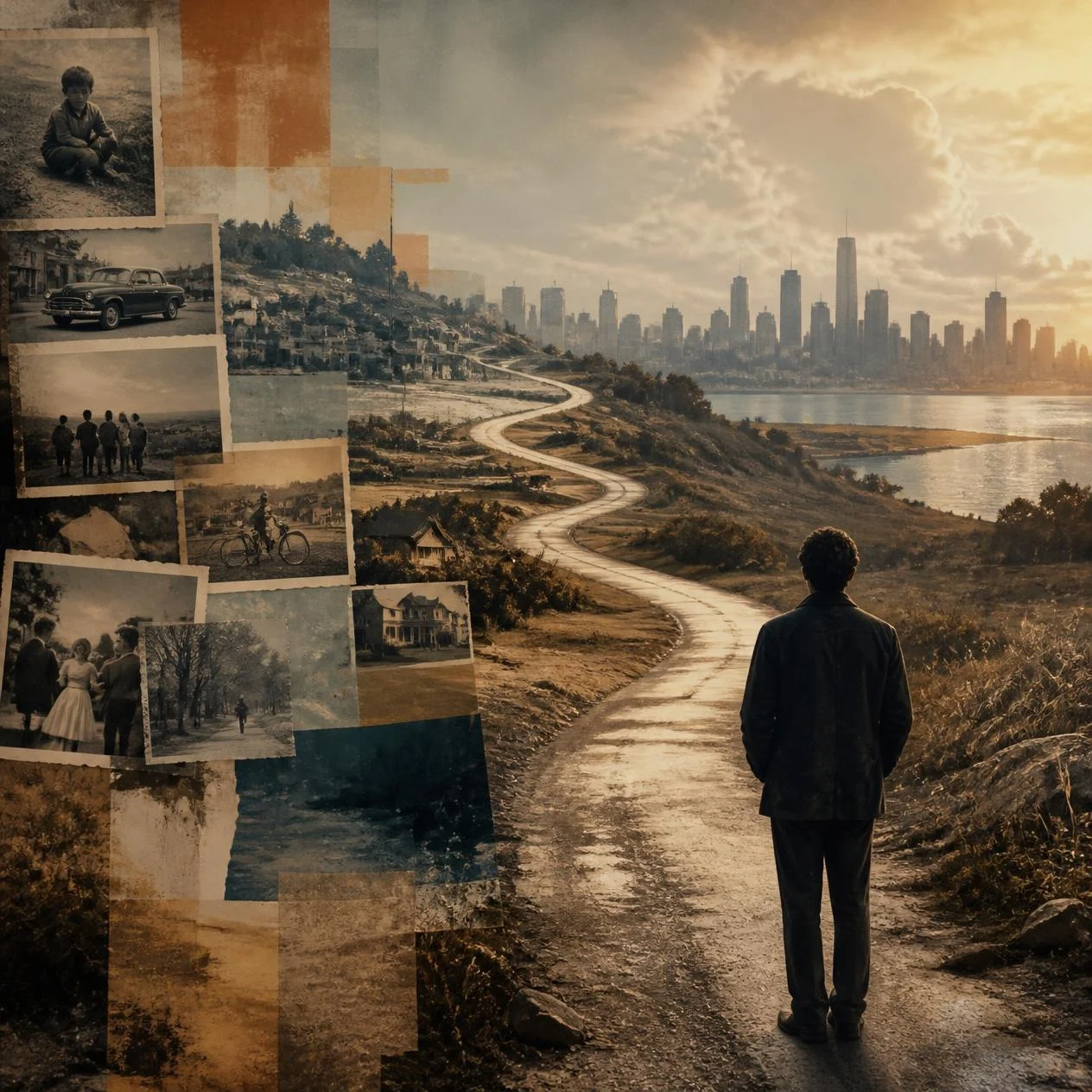
I concluded several years ago that birthdays are no longer celebrations, but merely measurements of distance. This essay is the first of seven pieces that attempts to measure that distance. The first six each take a single decade of my life, the seventies, the eighties, the nineties, the 2000s, the 2010s, and the 2020s, and hold it up against the world we live in now. The seventh turns around and looks the other way, at the next fifty years. I’m not doing this to feel nostalgic or to complain about how things used to be better. I’m doing it to find the good in each decade, and to trace how it shaped the moment we’re in today.
We tend to think of the present as something that just happened to us, but it didn’t. It was planted, decade by decade, by people who mostly had no idea what they were growing. I want to go back and look at the seeds.
Let me start at the beginning.
The Seventies
I don’t remember the seventies the way most Americans my age do. I have no memory of gas lines in New Jersey or Watergate hearings on the family television. I spent the seventies as a boy in Bhopal, a city in central India, in a world that moved at the speed of the monsoon.
We didn’t have a television. Television didn’t reach my neighborhood until the early-eighties. We had the radio, and we had letters. In India back then, a family had to wait years just to get a telephone line installed. When news came, it came slowly. When a letter arrived from a relative far away, it was read aloud and passed around. My grandfather, who lived in Kerala, a state in southern India, read the sky to know when to plant. That was his information technology.
When people talk about the seventies in America, they usually talk about what went wrong: Vietnam, Watergate, inflation, the oil shock, and of course, disco. It was a decade of hangovers, a country waking up from the sixties with a headache and a lot of questions.
But the seventies were one of the most important decades of the last century. Not because of what happened then, but because of what started then. Many of the things that define life in 2026 were born, quietly, in those ten years.
The Seeds of the Pocket Computer
In 1971, a company called Intel released a tiny chip called the 4004, the first commercial microprocessor. That same year, an engineer named Ray Tomlinson sent the first networked email between two computers sitting side by side, and he chose the @ sign to separate the user from the machine. In 1973, a Motorola engineer named Martin Cooper stood on a New York sidewalk and made the first call from a handheld mobile phone. The thing weighed over two pounds. In 1975, two young men founded Microsoft. In 1976, three more founded Apple in a garage.
Think about that. The chip, the email, the cell phone, and the personal computer. Many of the key pieces of the device you’re probably reading this on were invented in a single decade, mostly by people in their twenties, mostly without anyone noticing.
Nobody in 1973 imagined that the brick in Martin Cooper’s hand would one day hold your bank accounts, your photos, your maps, and your grandson’s face on a video call from across the country. They just thought it was a neat trick. That’s the thing about seeds. You don’t see the tree when you plant them.
READ: The Review by Ajay Raju | Philadelphia discovers. Boston profits. That can change. (October 12, 2026)
The Seeds of the Biology Revolution
This is the part of the seventies that matters most to me personally, because it’s the world I work in now.
In 1973, two scientists, Stanley Cohen and Herbert Boyer, figured out how to cut a piece of DNA from one organism and paste it into another. It was called recombinant DNA, and it was the moment humanity learned to edit the code of life. In 1976, Boyer co-founded a company called Genentech. By 1978, they had used bacteria to produce human insulin. Before that, diabetics depended on insulin taken from the pancreases of pigs and cows.
That was the birth of the biotechnology industry. Every mRNA vaccine, every CAR-T therapy, every gene-editing trial happening today, including the extraordinary work being done in Philadelphia, my city, traces its family tree back to that decade.
In 1975, the scientists behind this new power gathered at Asilomar, California, and voluntarily agreed on rules to keep their own research safe. They didn’t wait for Congress. They didn’t wait for a disaster. They policed themselves because they understood what they were holding. I wish we’d see more of that today, in biology and especially in artificial intelligence.
The Seeds of the Green Economy
On April 22, 1970, about twenty million Americans took part in the first Earth Day. By the end of that year, the country had a new Environmental Protection Agency and a far stronger Clean Air Act. Rivers had been catching fire. Cities had been choking on smog. And for once, Americans of every political stripe agreed that something had to be done.
Then, in 1973, the Arab oil embargo sent gas prices soaring and left Americans waiting in long lines to fill their tanks. It was humiliating, and it was a wake-up call. It pushed the country toward fuel efficiency standards and got people seriously thinking about solar power for the first time. In 1979, President Carter even put solar water heaters on the roof of the White House.
They were taken down a few years later. But the idea didn’t die. Today, solar is the cheapest source of new electricity in much of the world, and electric cars are a normal sight in our driveways. The seventies didn’t solve the energy problem. But they asked the question, and we’re still living inside the answer.
The Seeds of Two Democracies
Two major democracies were tested in the seventies.
In America, Watergate showed that a sitting president could be held to account. Richard Nixon resigned in 1974 not because of a coup or a revolution, but because a free press, independent courts, and a Congress from both parties did their jobs. It was ugly. It shook people’s faith in government, and that faith has never fully come back. But the system held.
In India, the test was harder. In 1975, Prime Minister Indira Gandhi declared a state of Emergency. Elections were suspended, newspapers were censored, and opponents were jailed. For almost two years, the world’s largest democracy wasn’t really a democracy at all. And then, in 1977, she called an election, and Indian voters, many of them poor and many unable to read, threw her out of office.
I was a small child, and I didn’t understand any of it at the time. But I’ve spent my life thinking about it since. Ordinary people, given a ballot, chose freedom. If you are worried about the state of democracy in America or in India, remember 1977. People are often wiser than their leaders expect.
The Seeds of My Own Story
There was one more thing that started in the seventies, and it happened close to home.
After the oil boom, the Gulf countries needed workers, and my grandfather’s Kerala sent them by the hundreds of thousands. Nearly every family seemed to know someone who had gone to Dubai, or Kuwait, or Saudi Arabia. They sent money home. They built houses. They put their children through school. They came back on holidays carrying radios and stories.
Those stories of people leaving for America, England, and the Middle East planted an idea in my head: that you could leave, that the world was bigger than your town, and that leaving didn’t mean forgetting where you came from. A few years later, in 1983, my family made our own journey. Not to the Gulf, but to America. I don’t think I would’ve understood it as possible if the seventies hadn’t shown me people doing it all around me.
READ: The Review by Ajay Raju | Cultivating farmers, not the seeds: Germination Project’s 50-year bet on Philadelphia (October 5, 2026)
Then and Now
So what did we lose between then and now?
We lost waiting. In the seventies, waiting was just part of life. You waited for the letter, for the phone call, for the harvest, for the news. Today, we can’t wait thirty seconds for a video to load. I’m not sure we’re happier for it.
We lost some trust. Americans in the early seventies still largely believed their institutions would tell them the truth. Today, only about one in six Americans say they trust the federal government most of the time. Some of that distrust was earned. But a society can’t run on suspicion forever.
And what did we gain? Almost everything else. The children of the seventies faced measles and smallpox as real dangers. In 1979, smallpox, a disease that killed hundreds of millions of people across history, was declared eradicated. Today, a baby born in Bhopal has a far better chance of reaching adulthood than I did. Far more people around the world can read. Far fewer live in extreme poverty. The tools the seventies invented became the tools that lifted billions.
A Message in a Bottle
In 1977, NASA launched a spacecraft called Voyager 1. On board was a golden record, a message in a bottle for anyone out there, carrying greetings in dozens of languages, music from around the world, and the sounds of life on Earth.
Nearly fifty years later, Voyager is still out there, farther from home than anything humans have ever built, still sending faint signals back to us. A machine built in the seventies, with less computing power than a car key fob, is still talking to us from the edge of the solar system.
That’s the seventies, a decade of confusion and scandal and bad haircuts. But it was also a decade that sent things out into the future without knowing where they would land. The microchip, the DNA splice, Earth Day, a ballot in the hands of a poor farmer in India, and young men from Kerala boarding planes for the Gulf.
My grandfather read the sky to know what to plant. The people of the seventies were planting too, whether they knew it or not. We are the harvest.
Next: The Eighties.