



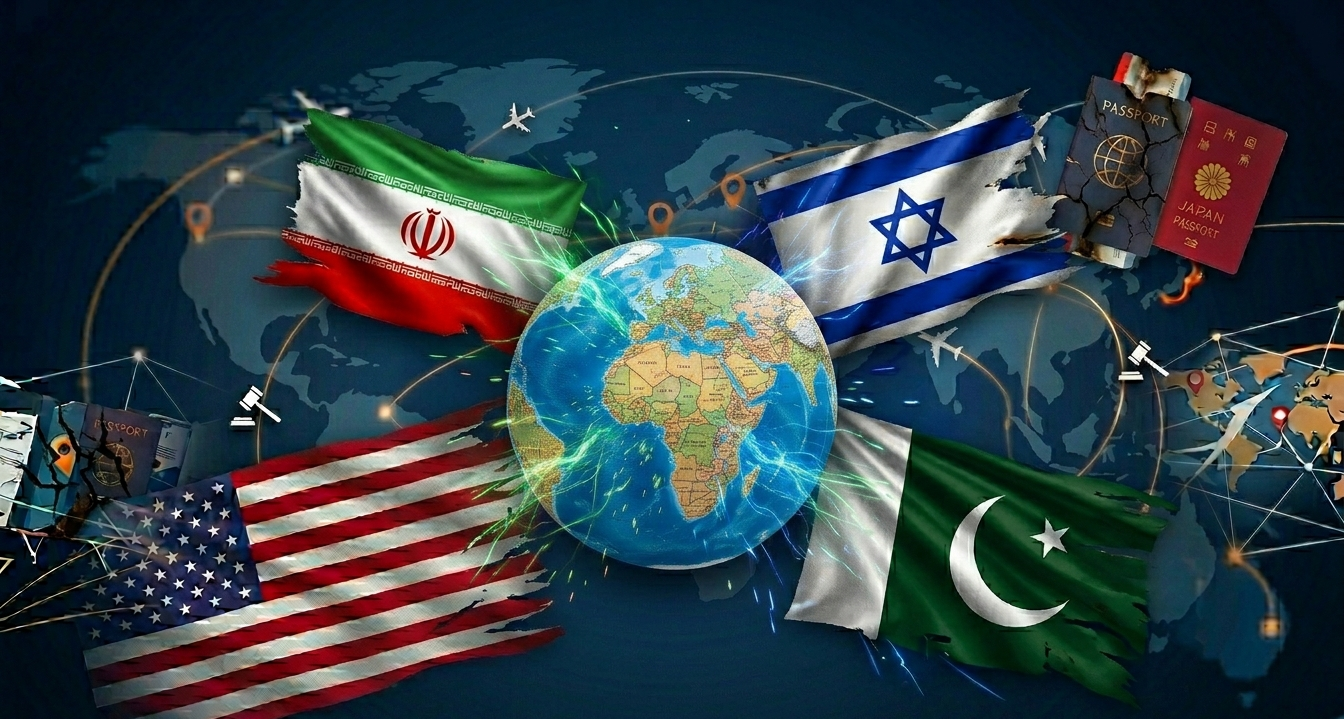
The fragile ceasefire that briefly paused the U.S.-Iran conflict has collapsed, and with it the last diplomatic bridge holding back escalation. Hours after the breakdown of marathon talks in Islamabad, President Donald Trump announced that the U.S. Navy would begin a direct blockade of the Strait of Hormuz. Mines, toll‑collecting Iranian vessels, and any resistance would be targeted. The message was blunt: any Iranian attack would be met with overwhelming force.
This moment did more than ignite a new phase of confrontation. It reshaped the diplomatic landscape of South Asia, elevating Pakistan to the center of global crisis management while leaving India on the sidelines of a conflict that directly affects its energy security and regional ambitions.
Pakistan’s unexpected rise as the crisis manager
Pakistan emerged as the only state capable of hosting U.S.-Iran negotiations and the only actor trusted by both sides. Islamabad became the venue for the most significant U.S.–Iran dialogue in decades, with Pakistan’s leadership playing a decisive role in keeping the channels open.
READ: Trump threatens countries helping Iran with 50% tariffs (April 9, 2026)
Asim Munir’s personal diplomacy became the anchor of the entire process. He maintained continuous communication with both delegations, projected neutrality through carefully calibrated symbolism, and used Pakistan’s military credibility to reassure each side that commitments would be honored. His presence gave the talks legitimacy and momentum at a moment when mistrust was at its peak.
Pakistan also provided the diplomatic off‑ramp that allowed Washington to pause escalation earlier in the conflict. Public appeals from Pakistan’s leadership gave the U.S. political space to delay strikes without appearing to retreat. The temporary ceasefire that followed was widely viewed as a product of Pakistan’s mediation, marking one of its most significant diplomatic achievements in years.
Even after the ceasefire collapsed, Pakistan remained the only country positioned to attempt another round of talks. Its geography, military channels, and balanced relationships with Iran, the Gulf, China, and the United States made it indispensable.
How India missed the moment
India, despite its size and global aspirations, played no meaningful role in the crisis. The conflict directly affects India’s oil supply, diaspora, and regional strategy, yet New Delhi remained largely absent from the diplomatic arena.
India’s public alignment with Israel early in the conflict closed the door to any meaningful role with Tehran. What could have been a moment to demonstrate strategic autonomy instead became a period of silence. India’s traditionally careful balancing between the U.S., Iran, and the Gulf was replaced by a muted, risk‑averse posture that left it without leverage.
READ: Trump says US may exit Iran war in ‘two’ or ‘three’ weeks (
While Pakistan activated military, diplomatic, and intelligence channels within days, India made no visible attempt to mediate or convene talks. The result was a vacuum that Pakistan filled with speed and confidence. For a crisis unfolding in India’s extended neighborhood, the absence was striking.
The contrast was clear: Pakistan became the bridge, India became the bystander.
The blockade and its strategic meaning
Trump framed the blockade not as an oil war but as a mission to secure global shipping lanes. The U.S. is already the world’s largest producer; the goal was to prevent Iran from using the strait as a pressure tool. American ships began clearing mines to restore safe passage through a chokepoint that carries a fifth of the world’s oil.
This marks a shift from decades of proxy conflict to direct naval confrontation. The old pattern—sanctions, covert strikes, militia skirmishes—has given way to open, high‑risk operations in one of the world’s most sensitive waterways.
A region entering a more dangerous era
The next phase of the conflict carries risks that extend far beyond the strait. Damaged nuclear sites could push Iran toward rapid enrichment. Naval clashes could become routine. A single tanker hit could send oil prices soaring. Russia and China’s support for Iran complicates Western unity. Inside Iran, protests simmer beneath the surface, tying regime survival to confrontation.
The long‑term outlook is not a clean resolution but cycles of hot peace, flare‑ups, and uneasy pauses.
Markets react as diplomacy falters
Oil prices surged toward $120 per barrel as the blockade began. Pakistan signaled willingness to attempt another round of talks, but with the ceasefire gone and naval forces on high alert, the path back to diplomacy is narrowing.
A crisis that redefined South Asian diplomacy
The 2026 Strait of Hormuz crisis did more than escalate U.S.–Iran tensions. It reordered the diplomatic hierarchy of South Asia.
READ: Trump agrees temporary Iran ceasefire amid rising tensions (April 7, 2026)
Pakistan stepped into a role few expected, becoming the central mediator in a global crisis. Asim Munir emerged as a pivotal figure, shaping the only meaningful diplomatic progress of the conflict. India, despite its ambitions and capabilities, remained on the margins.
In a moment when the world needed a mediator, Pakistan acted. India hesitated. And the consequences of that contrast will shape regional diplomacy long after the blockade ends.