



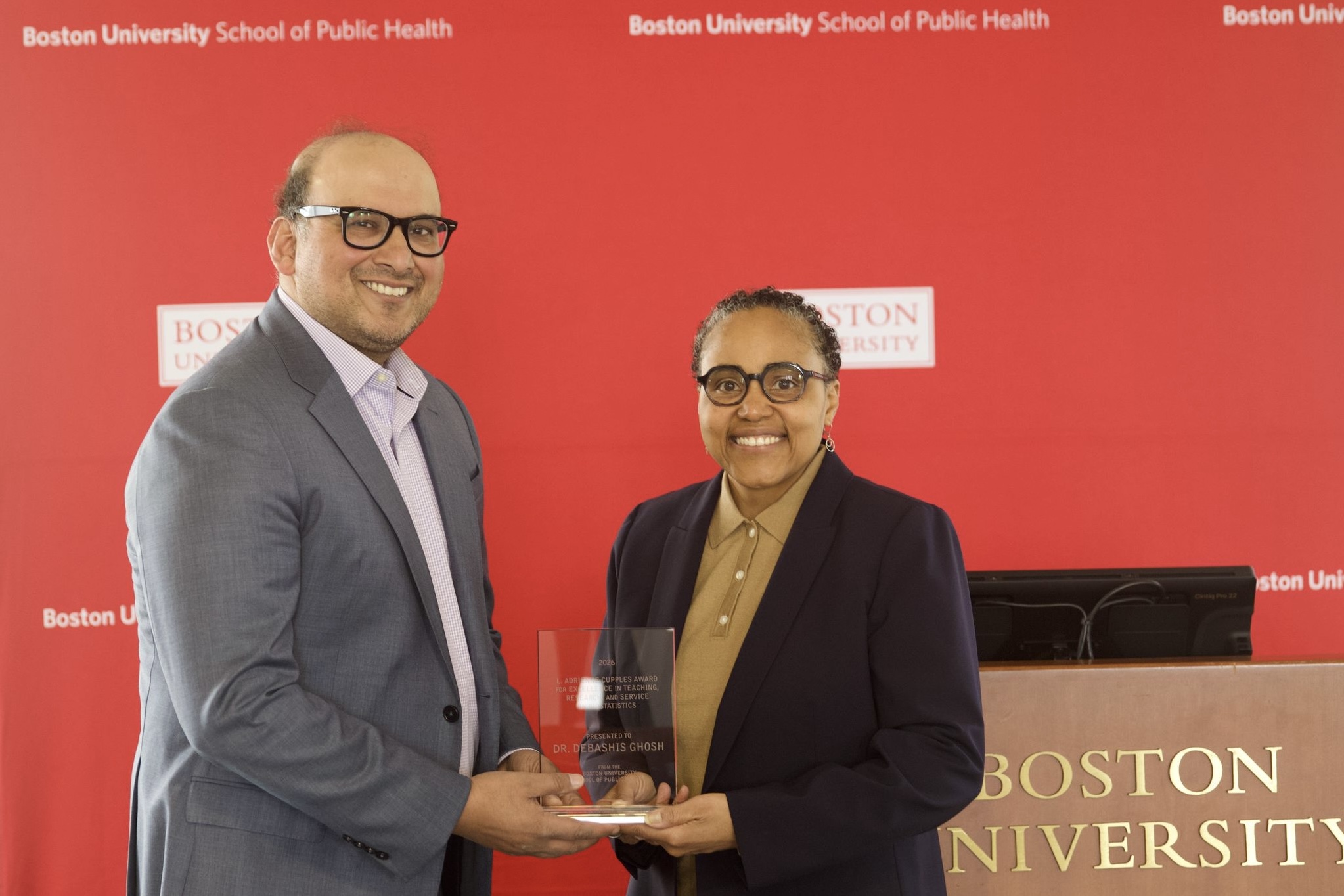
Debashis Ghosh, an Indian American professor of biostatistics and informatics at University of Colorado Anschutz Medical Campus, is the recipient of the 2026 L. Adrienne Cupples Award for Excellence in Teaching, Research, and Service in Biostatistics.
The L. Adrienne Cupples Award is presented each year by the Department of Biostatistics at Boston University School of Public Health to recognize a biostatistician whose academic achievements reflect the contributions to biostatistics exemplified by the late L. Adrienne Cupples, an emeritus professor of biostatistics and epidemiology and the award’s first recipient.
The Cupples Award committee was impressed by Ghosh’s extensive mentorship of both doctoral and post-doctoral students, his robust contributions to the scientific and statistical literature, and the applications of his research in the fields of cancer genomics, pediatric autoimmune disease, and health aging, according to a Boston University report.
READ: 4 Indian American educators honored for teaching excellence (May 22, 2026)
Ghosh has been a professor at CU Anschutz for more than a decade, during which time he also served as chair of the Department of Biostatistics and Informatics.
He was previously a faculty member at Penn State University and the University of Michigan. He specializes in the use of machine learning methods and causal inference to solve biostatistical and bioinformatics challenges.
His work has earned him numerous other honors over the years, including awards from the International Biometric Society, International Indian Statistical Association, American Public Health Association, and Harvard T.H. Chan School of Public Health. He holds a PhD in biostatistics from the University of Washington and a bachelor’s degree in mathematics from Rice University.
READ: 4 Indian Americans among Texas University Excellence Awards nominees (March 6, 2025)
On April 3, Ghosh visited SPH to accept the Cupples award and deliver a presentation titled, “Being a Statistician in the Age of AI.” He discussed the ways artificial intelligence has disrupted society and his perspectives on the promises and pitfalls of the technology.
“I’m using it, but [I’m] still in the exploration stage of seeing how it can help,” says Ghosh, who is most excited about AI’s potential to advance research methodologies and cautiously optimistic about its value in training students.
“As a tool for automating systems and their use in broader society, this is probably [what] I’m most concerned about. I see a lot of ways in which things could go wrong.”