



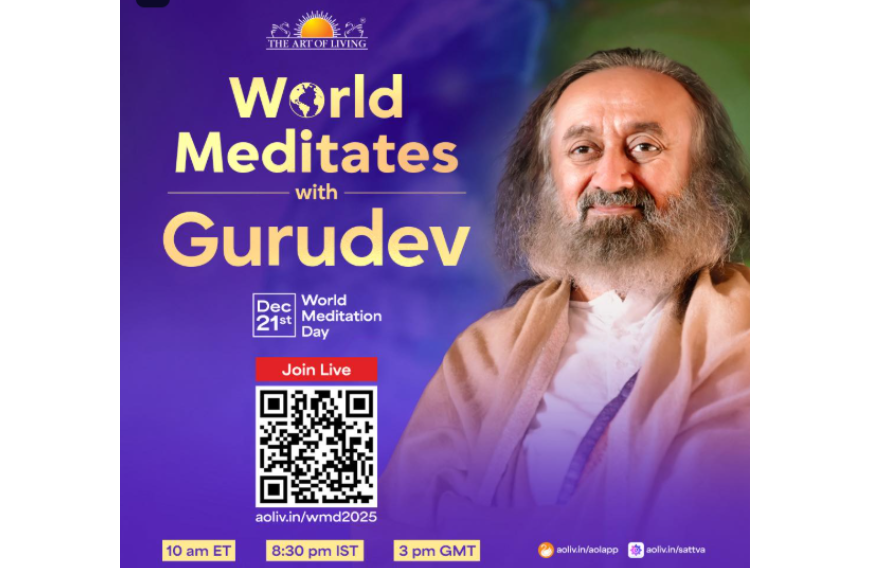
On the launch of the Center for Absolute Intelligence by Guru Sri Sri Ravi Shankar and World Meditation Day at Ground Zero, two deeply linked events that invite reflection on inner awareness, resilience, and the intelligence that connects humanity and technology.
On Friday, Dec.19, Guru Sri Sri Ravi Shankar will inaugurate the Center for Absolute Intelligence and address the United Nations. Two days later, on Dec. 21, he will lead World Meditation Day from the Oculus at Ground Zero in New York City. These moments are deeply interconnected. One marks the birth of a space devoted to inner understanding; the other invites the world into silent reflection from a place that holds both unspeakable loss and extraordinary resilience. Together, these events point toward a simple but radical question: What is the intelligence that is already alive within us, even before the thought emerges. What is the common link that sustains intelligence both human and artificial.
Absolute intelligence as consciousness
When we hear the word “intelligence,” we usually think of reasoning, memory, or problem-solving. Now in an evolving world of artificial intelligence, it means so much more. Yet the fundamental question remains whether artificial intelligence will ever be able to truly replicate human intelligence. More importantly, will artificial intelligence ever be conscious? But absolute intelligence refers to something far more fundamental. It is the quiet awareness that knows a thought as a thought, an emotion as an emotion, a breath as a breath. It is not something we create but rather that which sustains everything like pearls on a string never visible. This very awareness is consciousness that is the prerequisite for intelligence, whether it is human or artificial.
This “absolute” intelligence is constant, while the contents of the mind are always changing. Thoughts come and go, and moods rise and fall. Our roles, identities, and stories shift over time. Yet something remains present through all of it watching, aware, unchanged. That presence is consciousness itself or absolute intelligence. Consciousness serves as the anvil for intelligence, the enduring ground that supports every spark of understanding, whether in the human mind or in a machine.
Eastern traditions have long suggested that consciousness is not a byproduct of life but its foundation. We do not access it by accumulating more information or striving harder. We recognize it when the mind settles and attention turns inward. Mediation then becomes the path to accessing that consciousness. German spiritual teacher Eckhart Tolle describes this as the portal to “now.” The reality is that we tap into this consciousness daily unknowingly. When we are in deep dreamless sleep, we are in that stage of no thought or consciousness. We also have moments of that consciousness in what is called “presence” or the flow state.
What science is beginning to notice
Modern neuroscience, in its own language, is beginning to echo this insight. Brain imaging studies show that much of our mental suffering is associated with endlessly narrating the past and anticipating the future. We get trapped in these spirals of doom and loops of negative thinking. When this activity dampens consciousness, a different mode of awareness emerges.
Scientists are actively trying to understand how consciousness arises in the brain, but they haven’t yet found a definitive explanation. In a recent large-scale study, researchers compared two major theories of consciousness: Global Neuronal Workspace Theory (GNWT) and Integrated Information Theory (IIT) by testing their different predictions with brain imaging.
GNWT suggests that consciousness happens when information is broadcast widely across many brain networks, like a spotlight shining on a stage. IIT, on the other hand, proposes that consciousness comes from the richness and integration of information itself, no matter where it occurs in the brain. When researchers tested these ideas side by side, neither theory was fully supported by the data, showing that the neural basis of consciousness is still very much an open question. What this illustrates is that even the best scientific models today still struggle to explain why subjective experience exists, highlighting the depth of the mystery we are trying to explore.
Yet even with all our advances, science still cannot explain why awareness exists at all. It can map the brain’s activity, but it cannot locate the one who is aware of it. It can’t locate the anvil.
Neuroscience is in a position not unlike physics once did when it first encountered the quantum world. Scientists can observe brain activity with remarkable precision, yet they still cannot explain how subjective experience arises from those observations. Competing theories describe where or how information might become conscious, but none can account for why awareness appears at all.
This is reminiscent of what happens at the quantum level: when light as a photon strikes an atom, the charged particle rises to a higher energy state, but in moving from the lower to the higher state it disappears into empty space and then reappears from nowhere. That empty space—the quantum space—is where the transformation actually occurs, though it cannot be directly observed.
In the same way, consciousness may not arise in the measurable firing of neurons alone, but in the unseen interval between mechanisms, in the quiet gap where explanation gives way to experience. Transformation, whether in matter or mind, does not happen along the visible trajectory; it happens in the unseen space that science can point to, but not yet enter that activity.
Meditation as the path to absolute intelligence
Meditation invites us into that unseen space. Meditation does not give us consciousness. It removes what obscures it. Between one thought and the next, there is a pause. In that pause, there is no problem to solve, no identity to defend, no past to fix. Meditation has been shown to reduce activity in habitual mental loops and to support greater emotional balance, clarity, and presence. Long-term practitioners consistently report a felt sense of spaciousness and ease, alongside measurable changes in stress hormones, attention, and emotional regulation.
Studies of meditation consistently show that when the mind settles, neural activity becomes more coherent and efficient.
A Scientific American article argues that meditation research is entering a new “third wave” focused not just on stress reduction but on deep meditative states that can transform the brain and subjective experience. The authors describe how extended practice can lead to altered states of consciousness, including diminished self-referential thinking and even temporary suspension of ordinary self-awareness, with potential implications for mental health, well-being, and our understanding of what it means to be human.
Consciousness as the ground we share
Cultures and eras have pointed to a common realization that consciousness is the ground from which everything arises and to which everything returns. Thoughts arise within it and dissolve. Lives unfold within it and conclude. Even moments of great upheaval appear within this larger field of awareness.
The Center for Absolute Intelligence arrives at a time when we are fascinated by artificial intelligence and external power. Its deeper message is a quiet counterpoint that most transformative intelligence is already here. In the silence beneath thought, in the emptiness where transformation occurs, consciousness is from where all intelligence emerges.
Meditation does not create this absolute intelligence. It reveals it.