



By Soumoshree Mukherjee
Editor’s note: This article is based on insights from a podcast series. The views expressed in the podcast reflect the speakers’ perspectives and do not necessarily represent those of this publication. Readers are encouraged to explore the full podcast for additional context.
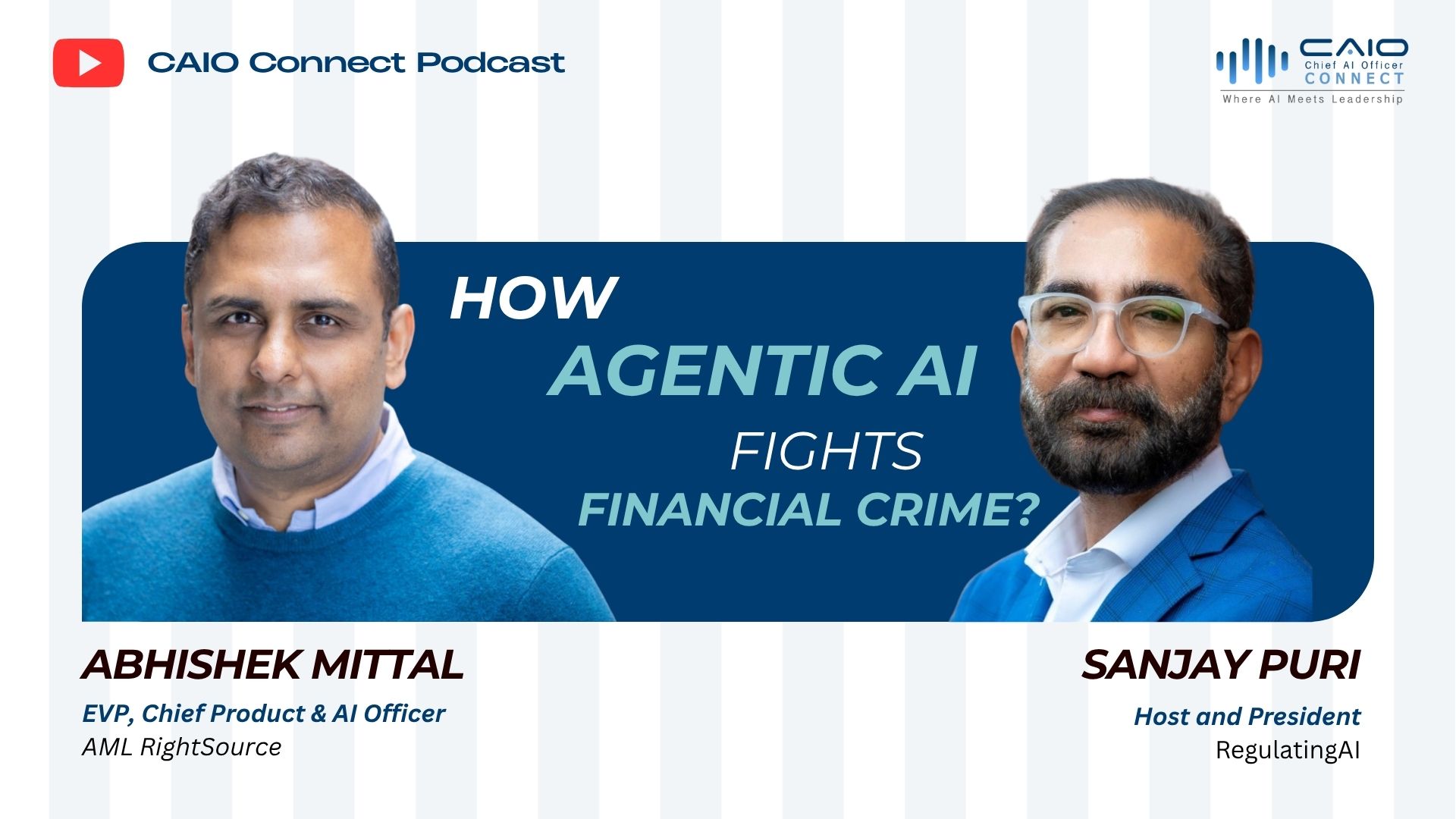
When Abhishek Mittal speaks about artificial intelligence, he does so with the calm confidence of someone who has lived through its failures as much as its successes. Now EVP and Chief Product & AI Officer at AML RightSource, Mittal joined the “CAIO Podcast” to unpack how enterprise AI can move beyond hype and into meaningful, measurable impact.
Introducing him, host Sanjay Puri described Mittal as someone who had been reimagining entire business models long before AI was cool, pointing to his work transforming manual legal and compliance processes into AI-powered solutions handling billions of dollars in legal spend. But Mittal’s most striking ideas challenge some of the industry’s most deeply held beliefs.
One such belief is the obsession with perfect data. “Obviously, I would love to have perfect data… but life is not perfect,” Mittal said. Waiting endlessly to clean data, he argued, often leaves companies stuck in what Puri jokingly called “proof-of-concept purgatory.”
READ: Nebraska’s Attorney General Mike Hilgers shares his take on AI-enabled child exploitation (
Instead, Mittal likened AI development to running a marathon in laps, where organizations improve data quality iteratively while solving real business problems.
That pragmatism also shapes his view of synthetic data. Once a skeptic, Mittal now sees it as a critical tool, especially for preparing AI systems for scenarios that have never occurred before. Recalling the 2008 financial crisis, he noted, “The data was not showing that [the risk].”
Obviously, we as experts were obviously more able to see those patterns and able to accommodate that in our models, but the data was not able to do that on its own.
Synthetic data, he explained, allows models to be trained for such unseen futures rather than blindly trusting historical trends.
At AML RightSource, where employees proudly call themselves financial crime fighters, AI is not about replacing humans but augmenting them. Financial crime, Mittal pointed out, is so vast that “it’s like if it was a country, financial crime would have been (the) seventh largest GDP.”
Combating it requires a delicate balance stopping illicit activity without choking legitimate innovation. “It’s very easy to say no,” he said, “how do you balance the risks and allow their business to happen at the same time?”
This balance extends to emerging technologies like crypto. While blockchain is theoretically transparent, Mittal warned that “You can make it complicated. It’s transparent, but it’s still complicated. You can use technology to distribute, mix the various cryptos together,” demanding equally advanced AI tools on the compliance side.
Perhaps most compelling was his take on agentic AI. Contrary to popular hype, Mittal insisted that agents are not the “main character” of transformation. Instead, success depends on reimagining processes, empowering domain experts, and stitching AI into existing enterprise systems.
Over time, he said, experience itself becomes a competitive moat: “The bigger differentiator was not that we had AI, but (the) biggest differentiator we had was we had people who had been using AI for seven years.”
In a world racing toward automation, Mittal’s message was refreshingly grounded: Start with purpose, accept imperfection, and make AI earn its place: commercially, ethically, and operationally from day one.